
Yes, saffron can grow in Canada, but where and how you grow it matters enormously. In mild coastal zones (roughly PHZC Zone 6 and above), outdoor planting in well-drained beds is genuinely feasible. In the prairie provinces and anywhere with brutal winter minimums, you are looking at container growing, cold frames, or lifting corms in autumn, otherwise you will lose them. Most of southern British Columbia, southern Ontario, and parts of the Maritimes sit in territory where outdoor saffron is realistic with proper site prep and a little winter protection. North of those belts, it becomes a protected-culture project.
Can Saffron Grow in Canada? Regional Guide for Gardeners

Marcus Petersen
12 Jul 2026
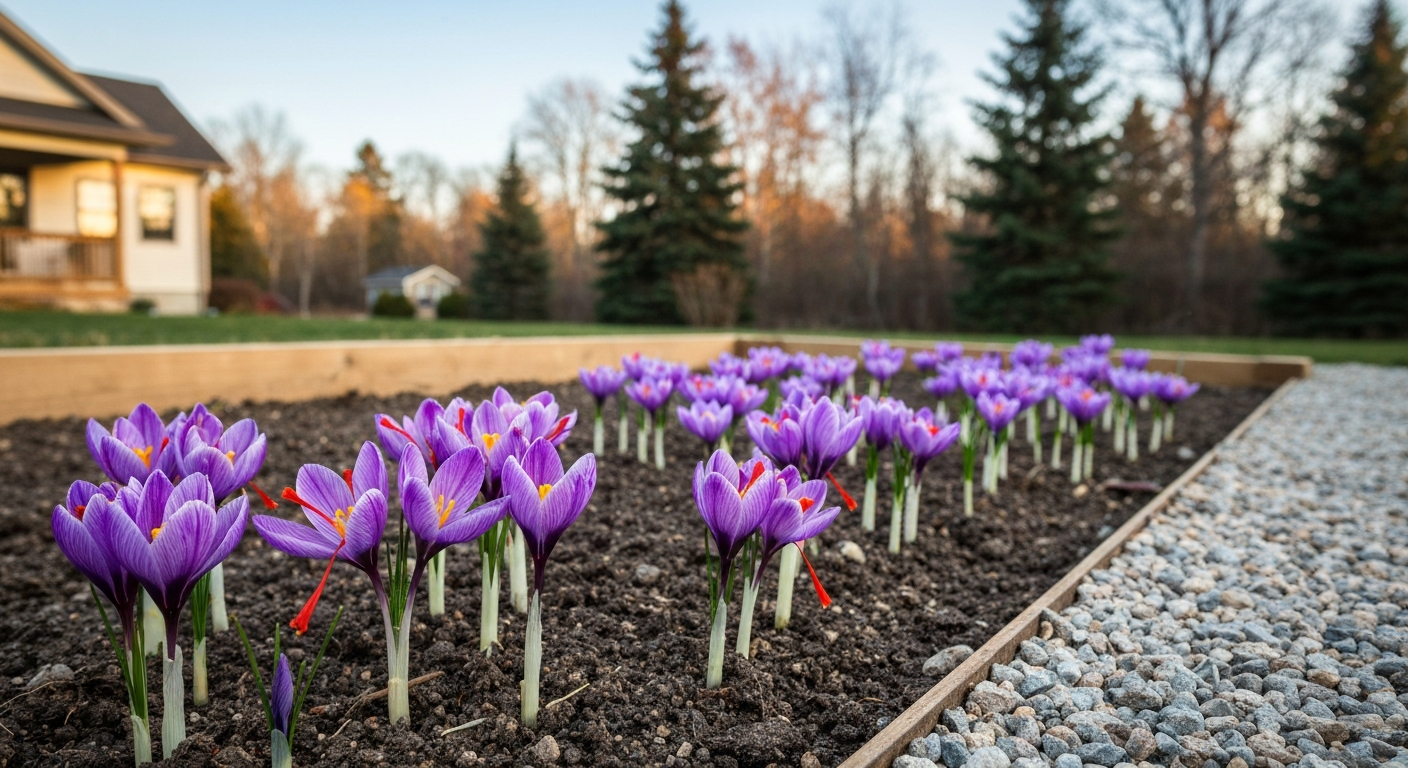
How saffron actually grows: climate, life cycle, and soil
Crocus sativus is a sterile triploid geophyte, meaning it cannot set seed and is propagated entirely from corms. Every plant you grow comes from a corm you buy or divide, there is no other way in. Each corm produces one or more flowers in autumn (typically October into November), and each flower carries three deep-red stigmas. Those stigmas are saffron. You hand-pick them, dry them, and that is your harvest. A single flower yields roughly 0.007 g of dried saffron, which explains why it takes somewhere between 70,000 and 200,000 flowers to produce one kilogram of dried spice.
The plant's seasonal rhythm is almost backwards from most garden crops. Corms go dormant through summer heat, break dormancy in early autumn when soil cools, throw up flowers before or alongside their leaves, and then spend winter and early spring building daughter corms underground. By early summer the foliage dies back and the cycle resets. This means saffron needs cool, dry summers (or at least the ability to keep the soil dry during dormancy), a real autumn chill to trigger flowering, and enough winter cold to satisfy its vernalization requirement, but not so much that the corms freeze solid.
Extension literature generally places Crocus sativus in the USDA Zone 4–8 range (with most practical success in Zones 5–8). In Canadian Plant Hardiness Zone terms (which use a 0–9 scale based on 1991–2020 normals from Natural Resources Canada), that maps loosely onto PHZC Zones 4b through 8b. Saffron wants a neutral to slightly alkaline, well-drained soil: sandy loam or a friable calcareous loam, pH around 6.0–8.0, moderate fertility, and absolutely no waterlogging. Corms sitting in saturated soil rot. Fast. I learned that the hard way before I started putting every bed on a slope or in raised boxes.
Province by province: where outdoor saffron is realistic
The honest picture across Canada's provinces looks quite different depending on where you are. Southern British Columbia is the most favourable region in the country. The Okanagan Valley and the Fraser Valley (including the Abbotsford area, where at least one farmer has already completed a commercial harvest) sit in PHZC Zone 6–7, with mild winters and warm, dry summers that match saffron's dormancy needs almost perfectly. Southern Ontario, roughly from Windsor through the Niagara Peninsula and up to Toronto, falls in PHZC Zone 6–7 as well. The growing season is right, winters are cold but usually manageable with mulch, and drainage is the main challenge. Parts of the Maritimes, particularly the southwestern shore of Nova Scotia, reach PHZC Zone 6 and are worth trying with good site selection. Quebec's Southern Lowlands (Montreal corridor, Zone 5b–6a) are marginal but achievable with deeper planting and reliable snow cover or straw mulch. The prairie provinces, Manitoba, Saskatchewan, and most of Alberta, are PHZC Zone 3–4 in populated areas, and outdoor saffron there is a gamble at best. The winter minimums regularly hit temperatures where corms sustain freeze damage even at depth.
| Province / Region | Typical PHZC Zone | Outdoor Feasibility | Key Challenge |
|---|---|---|---|
| BC Interior (Okanagan) | 6b–7a | Good | Summer irrigation during dry spells |
| BC Coast / Fraser Valley | 7a–8b | Very Good | Wet winters; drainage is critical |
| Southern Ontario (Windsor–Niagara) | 6a–7a | Good | Wet clay soils common; amend well |
| Greater Toronto Area | 5b–6a | Moderate | Cold snaps; mulch essential |
| Southern Quebec (Montreal area) | 5a–5b | Marginal | Hard winters; deep planting + mulch |
| Maritime coast (SW Nova Scotia) | 6a | Moderate | Salt wind; good drainage needed |
| Prairie provinces (MB, SK, AB) | 3a–4b | Poor outdoors | Use containers or lift for winter |
| Northern Canada (YK, NT, NU) | 0–2 | Not practical outdoors | Container/greenhouse only |
Where outdoor growing gets marginal: containers and protected culture
If you are in Winnipeg, Saskatoon, Regina, Edmonton, or anywhere with PHZC Zone 4 and below, outdoor in-ground saffron is not a reliable project. Controlled freezing research shows corms suffer physiological damage at around -10 °C to -20 °C depending on planting depth and corm origin, temperatures that are routine in prairie winters. Your practical options are containers you bring into an unheated garage or cold room in late November (keeping them cool but above -5 °C), cold frames over raised beds with straw insulation, or simply lifting corms after foliage dies in spring and storing them cool and dry until replanting in late summer.
Container growing works well: use a pot at least 30 cm deep with excellent drainage holes, a gritty, well-draining mix, and plant the same way you would in a bed. The main tradeoff is that containers dry out faster in autumn, which can stress corms right when they need to break dormancy. Water lightly and consistently once you see shoot tips emerging. Growers in colder zones who want to skip the lifting process can also use a cold greenhouse or hoop house with enough insulation to keep the root zone from freezing solid, saffron does not need warmth to flower, it needs cold avoidance of the truly lethal range.
Picking your site and getting the soil right
Drainage is the single biggest factor in Canadian saffron success, and it deserves more attention than most guides give it. Canada's most saffron-suitable regions (southern BC and southern Ontario) are also areas with significant autumn and winter rainfall or heavy clay soils. A flat bed in a clay-heavy Ontario garden will kill corms through rot before winter even becomes a factor. Choose a south- or southwest-facing slope if you have one, or build raised beds at least 20–30 cm above grade and fill them with a mix that drains freely.
Target a soil pH between 6.0 and 8.0, with 6.5–7.5 being the sweet spot. If your soil is acidic (common in parts of BC and the Maritimes under conifer cover), work in agricultural lime the season before planting to bring the pH up. For heavy clay soils, incorporate coarse sand and compost together, compost alone can actually hold too much moisture. Avoid high-nitrogen fertilizers; saffron does not want a lush nitrogen push. A low-nitrogen, higher-phosphorus amendment worked into the bed at planting (bone meal is a traditional choice) supports root and corm development without pushing excessive foliage.
- Choose a sunny spot with at least 6 hours of direct sun per day
- Avoid low-lying areas where water pools after rain or snowmelt
- For clay-heavy soils, raise the bed 20–30 cm and amend with coarse sand plus compost
- Test pH and aim for 6.5–7.5; lime acidic soils the season before planting if possible
- Work in bone meal or a low-nitrogen bulb fertilizer at planting depth
- In wetter climates (coastal BC, Maritime regions), line the bed base with a gravel drainage layer
Sourcing and selecting corms in Canada
Corm quality is one of the most overlooked variables in first-year saffron performance. Larger, physiologically mature corms flower reliably in year one; small offsets may not flower at all until year two or three. Look for firm, unblemished corms with a diameter of at least 2–3 cm (the larger the better for first-year flowers). Soft spots, mold, or signs of basal rot are immediate disqualifiers, do not plant compromised corms hoping they will recover.
Sourcing within Canada requires some effort. Large U.S. bulb suppliers often restrict shipping to Canada, partly because the Canadian Food Inspection Agency regulates propagative plant material including corms under its import directives, and cross-border shipments need phytosanitary certification. The practical result is that many Canadian buyers use Canadian-based sellers on platforms like Etsy, small boutique growers, or local garden centres that have already cleared the import requirements. When buying online, read descriptions carefully: confirm the seller is shipping from within Canada or has confirmed CFIA compliance, ask for corm size information, and buy from sellers who can tell you how the corms were stored. Corms stored improperly through summer will perform poorly.
Store your corms in a cool, dark, dry place (around 15–20 °C) from the time you receive them until planting. A mesh bag or open paper bag in a basement works well. Do not refrigerate unless you are deliberately extending dormancy past your planting window, and never seal them in plastic, moisture trapped around corms causes rot. Check them every week or two before planting; discard anything that softens or shows mold.
When to plant: a province-by-province calendar
Saffron corms are planted in late summer to early autumn, timed so they settle in before the soil cools dramatically but after the worst summer heat. Extension guides, including Saffron Production for Home Gardeners (UVM Extension factsheet), recommend planting in late summer–early autumn (commonly August–October) when soil has cooled to roughly 15–18 °C but is not frozen. The goal is soil that has dropped to roughly 15–18 °C or below, but is not yet approaching freezing. In Canadian terms, that window shifts significantly depending on where you are. Plant too late and corms do not establish before hard frost. Plant too early in warm soil and they may try to sprout prematurely or encourage rot.
| Province / Region | Target Planting Window | Notes |
|---|---|---|
| BC Coast / Fraser Valley | Mid-September to mid-October | Avoid planting in hot late-summer spells; wait for soil to cool below 18 °C |
| BC Okanagan Interior | Early to mid-September | Summers are hot; soil cools earlier than coast; do not delay |
| Southern Ontario (Niagara, Windsor) | Mid-September to early October | Aim to plant 4–6 weeks before expected hard frost |
| Greater Toronto Area | Early to mid-September | First hard frost often early October; plant promptly |
| Southern Quebec (Montreal) | Late August to mid-September | Shorter window; earlier planting reduces risk |
| Maritime provinces (NS, NB, PEI) | Early to mid-September | Variable; check local frost date and adjust |
| Prairie provinces (container growers) | Late August to early September | Move containers outdoors briefly for chilling then bring in before hard freeze |
How to plant: depth, spacing, and bed technique
The standard planting depth for saffron corms is 7–15 cm (roughly 3–6 inches), measured to the base of the corm. In milder zones (PHZC 6 and above) where winters are not extreme, the shallower end of that range (7–10 cm) is fine and allows for easier flower emergence. In colder zones (PHZC 5 and into Zone 4 with mulch), plant at the deeper end, 12–15 cm, to give the corm more insulation from frost. Research confirms that planting depth interacts directly with freeze survival: corms at greater depth experience lower temperature fluctuations and reduced ice crystal damage during cold snaps.
Spacing should be 7–15 cm (3–6 inches) between corms. Closer spacing (7–10 cm) produces a denser first-year display and is preferred by many home growers who want maximum flowers from a small bed. Wider spacing (12–15 cm) gives daughter corms more room to develop, which matters if you are building up your stock over multiple years. Plant corms with the pointed end or the dried tunic (papery covering) orienting upward. The base plate, where roots emerge, faces down. If you cannot tell which end is up, plant the corm on its side; it will self-correct.
For raised beds, dig down to loosen the base layer, lay in your gritty amended mix, and plant in a grid pattern at your chosen spacing. For in-ground beds, dig a flat-bottomed trench 15 cm wide and your chosen depth, set corms at spacing, and backfill. Either way, water lightly after planting to settle the soil but not to soak it. Then step back. Saffron does not need fussing at this stage, and overwatering a freshly planted bed is one of the most common early mistakes.
Watering, summer dormancy, and winter care
After planting, water modestly until shoots emerge in autumn, then let natural rainfall do most of the work through the flowering and foliage period. Come late spring, as foliage yellows and dies back, stop watering and keep the bed as dry as you can manage through summer. This is the dormancy period, and soggy soil during summer dormancy is a fast path to corm rot. In rainy coastal climates, a removable rain cover or a gravel mulch layer over the bed helps shed excess moisture. In drier prairie or interior BC climates, this phase is naturally well suited to saffron.
Winter care depends on your zone. In PHZC 6 and above, a 5–10 cm layer of straw mulch applied after the ground has started to cool (but before it freezes) provides enough insulation for most winters. Remove it gradually in spring once nighttime temperatures are consistently above freezing to prevent the bed staying too damp. In PHZC 5 (Montreal, greater Toronto), mulch is not optional, it is the difference between a healthy corm and a dead one during a cold snap without reliable snow cover. In PHZC 4 and below, even deep mulch may not be sufficient; lifting corms after foliage dies (late spring to early summer) and storing them in a cool, dry indoor location until late summer is the most reliable approach.
Harvesting the stigmas: timing and technique
Saffron flowers in Canada typically appear from late September through October, sometimes into early November in milder zones. The harvest window is brutally short: flowers open for only one to three days, and stigmas degrade quickly once the flower opens. Check your bed daily once you see buds emerging. Harvest in the morning when flowers are freshly open, ideally before afternoon heat builds.
Pick the three red stigmas from each flower by hand. You can pinch them out with fingernails or use small scissors or tweezers for precision. Collect them into a dry dish or small container. Do not mix wet or dewy stigmas with dry ones. If you are harvesting over several days, keep each day's collection separate. Petals and stamens are not saffron, leave them or compost them. Some growers pick the entire flower and process it on a tray inside; others pick stigmas directly in the field. Either approach works at hobby scale.
Drying and storing your harvest
Fresh stigmas contain roughly 80% moisture and need to be dried quickly to prevent mold and preserve quality. Spread them in a single layer on a fine-mesh screen or paper towel in a warm (around 40–50 °C), dry location. An oven set to its lowest temperature with the door cracked, a food dehydrator on a low setting, or a sunny windowsill in a dry room all work. Most drying takes 30–60 minutes in an oven or dehydrator, or a full day in open air. The stigmas are ready when they are brittle and snap cleanly rather than bending.
Store dried saffron in an airtight glass container away from light and heat. Properly dried and stored saffron holds its potency for two to three years. Even a few dozen threads are meaningful in cooking, so do not be discouraged by small volumes from a hobby plot, what you grow is genuinely high-quality spice, and you know exactly where it came from.
Realistic yields and what to expect from a hobby plot
Let me be direct: you will not get rich growing saffron in your backyard. A single corm, under good conditions, produces one to three flowers in its first year. At roughly 0.007 g of dried saffron per flower, 100 corms might yield somewhere between 0.7 and 2 g of dried saffron in year one. Commercial field yields are cited in ranges of 2–15 kg per hectare (with exceptional optimized operations reaching up to 20–24 kg per hectare), but those numbers are not translatable to a 2-square-metre raised bed. Reported commercial and experimental saffron yields vary widely by environment and management; commonly cited ranges are about 2–15 kg dry stigmas per hectare, with exceptional experimental/optimized sites up to roughly 20–24 kg·ha−1 Reported commercial and experimental saffron yields vary widely by environment and management; commonly cited ranges are about 2–15 kg dry stigmas per hectare, with exceptional experimental/optimized sites up to roughly 20–24 kg·ha−1..
The trajectory over multiple years is better. Each mother corm produces several daughter corms over the season. By year two or three, you are planting those daughters back out and your bed density increases naturally. Many hobby growers find year three to be when the harvest becomes satisfying, enough saffron for regular culinary use, and enough surplus corms to expand or share. That is the realistic timeline: commit to three years before judging whether the project is worth continuing.
Costs and what you are actually signing up for
Saffron corms sold in Canada typically run anywhere from $1 to $3 per corm depending on size and source, with bulk pricing available from some sellers. A starter bed of 50 corms might cost $50–$100 for the corms alone, plus the cost of raised bed materials, amendments, and mulch if you do not have those already. Given that quality saffron retails for $10–$20 per gram or more, the theoretical payback on even a modest plot looks good on paper. In practice, the reward for most hobby growers is the experience, the genuinely fresh saffron quality, and the slow accumulation of a productive corm stock over years, not a fast economic return.
Pests, diseases, and the problems most growers actually encounter
Saffron has relatively few serious pest problems in Canada, but there are a few worth knowing. Rodents, particularly squirrels, voles, and mice, will dig up and eat corms if given the opportunity. Hardware cloth (metal mesh) laid over a freshly planted bed and pegged down, or lining the bed base with mesh before filling, is the most effective deterrent. Slugs can damage emerging foliage in wet autumns, particularly in coastal BC; iron phosphate bait works without harming soil life.
Corm rot (caused by Fusarium and related fungi) is the most common disease issue, and it almost always traces back to poor drainage or damaged corms introduced at planting. Inspect every corm before planting, cut away any soft or discolored tissue, and dust cut surfaces with powdered sulfur before planting if you have had rot problems before. If an entire bed section rots in a wet year, improve drainage rather than just replanting in the same spot. Virus infection (producing streaked or distorted foliage) occasionally appears in commercially sourced stock; there is no cure, so remove and destroy affected plants to prevent spread.
- Rodents digging corms: line beds with hardware cloth mesh before planting
- Corm rot: prioritize drainage; inspect and discard soft corms before planting
- Fusarium rot after wet winters: improve drainage and avoid replanting in the same affected spot
- Slugs on new foliage: use iron phosphate bait in wet autumn conditions
- Virus (streaked or mottled leaves): remove and destroy affected plants immediately
- Non-flowering in year one: usually a corm size issue; larger corms reliably outperform small offsets
Tips to maximize success on a hobby scale
The growers who get reliable results in Canada share a few consistent habits. They start with the largest corms they can source, not small offsets. They build raised beds rather than fighting heavy native soil. They do not skip mulching before winter, especially in Zones 5 and 5b. They check beds during harvest season daily rather than weekly, because the window is that short. And they think in multi-year terms from the beginning, knowing that year one is mostly about establishment and that the real reward is in years two and three when daughter corm populations have built up.
Canada is not the Mediterranean, and saffron did not evolve here. But the crop is more adaptable than its exotic reputation suggests, especially across the southern growing zones from BC to Ontario. For related guidance on growing nonnative seeds in different climates, see our article on can black seed grow in Nigeria. If you are in a favourable zone (PHZC 6 or above), have a well-drained sunny bed, and are willing to mulch before winter and harvest carefully for a few minutes each October morning, this is a genuinely achievable project. If you are in a colder zone, use containers or plan to lift corms in spring. It is worth trying if you are patient, practical about yields, and enjoy the novelty of growing something genuinely unusual. If you want a quick return on effort, grow garlic instead.
Saffron cultivation has been tested in comparable cool-temperate and Southern Hemisphere climates as well. If you’re asking can you grow saffron in New Zealand, consult our New Zealand-specific guide on saffron cultivation for climate and site recommendations. Growers curious about how Canadian conditions compare to other regions may find it useful to look at how the crop performs in South Africa or Australia, where the summer dormancy and winter chilling dynamics play out differently but some of the same drainage and soil principles apply. For practical guidance on whether saffron can grow in South Africa, see our guide Can saffron grow in South Africa.
FAQ
Can saffron (Crocus sativus) be grown successfully by home gardeners in Canada?
Yes — saffron can be grown successfully in many parts of Canada by home gardeners and hobbyists, but success depends on local winter minima, snow cover, drainage and summer dryness. It is a hardy, sterile bulb (corm) that needs a cool winter to trigger flowering and a dry summer dormancy. In mild, well‑drained regions it will perform like other temperate geophytes; in colder/very wet regions extra protections, containers or greenhouse culture are recommended.
Which Canadian provinces and Plant Hardiness Zones are realistic for outdoor saffron production?
Feasible outdoors: • British Columbia: Coastal and Interior valleys (Vancouver Island, lower mainland, Okanagan) — zones ~7–9 and some pockets of 6. • Ontario: Southern Ontario (Niagara, Windsor, Ottawa area fringes) — zones ~5–7 (best in sheltered sites). • Quebec: Southern fringe (Montérégie, Estrie, Lower St. Lawrence pockets) — zones ~4–6 with protections. • Maritime provinces: select sheltered, well‑drained sites in southern Nova Scotia and New Brunswick — zones ~5–7. Marginal/possible with strong protection or containers: Prairie provinces (southern pockets of Manitoba and Saskatchewan, zones ~3–4) and colder parts of Quebec/Ontario — require deep planting, heavy mulch or lifting. Not recommended outdoors without protection in most of the north and Arctic zones (zones <3). Use Natural Resources Canada Plant Hardiness map (1991–2020 normals) to match your exact locality.
What climate and soil conditions does saffron need?
Key requirements: • Winter chill: a period of cool temperatures is required to initiate flowering — temperate winters with snow insulation are helpful. • Well‑drained soil: sandy loam to friable calcareous loams; poor drainage leads to corm rot. • pH: tolerant around 6.0–8.0 (neutral to slightly alkaline preferred). • Moderate fertility: not heavy feeders; high nitrogen can encourage foliage but reduce corm hardening. • Dry summer dormancy: keep corms dry and largely dormant during hot months. • Avoid prolonged wet/warm winters which increase fungal/bacterial rot.
Where should I buy saffron corms in Canada and are there import restrictions?
Buy from reputable bulb suppliers, local specialty growers or Canadian marketplace sellers to reduce phytosanitary issues. Crocus sativus is propagated by corms (no seed). If importing corms into Canada, follow CFIA D‑08‑04 rules: imports require permits/phytosanitary certificates in many cases and are inspected on arrival. Using domestic sellers or growers within Canada simplifies compliance and lowers phytosanitary risks.
What size and type of corms should I select for the best chance of flowering in the first year?
Choose healthy, firm, disease‑free corms in the largest available size class you can afford — larger, physiologically mature mother corms produce more flowers and faster daughter‑corm bulking. Avoid shriveled, soft, moldy or insect‑damaged corms. If buying small corms to save money, expect little to no first‑year flowering and plan for 1–2 years of growth before reliable harvests.
When is the best time to plant saffron corms in Canadian conditions and how deep/close should I plant?
Plant in late summer to early fall when soil is cool but not frozen — typically August to October depending on your region and first frost dates. Plant depth: 7–15 cm (3–6 in) from crown to soil surface. Spacing: 7–15 cm (3–6 in) between corms (home beds commonly 10 cm/4 in). For colder regions plant toward the deeper end (within recommended range) to reduce freezing injury and heaving. In wet sites use raised beds to improve drainage.
Next Articles
Can Black Seed Grow in Nigeria? How to Plant and Harvest Nigella sativa
Yes, Nigella sativa can be grown in Nigeria. Learn seed sourcing, planting timing, care, harvest, drying, and troublesho
Can Saffron Grow in South Africa? How to Plant It
Find if saffron can grow in South Africa, plus planting time, soil, drainage, irrigation, and troubleshooting for succes
Can You Grow Black Pepper in the US Where and How
Learn where black pepper can be grown in the US and how to grow it indoors or in warm zones for fruit.