
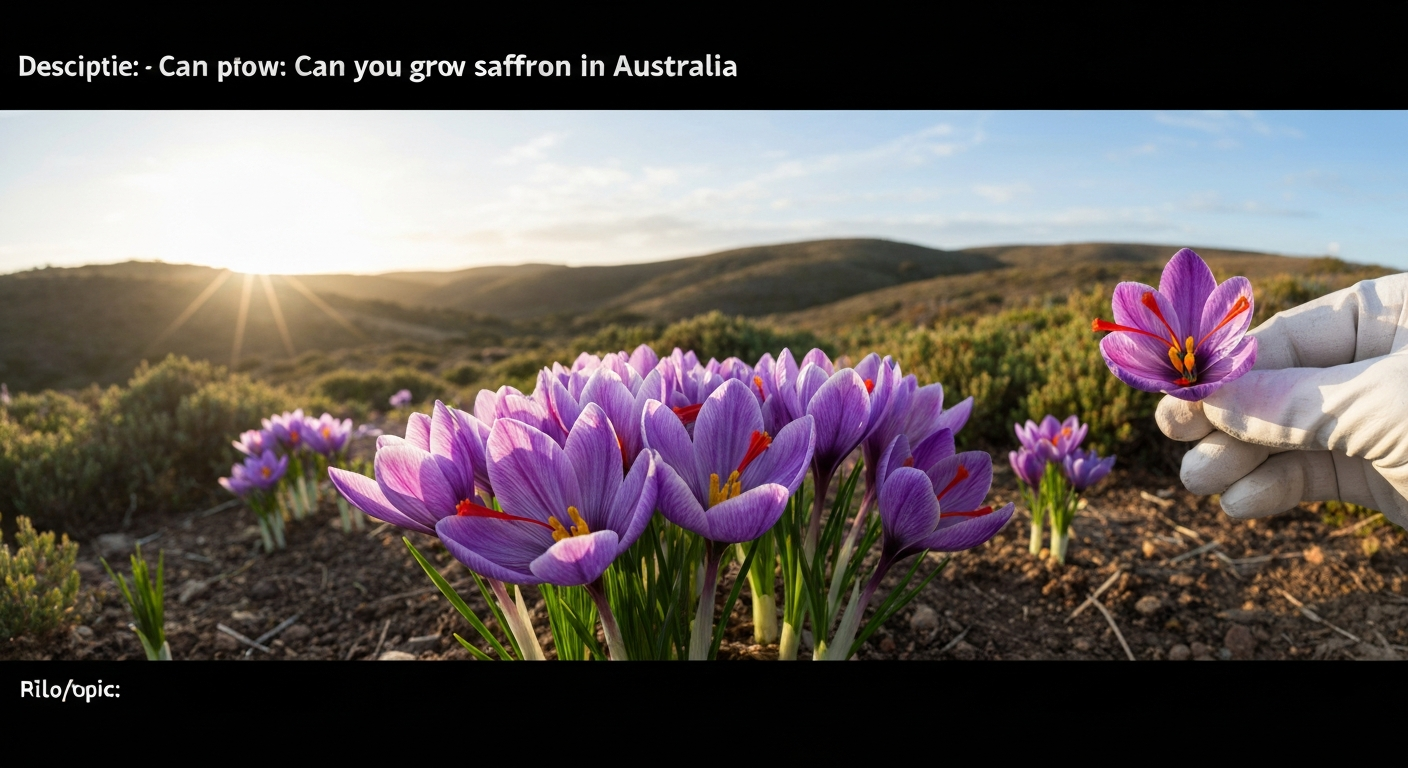
Yes, you can grow saffron in Australia, but where you live in the country matters enormously. In southern Western Australia, South Australia, Victoria, Tasmania, and the cooler highlands of NSW, saffron (Crocus sativus) is a realistic and rewarding crop for home gardeners. In the tropical north and the hot arid interior, open-field growing is genuinely difficult without refrigeration tricks, containers, or shade management. The honest summary: if you're in southern Australia, plant some corms and expect real flowers by your second autumn. If you're in Brisbane or Darwin, it's a project, not a given.
Can You Grow Saffron in Australia? Regional Guide & Tips

Marcus Petersen
25 Jul 2026
Who this guide is for
This guide is written for home gardeners and hobbyists across Australia who want to know whether saffron is genuinely worth planting in their backyard, balcony, or raised bed. I'm not going to tell you that saffron is easy money or that every climate is 'perfect with a few tweaks.' Most of the people reading this will be in it for the experience and the satisfaction of harvesting something genuinely rare and expensive from their own garden. If you're thinking commercially, the picture is more complicated and I'll cover that too, but the honest framing is this: hobby production is achievable for a wide strip of southern Australia, while anything resembling a commercial operation requires the right climate zone, access to quality corms in bulk, and a serious commitment to hand-harvesting labour.
Tasmania has shown it can be done at small commercial scale, with at least one farm operating for over 25 years. But for most of us, the goal is a small bed or a few pots producing enough saffron to flavour a paella or a risotto. That is absolutely achievable, and this guide walks you through it region by region.
At-a-glance suitability by Australian climate zone
Before diving into specifics, here's a quick-reference table covering the main climate zones you'll encounter across Australia. Saffron needs a dry summer dormancy, a cool autumn to trigger flowering, a mild or cold winter for leaf and corm development, and well-drained soil above all else. The Bureau of Meteorology climate maps show clearly that these conditions exist most naturally across the southern and highland parts of the country.
| Climate Zone | Example Regions | Suitability | Key Constraint |
|---|---|---|---|
| Mediterranean | Southern WA (Perth surrounds, Great Southern), southern SA (Adelaide Hills, Barossa, Coonawarra) | Very good | Hot dry summers suit dormancy; ensure drainage |
| Temperate / Oceanic | Victoria (most of state), ACT, SA mid-north | Very good to excellent | Reliable cool autumn triggers flowering well |
| Cool Temperate | Tasmania, elevated VIC (Dandenongs, high country), NSW highlands (Orange, Oberon, Armidale) | Excellent | Best flowering consistency; watch late frosts at harvest |
| Subtropical (Coastal) | SE QLD coast, northern NSW coast, Sydney basin | Marginal to possible with adaptation | Warm winters reduce corm development; pre-chilling required |
| Tropical / Monsoonal | QLD north of Rockhampton, NT, northern WA | Very difficult outdoors | No meaningful cold period; corm rots from wet season humidity |
| Semi-arid / Arid | Inland QLD, NSW, SA, WA | Poor without irrigation and shade management | Extreme summer heat damages dormant corms; low humidity in flowering season |
Mediterranean, temperate and cool-temperate zones: where saffron is easiest
Southern WA is essentially built for saffron's calendar. The dry, warm summers keep dormant corms from rotting in the ground, autumn rains arrive as temperatures drop to trigger flowering, and winters are mild but cool enough to push leaf and daughter-corm development. The Great Southern region around Mount Barker and Albany has conditions that closely mirror the saffron-growing areas of Iran and Spain. Perth itself is a little warm in winter but the outer hills and southern coastal zones are well suited.
South Australia's Adelaide Hills, Barossa, Clare Valley, and Coonawarra are reliable performer zones. The key advantage is that the Mediterranean pattern keeps soils relatively dry through the dormancy period, which is the single biggest factor in preventing corm rot. Adelaide itself gets enough winter cool, but you'll want excellent drainage in the clay-heavy soils of the plains.
Victoria and Tasmania are the sweet spots for Australian saffron. Victoria's cooler inland areas from Ballarat through Bendigo and across the high country get reliable cold winters that promote vigorous leaf growth and strong daughter-corm production. Tasmania is effectively the country's most proven saffron zone, with at least one commercial operation running for over 25 years. Flowering peaks in April in most Tasmanian sites, corms are typically planted in December to January, and the combination of cool autumns and cold winters does exactly what saffron wants.
The NSW highlands, including Orange, Oberon, Bathurst, Armidale, and similar elevated zones along the Great Dividing Range, behave similarly to cool-temperate Victoria. Frosts during autumn can occasionally clip flowers before you harvest the stigmas, so check your timing and pick promptly when flowers open. I've spoken to growers in Orange who get consistent flowering from April into May with minimal intervention.
Why tropical and arid areas are challenging (and what you can do)
In the tropical north, the core problem is the absence of any meaningful cold period. Crocus sativus is a geophyte that uses temperature cues to break dormancy and initiate flowering. Without a cool autumn, corms just sit there. Layer on top of that the wet season humidity, which creates exactly the waterlogged, warm, fungal-friendly conditions that kill corms through rot, and you have a genuinely hostile environment. I wouldn't plant saffron outdoors in Darwin or Cairns and expect results. If you're interested in crops better suited to tropical climates, see guidance on growing black seed in Nigeria for a comparison of tropical-friendly options.
In the arid interior, the summer dormancy period is actually fine from a moisture perspective, but extreme heat (regularly above 40°C) can damage corms sitting in shallow, sun-baked soil. Winter nights do get cold in many arid regions, which helps, but the reliable autumn flowering trigger is inconsistent, and dry hot winds during the brief flowering window can desiccate flowers before you've harvested the stigmas.
For subtropical coastal areas like south-east Queensland or coastal northern NSW, there's a workable middle ground. The key adaptation is pre-chilling corms in the refrigerator at roughly 1 to 7°C for four to twelve weeks before planting. This replicates the cold period the corm would naturally get in a cool-temperate ground. Plant the pre-chilled corms in late summer to early autumn, in containers with very sharp drainage, in a position that gets morning sun but shade from the harsh afternoon heat. It's extra effort, but hobbyists in Brisbane have reported flowers this way. Don't expect the same yield or consistency as a Tasmanian grower, but it's worth a try if you're curious.
- Pre-chill corms at 1–7°C for 4–12 weeks before planting in subtropical or mild-winter zones
- Use containers rather than in-ground planting in humid subtropical areas so you control drainage completely
- In arid zones, plant corms at the deeper end of the range (12–15 cm) to buffer against surface heat
- Use shade cloth during summer dormancy in areas where soil temperatures exceed 35°C
- A greenhouse or enclosed verandah with airflow control is a practical option for persistent northern-zone gardeners
Planting and seasonal calendar for southern-hemisphere Australia
Saffron follows a fairly predictable annual cycle: summer dormancy, autumn flowering, winter-through-spring leaf and corm growth, then back to dormancy as temperatures rise. In Australia, this means the southern-hemisphere calendar is the mirror image of European and North American saffron guides, which can be confusing if you're reading overseas resources.
| Region | Plant Corms | Expect First Flowers | Lift / Sort Corms | Dormancy Period |
|---|---|---|---|---|
| Southern WA (Great Southern, Albany area) | January–February | April–May | November–December (every 3–4 years) | November–January |
| Adelaide Hills / Barossa / Coonawarra SA | January–February | April–May | November–December (every 3–4 years) | November–January |
| Melbourne and lowland VIC | January–February | April–May | November–December (every 3–4 years) | November–January |
| Tasmania | December–January | April (peak) | November–December (every 3–4 years) | November–December |
| VIC and NSW high country (Ballarat, Orange, Armidale) | January–February | Late March–May | October–November (every 3–4 years) | October–January |
| Subtropical / coastal SE QLD and northern NSW coast (with pre-chill) | February–March (after 6–10 weeks refrigeration) | May–June (less reliable) | October–November | October–February |
A note on first-year expectations: some corms will flower in the first autumn after planting, but don't be discouraged if the show is thin. Reliable and meaningful yield typically arrives in the second season as corms establish and daughter corms enlarge. Most published production literature and hobbyist reports align on this: year one is establishment, year two is when it gets interesting.
Site selection and soil preparation
Drainage is the non-negotiable starting point. Waterlogging is the primary cause of corm loss in Australian gardens, especially in VIC and TAS where winter rainfall can be significant. Saffron wants friable, loose soil, ideally a sandy-loam to light clay-loam. If you're on heavy clay (common around Melbourne, Adelaide plains, and much of coastal NSW), you need to act before you plant.
Soil amendment by region
- Heavy clay soils (Melbourne plains, Adelaide plains, much of coastal NSW): incorporate coarse sand (not fine beach sand), perlite, and aged compost to open up the structure; consider building a raised bed 20–30 cm above the surrounding grade
- Sandy soils (parts of SW WA, SA coastal plains): add compost and a small amount of balanced fertiliser to improve nutrient retention, but don't overdo organic matter as excess moisture retention defeats the purpose
- Loam or red volcanic soils (parts of VIC and SA high country): usually good to go with minor amendment; check pH and adjust if needed
- Tasmanian silty/peat soils: drainage improvement is critical; raised beds work very well here
- Target soil pH of 6.8–7.8 across all regions; slightly alkaline soils are fine and actually mirror the natural calcareous soils of saffron's native range
Sun exposure should be full to most-of-the-day for flowering and corm development. In subtropical zones, afternoon shade reduces heat stress, but in southern Australia you want an open, north-facing position that catches as much winter sun as possible for leaf and corm growth. Avoid planting under trees: root competition, shade, and leaf litter creating moisture traps are all problems.
Planting depth, spacing and irrigation
Plant corms at a depth of 8 to 15 cm, measuring to the base of the corm. In warm regions (subtropical, mild coastal), go deeper, around 12 to 15 cm, to buffer the corm against temperature swings. In cool-temperate zones like Tasmania or the NSW highlands, 8 to 10 cm is fine. Space corms 10 to 15 cm apart. Research trials have tested higher densities (up to 200 corms per square metre) but hobby growers are better off with 40 to 60 corms per square metre, which gives daughter corms room to develop without crowding. Overcrowding by year three or four is a common reason for declining yields and is why lifting and sorting every three to four years matters.
Irrigation timing matters more than volume. The critical watering periods are before flowering begins in autumn (roughly February to March in most southern Australian sites) to wake the corms from dormancy, and through late winter and spring when daughter corms are enlarging. Seasonal water requirement for a saffron planting runs roughly 280 to 530 mm across the season depending on region and management. In WA and SA Mediterranean zones, natural autumn rainfall often handles the flowering trigger well; winter rain covers the growth period. In drier inland zones and particularly over summer, you may need to water dormant corms very lightly once every three to four weeks just to prevent complete soil desiccation without creating rot conditions.
Mulching is useful in summer to reduce soil temperature around dormant corms in warmer zones, but pull the mulch back in autumn as flowering begins so you can see the flowers when they emerge. I've seen mulch-smothered flowers go unharvested and wasted more than once.
Fertiliser and corm care
Saffron is not a heavy feeder, but it does benefit from a balanced low-nitrogen fertiliser applied at planting and again as leaves emerge in late autumn. High nitrogen pushes leafy growth at the expense of corm development, so avoid fresh manure or lawn-style fertilisers. A handful of composted organic matter worked into the planting hole at establishment is usually enough. Potassium supports corm enlargement, so a light application of a potassium-rich fertiliser (or wood ash in small amounts) in late winter is worthwhile.
Lifting and sorting corms every three to four years is genuinely important, not optional maintenance. Studies show that by the third generation of daughter corms, populations become dominated by small corms that produce fewer flowers and smaller stigmas. When you lift, separate large corms (over 20 g) for replanting, discard diseased or very small ones, and allow the rest to dry briefly in a cool, airy spot before replanting or storing.
Container, greenhouse and indoor options
Containers are worth considering even in perfectly suitable climate zones if your garden soil is heavy clay and you don't want to deal with extensive amendment. Use wide, shallow pots or troughs at least 25 to 30 cm deep with drainage holes you can actually see water coming out of freely. Terracotta works well because it breathes, reducing the risk of waterlogging. Fill with a 50:50 mix of quality potting mix and coarse perlite or sand. Containers can be moved to shelter during extended wet periods, which is a real advantage in high-rainfall VIC and TAS winters.
For subtropical and tropical growers, a greenhouse or enclosed verandah with good airflow and the ability to control humidity is the most reliable pathway to a decent harvest. Keep temperatures as cool as practically possible through autumn. Combined with pre-chilled corms, this approach has produced results in otherwise marginal climates. Think of it as a controlled experiment rather than a garden bed.
Pests, diseases and common problems
Rodents and digging animals
Rats and mice are the most consistent pest problem Australian saffron growers report. Corms are essentially buried food, and rodents will excavate a newly planted bed with surprising thoroughness. Rabbits, hares, and in rural areas wallabies and deer will also dig or graze emerging foliage. The practical solution is a physical barrier: plant corms inside wire mesh baskets (hardware cloth, about 12 mm aperture), line the planting bed with wire mesh before filling, or use raised beds with mesh-lined bottoms. Containers on hard surfaces solve the problem entirely.
Corm rot and fungal diseases
Fusarium and Rhizoctonia corm rots are the main disease concerns, and both are directly linked to poor drainage and overwatering. If you get the drainage right, you substantially reduce your disease risk. Inspect corms before planting; any that show soft spots, brown internal tissue, or obvious mould should be discarded. If you're replanting into an area that previously had rot problems, rest that soil and plant into a fresh bed or fresh potting mix. There is no chemical fix worth relying on for home gardeners: prevention through drainage and healthy corm selection is the approach.
Watering mistakes
Overwatering during summer dormancy is probably the most common way home gardeners lose their corms in their first year. The corms need the ground around them to be relatively dry through summer. Water very sparingly if at all during December through February in most southern Australian zones. The second mistake is inconsistent watering going into autumn: a sudden heavy watering after a very dry dormancy can cause corms to split or rot. Bring moisture levels up gradually as you approach planting time or as natural autumn rains begin.
Harvest and processing
Saffron flowers open and are ready to harvest within a day or two, and each flower contains three red stigmas. You need to pick them on the morning they open, before the petals begin to wilt. Don't wait. Each flower produces roughly 6 to 7 mg of dried saffron, which means you need around 150 flowers to produce a single gram of dried saffron. At a realistic planting density of 40 to 60 corms per square metre and allowing for some first-year establishment, a one-square-metre bed might give you enough for a few good dishes in year two, growing to a more substantial harvest by year three or four.
To harvest, pick the entire flower or use tweezers to pull the three red stigmas free from the purple petals. Dry the stigmas on a small piece of paper or in a fine sieve in a warm, dry, airy spot away from direct sunlight for two to three days, or use the very lowest setting on a food dehydrator for about an hour. Store in a small sealed glass jar away from light. Properly dried and stored saffron retains quality for two to three years.
Realistic yields: hobby vs commercial
- Home garden bed (1 m², 50 corms): expect roughly a pinch to a small vial of dried saffron per season by year two; enough for cooking, not for selling
- Published field yield ranges: 0.2 to 3.0 g per m² (equivalent to 2–30 kg per hectare); country averages under traditional systems are closer to 2–8 kg per hectare
- Commercial viability requires large corm quantities, reliable cool-temperate climate, access to significant hand-harvest labour, and a realistic multi-year timeline to profitability
- Tasmania's commercial example shows it can work in Australia, but it is genuinely niche and demanding
- For most Australian home gardeners, the goal is personal satisfaction and a small supply for the kitchen, which is entirely achievable in suitable zones
Sourcing corms and biosecurity
Buy Australian corms wherever possible. There are established Australian suppliers who have grown and propagated saffron corms in-country, and using them avoids the biosecurity headache entirely. Importing saffron corms from overseas (Iran, Spain, New Zealand, or elsewhere) requires compliance with Australian biosecurity regulations enforced by the Department of Agriculture, Fisheries and Forestry. Can you grow saffron in New Zealand? Read a short guide comparing climates and biosecurity considerations to see how New Zealand's conditions and import rules affect saffron cultivation. Untreated corms can carry soil-borne pathogens and pests that Australia actively works to keep out. Corms imported without proper permits and treatment can be seized and destroyed at the border. Don't risk it when domestic suppliers exist.
When ordering locally, aim for large, firm corms with a diameter of at least 3 to 4 cm. Smaller corms may still flower but will be slower to establish. Ask suppliers when the corms were lifted and how they've been stored: freshly lifted corms from a known provenance are worth paying a little more for. Expect to pay a reasonable per-corm price; saffron corms are not cheap because the crop itself is labour-intensive at every stage.
Troubleshooting: poor flowering, late bloom and overcrowding
If your corms are not flowering at all in year one, the most common culprits are corms that were too small at planting, corms planted too late in the season, or (in warmer zones) insufficient cold cues. Give them another season before writing off the planting. If flowers appear very late (June or July in southern Australia rather than April to May), you're either in a warmer microclimate that needs pre-chilling assistance, or the corms were planted late. Adjust your timing the following year.
Declining yield after three or four years is almost always overcrowding. Daughter corms pack together tightly, compete for nutrients and space, and produce progressively smaller, fewer flowers. The fix is straightforward: lift, sort, and replant with appropriate spacing. This is also the moment to assess soil condition and add amendments if needed. Treating lifting as an opportunity rather than a chore makes a real difference to the next generation of the planting.
Is it worth it? A honest summary
If you're in southern WA, SA, VIC, TAS, or the NSW highlands, saffron is absolutely worth trying. Get your drainage right, buy quality Australian corms, plant them at the right depth in late summer to early autumn, and give the planting two seasons before judging the results. You won't get rich from it, but you will harvest something genuinely valuable and almost certainly end up more impressed with the plant than you expected.
If you're in subtropical coastal Queensland, northern NSW, or a milder urban microclimate, try the pre-chilling and container approach with realistic expectations. It's an interesting experiment and some people do get results. If you're in the tropical north or deep arid interior, I'd redirect your energy toward crops that actually suit your climate and save the saffron project for when you visit cooler friends.
Saffron also grows in other southern-hemisphere temperate climates with similar logic, including parts of New Zealand and South Africa, and the Canadian experience with cool-temperate production shares a lot of the same principles around cold triggers and drainage. If you're curious how the regional calculus works elsewhere, comparing those growing guides alongside this one gives a useful bigger picture of what the plant actually needs. For another useful climate comparison, see guidance on whether can saffron grow in South Africa to understand how different seasonal patterns affect success.
FAQ
Can you grow saffron (Crocus sativus) in Australia?
Yes. Saffron grows well in Mediterranean, temperate and cool‑temperate parts of Australia (southern WA, SA, VIC, TAS and cooler/highland NSW). Tropical and hot arid areas are generally unsuitable for open‑field production without controlled environment measures (containers, refrigeration, greenhouse).
Which Australian regions/climates are best for saffron?
Easiest: Mediterranean and temperate/coastal‑oceanic zones — southern WA, much of South Australia, Victoria, Tasmania and cooler highland strips of NSW. Suitable with care: cool temperate inland parts and higher elevation subtropical areas. Challenging: tropical north and arid interior unless using containers/greenhouse and artificial chilling.
When should I plant saffron corms in Australia and when will they flower?
Plant dormant corms in late summer to early autumn (southern‑hemisphere January–March). Flowers normally appear the following autumn (March–May), often peaking March–April in southern Australia. In warmer areas, pre‑chilling corms or using a controlled environment shifts or improves flowering timing.
What are realistic expectations for time to first harvest and yields?
Some corms can flower the first autumn after planting, but reliable, meaningful yields are usually from the second season after establishment. Per‑area yields vary widely: many traditional field systems produce ~0.2–3.0 g dried saffron per m² (200–3000 mg/m²), with typical conventional figures in the low grams per m². Per‑flower dried stigma mass is roughly 6–7 mg, and harvesting is labour‑intensive.
How should I prepare soil and what soil type does saffron prefer?
Saffron prefers loose, friable, well‑drained soils (sandy‑loam to light clay‑loam), neutral to slightly alkaline pH (~6.8–7.8). Avoid waterlogged or compacted soils—poor drainage increases corm rot risk. Improve heavy soils with organic matter and coarse sand or gravel to improve drainage.
What planting depth, spacing and density should I use?
Typical planting depth: 8–15 cm from crown to soil surface. Spacing varies with target density: hobby spacing of 10–15 cm between corms is common; production densities in trials ranged from ~67–200 corms per m². Higher densities can reduce individual corm size and affect long‑term yields—balance density against corm development goals.
Next Articles
Can Saffron Grow in Canada? Regional Guide for Gardeners
Can saffron grow in Canada? Practical, region-by-region guide to growing, harvesting, and storing saffron at home.
Can Black Seed Grow in Nigeria? How to Plant and Harvest Nigella sativa
Yes, Nigella sativa can be grown in Nigeria. Learn seed sourcing, planting timing, care, harvest, drying, and troublesho
Can Saffron Grow in South Africa? How to Plant It
Find if saffron can grow in South Africa, plus planting time, soil, drainage, irrigation, and troubleshooting for succes