Yes, you can grow ube (Dioscorea alata, also called purple yam or water yam) in the United States, but where you live determines almost everything about how you do it. In USDA zones 9 through 11, covering coastal California, South Texas, the Gulf Coast, South Florida, and Hawaii, you can plant ube outdoors and expect it to thrive as a perennial. In zones 7 and 8, think the Carolinas, the Pacific Northwest lowlands, and the mid-South, you can grow it as a warm-season annual if you start early and commit to lifting tubers before frost. Anywhere colder than zone 7, containers or a greenhouse are your realistic path. Ube is not a plant you casually tuck into a temperate garden and forget about. But for gardeners willing to work within those parameters, it is absolutely doable.
Can You Grow Ube in America? Regional Guide & Growing Tips
What ube actually is (and why that matters for growing it)
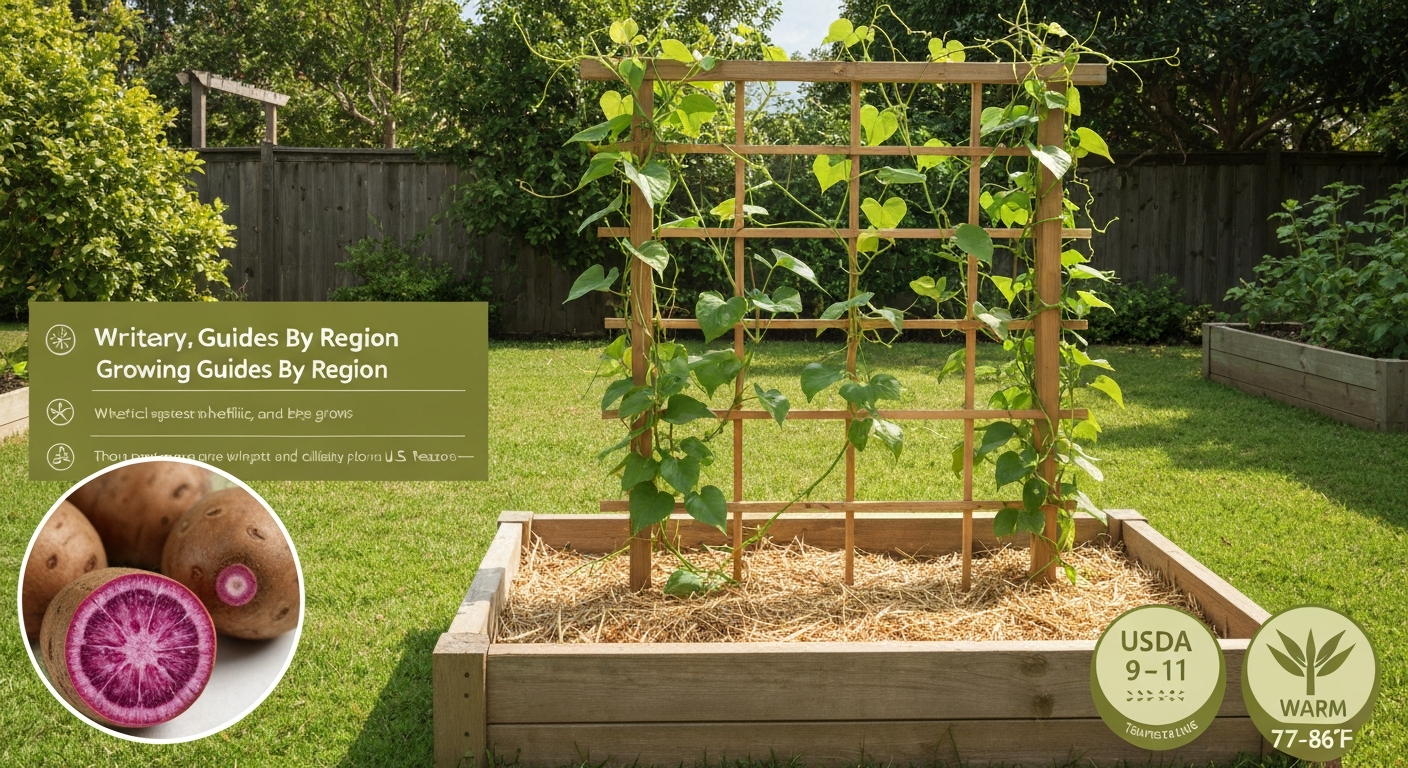
Ube is Dioscorea alata, a tropical vine in the yam family. Its dense, starchy tubers have a vivid purple-violet flesh and a mildly sweet, vanilla-like flavor that has made it a staple in Filipino and Southeast Asian cooking. The plant is not related to the orange sweet potato that American grocery stores often mislabel as 'yam.' It is a true yam, and that distinction is practically important: true yams are longer-season, more heat-demanding crops than sweet potatoes, and they need a genuine tropical or subtropical growing window to size up properly.
The vine itself grows vigorously, typically reaching 3 to 6 meters (about 10 to 20 feet) in a single season, and it needs a sturdy trellis. Optimal vegetative growth happens in the 25 to 30 degrees Celsius range (roughly 77 to 86 degrees Fahrenheit). Below about 20 degrees Celsius (68 degrees Fahrenheit), growth slows significantly. The plant is also photoperiod-sensitive: long summer days (above 12 hours of light) push vine and leaf growth, while shortening days in late summer and fall trigger tuber initiation and bulking. That photoperiod response is actually useful for U.S. growers because it aligns tuber development with late summer and fall, when days shorten naturally. What it also means is that the entire growing window from planting to harvest is long, typically 7 to 10 months in the tropics, and compressed to 5 to 7 months in marginal U.S. climates.
Where in the U.S. growing ube is actually feasible
The 2023 USDA Plant Hardiness Zone Map is the starting point for any honest assessment. Ube is commonly rated as perennial-hardy in zones 9 through 11 by major botanical references, including the Missouri Botanical Garden Plant Finder. Here is a practical breakdown of what that looks like across U.S. regions.
| USDA Zone | U.S. Region Examples | Outdoor Feasibility | Realistic Approach |
|---|---|---|---|
| 10–11 | South Florida, Hawaii, Puerto Rico, Lower Rio Grande Valley TX | Excellent: perennial outdoors | Plant and let it run; manage as a perennial |
| 9b | Houston TX, New Orleans LA, Tampa FL, coastal SoCal | Good: reliable annual; may perennialize in sheltered spots | Plant after last frost; mulch heavily in winter |
| 9a | Central Texas, Jacksonville FL, inland SoCal valleys | Fair: annual with effort; frost risk in winter | Plant early, lift tubers by November |
| 8a–8b | Carolinas, Georgia piedmont, Dallas TX, Pacific NW lowlands | Possible: short-season annual only | Start slips indoors; lift before first frost; expect smaller tubers |
| 7 and below | Most of the Midwest, Northeast, Mountain West | Not practical outdoors | Container or greenhouse growing only |
One important caveat for Florida growers: the University of Florida IFAS has flagged Dioscorea alata for invasive potential and has regulatory notes specific to the state. Ube can escape cultivation and naturalize in warm, humid climates. Before planting in Florida, check current UF/IFAS guidance and any Florida Department of Agriculture restrictions. I would rather you look that up than skip it and have a problem later.
Outdoor growing versus protected culture: what to actually expect
Outdoor growing in warm zones (9–11)
In zones 9b through 11, outdoor growing is the natural choice. You get the full growing window, reliable heat accumulation, and the vine will climb a trellis, bulk up tubers, and go dormant in fall without much intervention. In the warmest zones (10–11), the plant can overwinter in the ground and re-sprout in spring, though tuber quality often degrades if left unharvested for two or more seasons. In zone 9a and 9b, a hard freeze is still possible in January or February, so mulching the root zone with 4 to 6 inches of straw or wood chips and keeping the plant near a south-facing wall or fence gives you meaningful frost protection.
Growing as an annual in zones 7–8
This is where it gets honest. In zones 7 and 8, you are racing against the frost calendar on both ends of the season. The vine needs to be in the ground by late spring to accumulate enough heat before days shorten and tuber initiation begins. You also have to harvest before the first fall frost kills the vines, which in zones 7–8 can arrive as early as mid-October in some areas. The tubers will not reach the 1 to 3 kilogram sizes common in tropical production, but palm-sized tubers, averaging 300 to 600 grams, are realistic with a clean start and good soil. I have had seasons in marginal zones where the vine looked spectacular all summer and produced only golf-ball-sized tubers because the growing window was just too short. Starting with dormant tuber sets rather than bare soil cuttings and getting them in the ground 2 to 3 weeks earlier (with row cover if needed) makes a meaningful difference.
Container and greenhouse growing in cooler zones
In zones 6 and below, or anywhere your outdoor growing season reliably falls short of five months of warm weather, containers or a greenhouse are the honest answer. A 15- to 20-gallon container filled with well-draining potting mix gives the tuber room to develop. You can start in a greenhouse in March, move the container outdoors when nighttime temperatures stay above 60 degrees Fahrenheit, and bring it back inside (or into a frost-free garage) before first frost. The tradeoff is that container-grown tubers are smaller and the vine still wants to climb 10 feet, which is awkward indoors. A dedicated hoop house or greenhouse solves the vine problem and genuinely extends your season by 6 to 8 weeks on each end.
Picking your planting material
You have three main options: whole tubers or cut setts, rooted slips, and tissue-cultured plantlets. Each has real tradeoffs.
| Planting Material | Pros | Cons | Best For |
|---|---|---|---|
| Whole tuber or cut setts | Cheap, widely available, easy to plant | High disease risk (viruses, rot); slow to sprout if tuber is not pre-sprouted | Warm-zone growers who can source locally fresh material |
| Rooted slips (vine cuttings) | Faster establishment than dry setts; moderate cost | Still carries disease risk from source plant; variable quality | Zones 9–10 where season length is less critical |
| Tissue-cultured plantlets | Virus-tested, pathogen-reduced, highest quality stock | More expensive; requires careful hardening off; limited suppliers | Short-season growers and anyone starting a clean planting program |
The disease risk with setts is not abstract. Ube is susceptible to several viruses that are symptomless in the mother plant but reduce yields by 30 to 50 percent in subsequent generations. Anthracnose (caused by Colletotrichum species) is the other major threat, and it can devastate a planting in humid conditions. Tissue-cultured, virus-indexed plantlets are the gold standard for starting a clean planting. For practical purposes, if you are buying setts from a local Philippine or Asian grocery store or a home gardener, inspect for soft spots, rot, and unusual leaf markings on any sprouts before planting. Cut setts should be dusted with wood ash or a fungicide powder and allowed to callous for 24 to 48 hours before going into the ground.
Where to source planting stock in the U.S.
This is genuinely one of the harder parts of growing ube in America. Your most accessible sources are Filipino and Southeast Asian grocery stores, where fresh whole tubers can be purchased, pre-sprouted, and planted. Specialty online seed and tuber vendors (search specifically for 'Dioscorea alata' rather than just 'ube,' as the name is sometimes used loosely) occasionally stock tubers or slips, particularly in late winter and early spring. A handful of U.S.-based specialty nurseries and tropical plant suppliers in Florida, California, and Hawaii carry rooted slips or container-grown plants.
If you are tempted to import planting material from abroad, stop and check first. Check the USDA resource 'Plants with Special Requirements and Prohibited Plants | APHIS', it notes that most live plant propagative material requires a phytosanitary certificate and that certain taxa or yam propagules may be restricted or require permits. USDA-APHIS regulations require phytosanitary certificates for most live plant propagative material, and yam propagules have specific quarantine considerations. Importing without the correct permits is illegal and risks introducing pathogens that are not present in U.S. production areas. For germplasm collections, CGIAR and IITA genebanks hold extensive Dioscorea alata accessions, but access for home growers is effectively limited to approved research institutions. Stick to domestic suppliers and verify they can show clean sourcing if possible.
Planting calendar by U.S. region
Timing is where most U.S. ube growers go wrong, either planting too late or not accounting for the long growing window. Use NOAA frost probability tables for your specific county alongside the general guidance below. For U.S. gardeners planning planting windows, NOAA National Centers for Environmental Information (climate normals & frost/freeze statistics) provide 30‑year climate normals and freeze/frost probability tables that are the authoritative basis for choosing planting dates. These windows assume outdoor planting of pre-sprouted setts or rooted slips.
| U.S. Region | Start Indoors / Pre-sprout | Outdoor Plant Date | Tuber Initiation (approx.) | Harvest Window |
|---|---|---|---|---|
| Hawaii, South Florida (zone 10–11) | Not required | Year-round; best March–May | August–October | November–February |
| Gulf Coast, South Texas (zone 9b) | February (pre-sprout tubers) | March–April, after last frost | August–September | October–December |
| Inland South, Central TX (zone 9a) | January–February (pre-sprout indoors) | Late March–April | August–September | October–November |
| Southeast, Pacific NW lowlands (zone 8) | January–February (start slips indoors) | Late April–early May | Late August–September | September–October before first frost |
| Mid-Atlantic, Upper South (zone 7) | January (tissue culture or slips indoors) | Mid-May when soil >65°F | September | Early–mid October (race the frost) |
| Zone 6 and colder | March (greenhouse or containers) | Keep containerized; outdoors June–September only | September | October (bring containers in before frost) |
One practical tip that often gets overlooked: pre-sprouting tubers or setts in a warm, humid spot (70 to 80 degrees Fahrenheit, covered loosely with a damp cloth or in a plastic bag with air holes) for 3 to 4 weeks before your outdoor planting date jumpstarts the season meaningfully. I have consistently gotten 3 to 4 weeks of extra growth this way compared to planting cold, dormant setts directly in the ground.
Soil, light, and water: getting the basics right
Soil type and preparation
Ube is not forgiving of waterlogged or heavy clay soil. Tubers rot quickly in standing water, and compacted soil limits tuber expansion and shape. The FAO post-harvest compendium and multiple agronomy reviews consistently point to friable, well-drained loams or sandy loams with high organic matter as the ideal soil type. Target a soil pH of 5.5 to 6.5. If your native soil is heavy, build raised mounds or ridges 8 to 12 inches above grade and work in generous amounts of compost (at least 4 inches incorporated to a depth of 12 to 18 inches). In containers, use a mix of quality potting soil, perlite, and compost at roughly 2:1:1. Mulching the planting area with 3 to 4 inches of straw or wood chips helps retain moisture, moderate soil temperature, and suppress weeds during tuber bulking.
Sunlight
Full sun, meaning at least 6 to 8 hours of direct sunlight daily, is non-negotiable for productive tuber development. The vine is a sun-chaser and will lean aggressively toward light. Partial shade extends the vegetative (vine) phase and delays tuber initiation, which is exactly the wrong thing to happen when you already have a short season. Plant where it gets morning through early afternoon sun, and position the trellis to run north-south if possible to maximize light exposure along the vine.
Water and fertility
Ube needs consistent moisture during active vine growth, roughly equivalent to 1 to 1.5 inches of water per week, whether from rain or irrigation. The key word is consistent, not heavy. Cycles of drought followed by sudden heavy watering are a fast route to cracked or malformed tubers. During tuber bulking in late summer and fall, keep moisture steady but back off slightly as the vine begins to yellow and die back in preparation for dormancy. Drip irrigation works better than overhead watering in humid climates because wet foliage promotes anthracnose and other foliar diseases.
For fertility, a balanced approach works well: incorporate compost at planting, then side-dress with a moderate nitrogen fertilizer (such as 10-10-10 at label rates) once the vine reaches 18 to 24 inches. Shift to a lower-nitrogen, higher-potassium fertilizer (such as 5-10-15) as days begin shortening in late summer to support tuber development rather than continued vine growth. Over-fertilizing with nitrogen late in the season pushes lush vines at the expense of tuber size.
Trellising and spacing
Space plants 18 to 24 inches apart in rows 3 to 4 feet apart. Each plant needs a trellis, stake, or fence to climb. A simple bamboo teepee or a 6-foot rebar stake works for a single plant; for a row, run wire between posts at 2-foot and 5-foot heights. Do not skip the trellis: ube vines sprawling on the ground are far more susceptible to foliar disease and their yields are noticeably lower than trellised plants.
Overwintering, harvest, and storage
In zones 9b and warmer, you can leave tubers in the ground after the vine dies back and harvest when convenient, typically November through January. Mark your plants well because the vine disappears completely and it is easy to lose track of where the tubers are. In zones 9a and 8, harvest as soon as the vine yellows and begins to die back, before the first expected frost. Carefully loosen the soil with a fork starting 12 to 18 inches from the base of the old vine stem and work inward. Tubers can grow 12 to 24 inches deep and snap if you dig too aggressively.
After harvest, cure tubers in a warm (25 to 30 degrees Celsius), well-ventilated spot out of direct sun for 5 to 7 days. This hardens the skin and heals any cuts from digging. Cured tubers store well at 55 to 65 degrees Fahrenheit with moderate humidity, around 60 to 70 percent, for 2 to 4 months. Do not refrigerate freshly harvested tubers: cold temperatures cause internal chilling injury and discoloration. Save your best-formed, medium-sized tubers as setts for next year's planting rather than buying new stock every season.
Common problems and how to handle them
- Anthracnose (Colletotrichum spp.): The most serious foliar disease in humid climates. Appears as dark, sunken lesions on leaves and stems. Manage with proper spacing for airflow, drip rather than overhead irrigation, and copper-based fungicide sprays at first sign. Starting with clean planting material reduces initial infection pressure significantly.
- Tuber rot at planting: Caused by planting cold, wet setts in poorly drained soil. Pre-sprouting, dusting cut surfaces with wood ash or fungicide powder, and planting in raised mounds largely prevent this.
- Slow sprouting or no emergence: Usually a temperature problem. Setts planted in soil cooler than 65 degrees Fahrenheit sit and rot rather than sprout. Wait for consistently warm soil or pre-sprout indoors.
- Vine growing vigorously but no significant tubers at harvest: Most often caused by a planting date too late in the season, leaving insufficient time for tuber bulking after daylength triggers initiation. In marginal zones, every week of earlier planting (via pre-sprouted setts or indoor-started slips) matters.
- Yellowing or mottled leaves on new growth: Can indicate viral infection from contaminated planting material. There is no cure once the plant is infected; remove and do not replant from that stock.
- Deer and rodent damage: Both find ube tubers attractive. Use hardware cloth barriers around the planting area if rodents are active, and standard deer deterrents for vine protection.
Is it worth growing ube where you live?
If you are in zones 9b through 11, including South Texas, the Gulf Coast, South Florida, coastal Southern California, and Hawaii, ube is a genuinely rewarding crop. The vine is productive, visually striking, and the tubers are expensive at specialty stores, so growing your own has real value. The main commitment is managing disease pressure and giving it a proper trellis.
In zones 8 and 9a, I would say try it, but go in with realistic expectations about tuber size and commit to the full workflow: indoor pre-sprouting, early outdoor planting, attentive watering, and prompt harvest. One underpowered season (cold spring, late planting, early frost) will produce disappointing results, but a well-timed season is genuinely satisfying.
In zones 7 and below, the container or greenhouse route is the honest recommendation. It takes more infrastructure but it works. If you are already interested in other warm-season specialty crops, many of the same logistics apply: yacon (another underutilized Andean tuber crop gaining U. Can you grow yacon in the U.S.? Yes, yacon can be grown in suitable U.S. regions with a similar warm-season window, so see the linked guidance on growing yacon in the U.S. for regional tips and restrictions. S. grower interest) has a similarly specific regional window, and water spinach is another heat-loving vegetable with region-specific regulatory and growing considerations that parallel ube in some ways. For guidance on growing and legal considerations for water spinach in the U.S., see can you grow water spinach in us. Stevia, which grows across a broader range of U. For a state-by-state guide to cultivation, see what states grow stevia. S. climates, is a lower-effort entry point if you want to test your hand at specialty crops before committing to a high-maintenance vine like ube.
The short version: ube in America is absolutely possible. It just requires you to match your approach honestly to your climate rather than hoping tropical plants will adapt to temperate conditions on their own. They rarely do.
FAQ
Can you grow ube (Dioscorea alata, purple yam) in the United States?
Yes — but success depends on your climate and how you grow it. Ube is a tropical/subtropical yam that thrives with long warm growing seasons (optimal 77–86 °F / 25–30 °C). In the warmest U.S. zones (generally USDA 9–11, sometimes 10–12) it can overwinter outdoors and be grown in-ground. In warm‑temperate or cooler zones gardeners must use protected culture (greenhouse/hoop house), containers, or lift and store tubers over winter and treat it as an annual.
How do USDA hardiness zones and U.S. regions affect feasibility?
Tropical/subtropical (USDA 9–11+; Gulf Coast, southern Florida, southern California, parts of Hawai‘i): reliable outdoor/perennial. Warm‑temperate (USDA 7–9; parts of SE, mid‑Atlantic, Pacific Coast pockets): possible with season extension, protected culture, or annual production with lifted tubers. Temperate/cool (USDA <7): treat ube as an annual in containers/greenhouse or grow indoors; tubers will not survive outdoor winters without lifting and winter storage. Use local USDA zone maps and last‑frost/freeze data when planning.
Should I grow ube outdoors, in containers, or in protected culture?
Choose based on climate and space: - Outdoor in-ground: best where winters are frost-free and summers long/warm (USDA 9+). - Containers: flexible for colder climates, easier to move indoors for overwintering and to control soil; ideal for hobbyists. - Protected culture (greenhouse/hoop house): extends season, improves heat and humidity control, and yields better in marginal zones. In cool zones, greenhouse or container + indoor overwintering gives the most reliable results.
What planting material should I use (tubers, sets, or tissue-culture)?
Options and tradeoffs: - Whole tubers/sets: cheapest and simplest but can carry diseases (viruses, fungi). - Cut tuber pieces (sets): space‑efficient; follow sanitization and allow callusing before planting. - Tissue‑culture/micropropagated plantlets: more expensive but provide virus‑reduced, clean stock; recommended if sourcing material from abroad is restricted. Always verify legal import requirements and phytosanitary rules before acquiring foreign propagules.
Are there legal or phytosanitary restrictions on buying ube planting stock?
Yes. Importing vegetative yam material often requires APHIS permits and phytosanitary certificates; many materials are restricted under NAPPRA or other rules. Because yams can carry viruses, quarantine and clean‑stock requirements are common. Check APHIS rules and your state extension or department of agriculture before purchasing or importing propagules.
When should I plant ube (timing/seasonal calendar)?
Plant after the last hard frost when soil and air temperatures consistently warm (soil >65 °F / ~18 °C). In USDA 9+ you can plant in spring or at the start of the warm/rainy season. In marginal areas, start plants in containers or greenhouse 4–8 weeks before last frost, transplant after warm conditions set in, or use protected culture to lengthen the season. For annual production in cool climates, expect a growing season of several months—plan to lift tubers before first frost.
Learn where black pepper can be grown in the US and how to grow it indoors or in warm zones for fruit.

Regional guide to growing caper plants in the US, choosing cultivars, meeting soil and climate needs, and harvesting bud
Zone-by-zone guide to growing black pepper peppercorns in the US, including heat, humidity, indoor options, and timeline