
Yes, ginger grows very well in Southwest Nigeria. The six-state zone (Lagos, Ogun, Oyo, Osun, Ondo, Ekiti) sits squarely in the tropical warm-humid belt that ginger was practically designed for. Temperatures run between roughly 21 and 34 °C month to month, frost is completely absent, and annual rainfall across the region ranges from about 1,000 mm to over 3,000 mm depending on how close you are to the coast. That combination checks every box ginger needs. The real challenges here are not whether ginger will survive, but managing soil drainage, timing planting around the rainy and dry seasons, and keeping rhizome-borne diseases from wiping out your planting stock before the crop matures.
Can Ginger Grow in Southwest Nigeria? Practical Guide
Marcus Petersen
12 Aug 2026
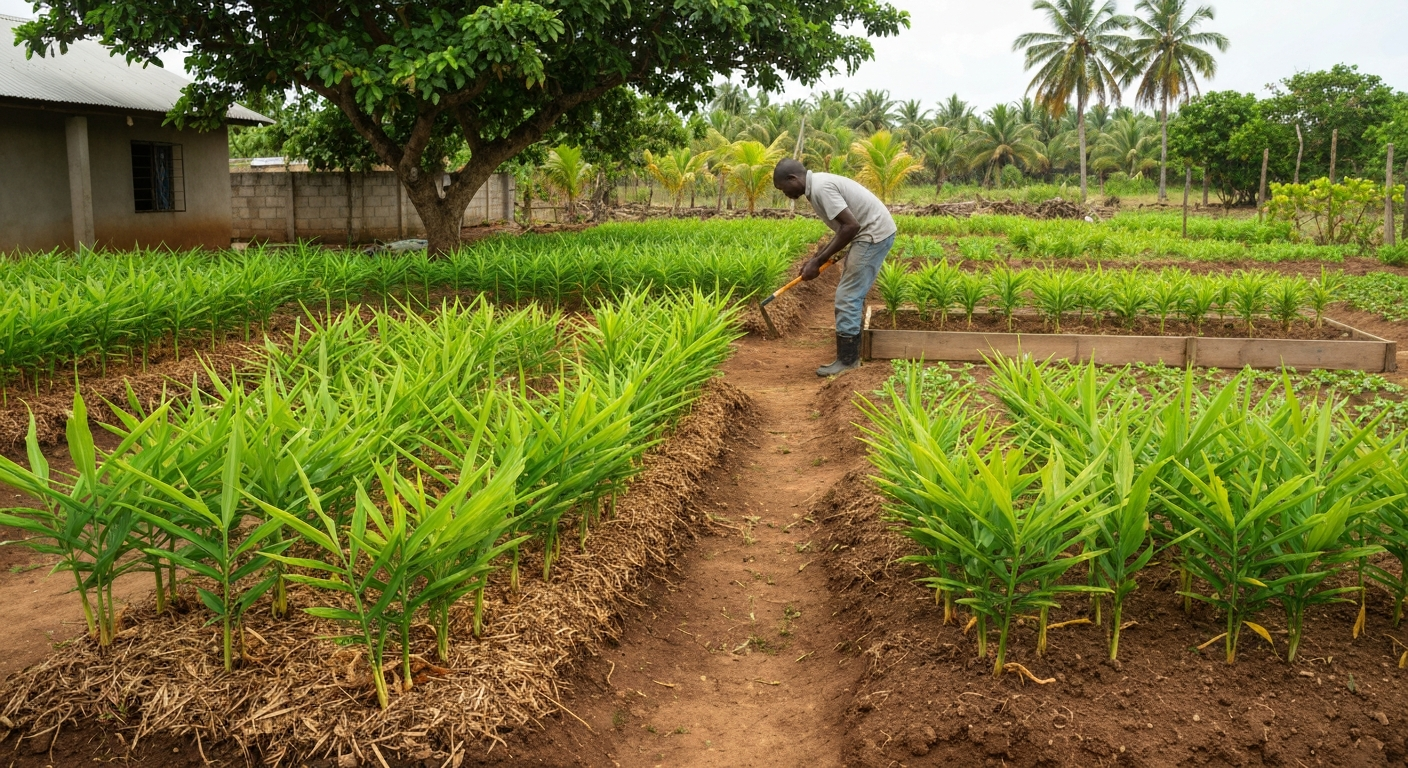
Southwest Nigeria's climate and the microclimates that matter for ginger
Ginger is a tropical herb that prefers temperatures in the 25 to 32 °C range with consistently high humidity during its vegetative and bulking phases. Southwest Nigeria delivers that almost exactly. Mean temperatures across the zone sit in the mid-20s °C, and even the cooler harmattan months rarely push conditions outside ginger's comfort range. Unlike growers in New England or other temperate regions who need to engineer warmth through containers or greenhouses, you are working with the climate rather than against it.
That said, the region is not climatically uniform. Lagos and coastal areas of Ondo see the heaviest and most reliable rainfall (often 1,500 to 3,000 mm per year) with a double-peak rainy season typical of the Guinea Coast. Move inland toward Oyo, Osun, and Ekiti and the rainfall becomes more concentrated in a single main season and the harmattan dry spell (roughly November through February) becomes more pronounced. In Ekiti especially, you will feel a more savanna-like dry season than a coastal Lagos gardener ever will. That inland-coastal gradient directly affects irrigation needs, mulching strategy, and how long your ginger can grow before the soil moisture runs out.
Microclimate is worth thinking about at the backyard scale too. A plot on the western side of a building that catches afternoon wind during dry season will dry out faster than a sheltered courtyard. Ginger does best in partial shade, so a spot with morning sun and afternoon shade from a wall, fence, or taller crop canopy is genuinely ideal. Full-day sun in the Lagos dry season can stress the foliage and accelerate soil moisture loss faster than mulch alone can compensate.
Soil and drainage: what ginger needs and what Southwest Nigeria often provides
Ginger wants a well-drained, fertile loam or sandy loam with a pH of around 5.5 to 6.5 and plenty of organic matter. Poor drainage is the single most reliable way to kill a ginger crop, because waterlogged rhizomes rot fast, often taking the whole planting with them. The soil situation across Southwest Nigeria is mixed in useful ways.
Inland localities in Ogun, Ondo, Ekiti, Osun, and Oyo tend to present sandy loam to loamy sand soils, which drain well but can shed moisture too quickly during dry spells. Regional soil and texture maps show heterogeneous textures across Southwest Nigeria, loamy sand and sandy loam are widespread inland while coastal/lagoon areas and parts of Lagos are commonly sandier or sandy‑clay (see Soil texture map of south‑western Nigeria (research figure / regional soil studies)). Coastal and lagoon areas in and around Lagos frequently have coarser, sandier textures or, in low-lying spots, poorly drained sandy-clay. Neither extreme is ideal, but both are fixable with moderate effort.
Sandy soils: the fix is organic matter and mulch
If your plot is on the sandier end, which covers a lot of backyard plots near Lagos, the issue is water retention rather than waterlogging. The National Horticultural Research Institute (NIHORT) recommends applying 5 to 6 tonnes per hectare of farmyard manure or compost as a basal dressing before planting. At backyard scale, that translates to working in a generous 5 to 8 cm layer of well-rotted compost or aged manure across your bed before you plant. This improves water-holding capacity, feeds the crop through the season, and gives the rhizomes the loose, friable structure they need to expand without resistance.
Clay-heavy or waterlogged spots: raised beds are the practical solution
If your site is low-lying or the soil holds water for more than a day after heavy rain, do not attempt flat-bed planting. Build raised beds at least 20 to 30 cm above ground level using a mix of your existing soil, compost, and coarse sand if available. This approach gives the roots immediate drainage while still holding enough moisture between rains. It is the same logic that applies to gardeners in sandy coastal zones who are trying to grow ginger in sand-dominated soils, where the challenge is retention rather than drainage. For practical tips on managing sandy soils and whether you can grow ginger in sand, consult guidance on improving water retention with compost, mulch, and raised beds can you grow ginger in sand.
Timing your planting around the rainy and dry seasons
Getting the timing right is probably the single most important decision you will make. Plant too early in the dry season and your rhizomes will sit in dry soil struggling to sprout. Plant too late in the rains and you risk establishing into waterlogged conditions that invite rot. The sweet spot, recommended by both NIHORT and research from the National Root Crops Research Institute (NRCRI), is planting at the onset of the main rains, which in most Southwest Nigeria localities falls in March to April for rainforest-zone areas and April to May for the more inland derived-savanna areas like much of Oyo and Ekiti.
The logic is straightforward: you want rising soil moisture that encourages sprouting and early root establishment, but you want the heaviest rains to arrive after the plant is already growing so the canopy can intercept some of that rainfall energy and reduce splash-dispersed disease. If you plant into the peak of heavy rains in June or July, drainage becomes a serious concern.
| Month | Condition in most of SW Nigeria | Ginger management action |
|---|---|---|
| November – February | Harmattan dry season, low humidity, cooling nights | Store seed rhizomes in covered pits or shaded sawdust heaps; prepare beds |
| March – April | First rains arrive; soil warming and moistening | Best planting window (rainforest zones); set rhizomes into prepared beds |
| April – May | Rains strengthening inland | Best planting window for inland/savanna areas; ensure drainage channels are clear |
| May – July | Peak of main rains, heavy precipitation | Maintain mulch layer; monitor drainage; apply first fertilizer top-dress |
| August – October | Second rains or continued main rains coastal; drying inland | Sustain irrigation if dry; avoid waterlogging; monitor for fungal disease |
| October – November | Rains receding; drying begins | Fresh ginger harvest at 5–7 months; allow to mature for dried/seed rhizomes |
| December – January | Full dry season | Harvest mature rhizomes (8–10 months from March planting); store seed setts |
If you want to grow outside this main window, irrigated production is possible but you will need to manage water supply carefully and your drainage infrastructure needs to be solid. Dry-season planting under irrigation can work, but it is genuinely more work than timing with the natural rains.
Choosing your planting stock: rhizomes, old setts, and the truth about seeds
Ginger is propagated vegetatively from rhizome pieces called setts. Commercial ginger varieties are largely sterile, they produce seed so rarely that botanical seed is not a practical planting option for a backyard grower. If you see anyone selling ginger 'seeds' in a packet at a general garden store, what they are almost certainly selling are dried rhizome setts. If you’re curious about unusual seed questions and viability, see the discussion titled 'can ancient seeds grow on ginger island' for related background and myths about seed germination. Do not let the terminology trip you up.
The NRCRI recommends sett sizes of 15 to 20 grams for seed-ginger production and 21 to 35 grams for ware (table) ginger production. In practice, for a backyard grower, a sett about the size of a large grape with at least one visible growth bud (eye) is a reliable unit. Each sett should come from a healthy mother rhizome with no soft spots, mold, or shriveling.
Can you use old or aged rhizomes?
This comes up a lot. I have planted old, slightly shriveled rhizomes bought from a market and had perfectly acceptable results, but viability drops meaningfully as rhizomes age and dry out. A firm, plump rhizome with turgid tissue and visible buds will outperform a wrinkled one almost every time. If you are working with aged rhizomes, soak them in water for a few hours before planting to rehydrate the tissue. NIHORT recommends seed-rhizome storage in covered pits or sawdust heaps in shaded conditions to preserve viability between seasons, which tells you the enemy is desiccation and heat during storage. Similarly, the question of whether old ginger root will grow at all, which many first-time growers wonder about, comes down to bud viability. For more detail on whether old ginger root will sprout, see will ginger root grow. If the buds are still firm and present, there is a reasonable chance. If the rhizome is completely desiccated with no discernible eyes, it will not sprout reliably.
For disease control, NIHORT also recommends treating seed setts with a fungicide dip before planting to reduce the risk of carrying rhizome-borne pathogens into your bed. At the very minimum, rinse setts in clean water and inspect carefully before planting.
Step-by-step planting for backyard growers
- Prepare your bed two to three weeks before planting: dig to about 30 cm, remove stones and hard clods, and work in 5 to 8 cm of well-rotted compost or farmyard manure. If the soil is very sandy, add extra organic matter. If drainage is poor, build the bed up 20 to 30 cm above the surrounding ground.
- Source healthy rhizomes with visible growth buds. Aim for setts in the 20 to 35 gram range for table ginger. If setts are large, cut them into smaller pieces, each with at least one bud, and allow cut surfaces to air-dry in shade for 24 to 48 hours before planting to reduce rot entry points.
- Treat setts with a fungicide dip (mancozeb-based products are commonly available in Nigeria) or at minimum soak in clean water for a few hours if you are avoiding chemical inputs.
- Plant setts at a depth of approximately 10 cm (about the width of two fingers laid flat). The bud should face upward.
- Space setts 20 to 25 cm apart within rows, with rows 30 to 40 cm apart. Closer spacing is fine in a very fertile, well-managed bed; wider spacing improves airflow and reduces fungal pressure.
- Apply mulch immediately after planting to a depth of 5 to 8 cm. Dry grass, straw, or dried leaves all work well. NIHORT recommends an initial green mulch application of the equivalent of 10 to 12 tonnes per hectare at planting, which at backyard scale means a generous layer covering all bare soil between plants.
- Water lightly if the soil is dry at planting, then allow the natural rains to take over. Avoid irrigation that pools water around the setts in the first two weeks.
- Mark your planting date. Set a reminder for the first fertilizer application at four to six weeks after emergence.
Container, raised-bed, and greenhouse options for marginal sites
Within Southwest Nigeria, containers and raised beds are not a fallback for marginal climate, the climate is fine everywhere in the zone. They are instead solutions for marginal soil or drainage situations: the Lagos plot that floods in July, the concrete courtyard with no ground soil, or the balcony grower who still wants fresh ginger. In these cases, large containers (at least 30 to 40 cm deep and 40 cm wide per plant cluster) filled with a well-draining potting mix of compost, garden soil, and coarse sand in roughly equal proportions work very well. Container-grown ginger in Southwest Nigeria will still produce a harvest, though yield per plant will be smaller than in-ground production.
The container and raised-bed logic extends directly to gardeners in genuinely challenging climates elsewhere. Growers in New England, for example, face the opposite problem: a short frost-free window, cold soil temperatures, and no reliable growing season outdoors. For them, containers that can be started indoors or in a heated greenhouse and moved outside only once temperatures are consistently above 20 °C are the main pathway to a ginger harvest. Southwest Nigeria gardeners reading this can skip that complexity entirely, but if you are advising a friend in a cooler region, container production in a greenhouse or sunny indoor space is the practical workaround.
Greenhouses have limited relevance in Southwest Nigeria for ginger specifically, you are not trying to create warmth that does not exist outdoors. Where a simple greenhouse or shade-net structure does help locally is in managing excessive rain intensity in the peak season on sandy soils prone to surface erosion, or in extending the dry-season growing window with drip irrigation under cover.
Care and maintenance through the growing season
Watering
During the main rains, natural rainfall will usually be sufficient as long as drainage is functioning and the mulch layer is intact. Watch for standing water after heavy rain, if water pools for more than several hours around your plants, add drainage channels immediately. During dry spells within the growing season (which can occur even in the rainy months) irrigate to keep the soil consistently moist but never saturated. Ginger is sensitive to both prolonged drought and waterlogging, and getting that balance right is the main ongoing task. In the harmattan months, if you are extending your crop toward full maturity, you will need supplemental irrigation every few days depending on your soil type.
Fertilization
NIHORT recommends a basal application of 5 to 6 tonnes per hectare of farmyard manure or compost at bed preparation, followed by 300 kg/ha of NPK 15:15:15 split into two doses: half at planting and half four to six weeks later. For a backyard grower, this means working compost into the bed before planting, then applying a balanced granular fertilizer lightly around plants at planting and again at about a month after emergence. Keep granular fertilizer off the stems and leaves and water in after application. NRCRI trial data also suggest a foliar micronutrient application at around eight weeks can support yield in nutrient-limited soils, which is worth considering if your plants look pale or slow to develop.
Mulching top-up and shade management
Mulch breaks down through the season, especially during the heavy rains. NIHORT recommends a second mulch application at about three months after planting (at roughly 5 tonnes per hectare equivalent, or a light refresh of your existing mulch layer). Top up the mulch before it thins out to bare soil, exposed bare soil around ginger plants during rain increases disease splash and accelerates moisture loss. For shade management, a partial overhead canopy is helpful in the driest months. If your plot is in full sun, consider temporarily erecting a simple shade-cloth structure at 30 to 50 percent shade rating over the hottest and driest part of the growing season.
Pests and disease to watch for
- Soft rot (Pythium and Fusarium species): the most destructive disease in Nigerian ginger production. Caused by waterlogging and poor drainage. Prevention is through drainage, mulching, and fungicide-treated setts. Once plants collapse from soft rot, there is no recovery — remove and destroy affected plants immediately.
- Bacterial wilt (Ralstonia solanacearum): causes sudden wilting even in moist soil. No chemical cure once established. Use clean planting stock, avoid replanting ginger in the same spot in successive seasons, and do not water with contaminated surface water.
- Rhizome scale and shoot-borer: inspect plants regularly. Shoot borers cause dead hearts (the central shoot dies). Remove and destroy affected shoots. Neem-based organic sprays or registered insecticides can be used at emergence if pressure is high.
- Leaf spot fungi: more cosmetic than fatal in most cases, but severe defoliation reduces yield. Improve airflow between plants through proper spacing and avoid wetting foliage when irrigating.
What to realistically expect at harvest
FAO postharvest data give a useful breakdown of harvest timing by end use: fresh or 'vegetable' ginger can be dug at around five months after planting, when the rhizomes are young, mild, and tender. The FAO document Ginger, Post‑harvest operations (FAO compendium) summarizes harvest timing: fresh/vegetable ginger ≈5 months; preserved/fresh‑pick 5–7 months; dried/oleoresin 8–9 months; and seed material is harvested later when leaves dry and rhizomes mature blank" rel="noopener noreferrer">Ginger — Post‑harvest operations (FAO compendium). If you want to preserve or use ginger fresh over a longer period, five to seven months is the window. For dried ginger or oleoresin production, waiting eight to nine months gives fully mature rhizomes with higher dry-matter and essential oil content. Seed material for the following season is harvested last, once the leaves have fully dried back and the rhizomes are at maximum maturity.
NIHORT gives crop maturity at eight to ten months from planting for ware ginger depending on variety and management. For a backyard plot planted in late March or April, that puts a full harvest in December to January, conveniently at the start of the dry season when conditions for curing and storing harvested rhizomes are good. A March planting also allows you to take a fresh-ginger partial harvest from August onward if you want young rhizomes for cooking, then leave the remainder of the crop in the ground to continue maturing.
Yield at backyard scale is not something I would put hard numbers on without knowing your specific soil, variety, and management level. What I can say is that well-managed in-ground plots in Southwest Nigeria on decent loamy soil are capable of good returns per square meter with the combination of manure, mulch, and correct timing described here. Container plants will yield less per unit but are a completely viable source of fresh young ginger for kitchen use through the season.
Is it worth growing ginger in Southwest Nigeria?
Absolutely, and with less effort than you might expect. The climate is about as close to ideal as ginger gets anywhere in the world. The constraints are practical and solvable: manage your drainage, time your planting to the rains, use healthy rhizomes treated against fungal rot, keep the mulch layer intact through the season, and give the plants a balanced feed. If you have sandy coastal soil, load up on compost. If you have a low-lying waterlogged spot, build a raised bed. If you only have a balcony, use a large container. None of these are exotic solutions, they are the same core principles that apply whether you are growing ginger in Southwest Nigeria or trying to coax it through a short growing season somewhere far less forgiving.
FAQ
Can ginger (Zingiber officinale) be grown successfully by home gardeners in Southwest Nigeria?
Yes. Southwest Nigeria is within ginger’s climatic comfort zone (warm, humid, frost‑free). With well‑drained soil, timely planting at the start of the rainy season, basic fertility and mulch/irrigation management, backyard gardeners can grow marketable fresh ginger in 5–8 months and mature rhizomes for drying or seed in 8–10 months.
What specific climate and microclimate factors in Southwest Nigeria matter for ginger?
Key factors: warm temperatures (ideal 25–32 °C) and a frost‑free environment are suitable. Reliable moisture during the bulking period is important — ginger needs consistent soil moisture but cannot tolerate prolonged waterlogging. Microclimates that are sheltered from strong wind, receive morning sun or dappled shade, and have protection from standing surface water are best. Avoid low‑lying, flood‑prone spots without raised beds or drainage.
What are ginger’s soil and drainage requirements, and how does it perform in sandy soils?
Ginger prefers loose, fertile, well‑drained soils with pH about 5.5–6.5. Poor drainage (heavy clay, perched water table) causes rot. Sandy and sandy‑loam soils common in parts of Southwest Nigeria can work if amended: add 5–10%+ organic matter (compost, well‑rotted manure), use mulches to conserve moisture, and consider mulch/green manure and frequent low‑volume irrigation to offset low water retention. Raised beds reduce waterlogging risk on heavier patches.
When should gardeners in Southwest Nigeria plant ginger relative to the rainy/dry seasons?
Plant at the onset of the main rains (commonly March–May depending on locality) so setts establish as soil moisture increases but before prolonged waterlogging. In irrigated or well‑drained sites you can plant outside the main rains, but you must provide regular irrigation during the establishment and bulking period and protect against waterlogging.
What propagation method should home gardeners use? Are old or aged rhizomes or seeds viable?
Propagate vegetatively with healthy rhizome setts (pieces of mature rhizome with 1–2 buds/‘eyes’). Commercial/extension guidance recommends sett weights: ~15–20 g for seed production plots, ~21–35 g for ware (consumption) production. Botanical seed is generally not used — cultivated ginger is largely sterile. Aged/old rhizomes can be used if they are firm, disease‑free, and have visible buds; avoid shriveled, soft, or moldy pieces. For disease‑free stock, use fresh healthy rhizomes, tissue‑cultured plantlets where available, or purchase certified seed ginger.
How should I prepare seed rhizomes and planting beds?
Select firm, plump rhizomes with visible buds. Cure or store in a cool, shaded, dry ventilated place (sawdust or dry sand) if not planting immediately. Prepare beds by digging/loosening 20–30 cm, incorporate 5–6 t/ha equivalent of compost or well‑rotted manure (for backyard: 2–4 handfuls per planting hole or a thick compost layer across the bed), and build raised beds ~15–25 cm high if drainage is a concern. Mark rows ~30–40 cm apart and plant setts about 8–10 cm deep and 20–30 cm within rows (home garden spacing can be tighter or wider depending on seed availability). Mulch heavily after planting.
Next Articles
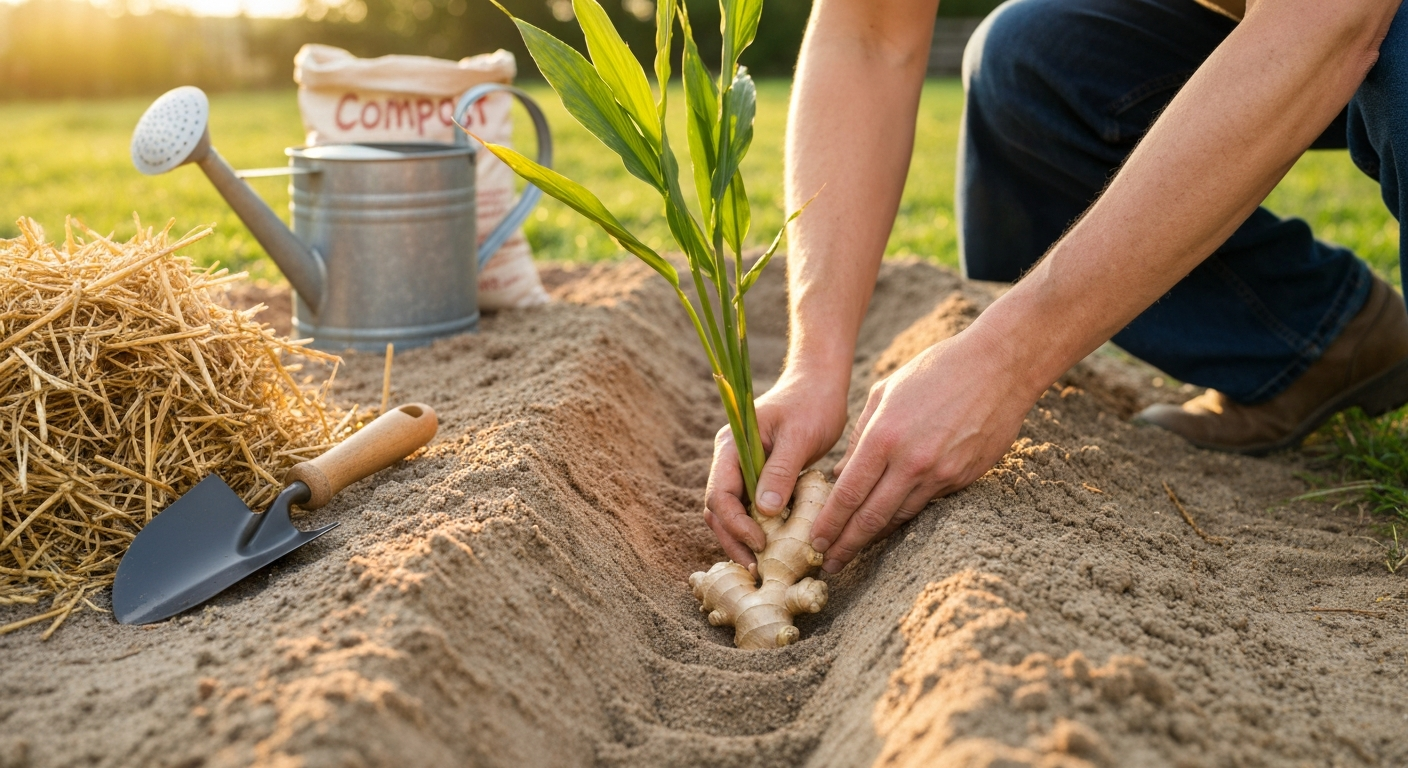
Can You Grow Ginger in Sand: Tips for Success in Sandy Sites
Can you grow ginger in sand? Practical planting, soil fixes, container recipes, and climate-smart tips for success.
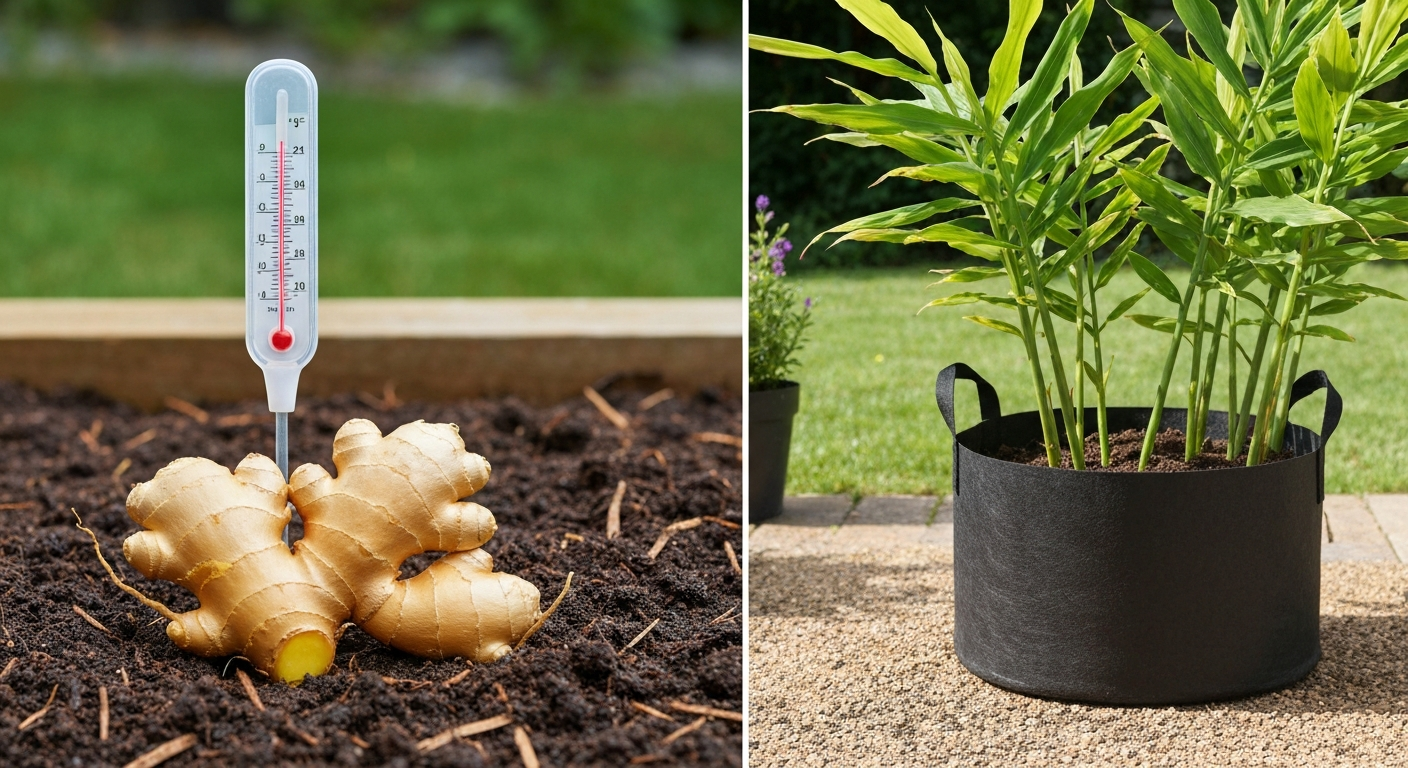
Will Ginger Root Grow? Zone-Based Guide for Home Gardeners
Will ginger root grow? Zone-by-zone verdict, how to force grocery rhizomes, containers, care and harvest.
Can You Grow Black Pepper in the US Where and How
Learn where black pepper can be grown in the US and how to grow it indoors or in warm zones for fruit.