
Yes, you can grow ginger in sandy soil, but only if you treat the sand as a starting point rather than a finished bed. Raw sand drains too fast, holds almost no nutrients, and dries out before ginger rhizomes can do much of anything. Amend it heavily with organic matter, keep up with watering and feeding on a tighter-than-usual schedule, and ginger will grow just fine in a sandy site. Skip those steps and you'll get weak shoots, stunted rhizomes, and a lot of frustration. The good news is that sandy ground is far easier to fix than clay, and in hot, humid climates where waterlogging is the bigger enemy, a sandy base can actually give you a head start.
Can You Grow Ginger in Sand: Tips for Success in Sandy Sites

Marcus Petersen
10 Aug 2026
How sand actually affects ginger
Ginger (Zingiber officinale) wants loose, well-drained soil that still holds enough moisture to keep rhizomes plump between waterings. Sand gets the 'loose and drained' part right, sometimes too right. A sandy substrate can have a saturated hydraulic conductivity around 29 cm per hour, compared to roughly 4 cm per hour for loam. Reported intact‑core Ks examples, sand ≈29 cm·h⁻¹, loam ≈4.1 cm·h⁻¹, clay‑loam ≈0.09 cm·h⁻¹, illustrate orders‑of‑magnitude differences (blank" rel="noopener noreferrer">Factors affecting saturated hydraulic conductivity – GeoLibreTexts/04%3ASoilWaterFlow/4.05%3AFactorsaffectingsaturatedhydraulicconductivity)). Water moves through it so quickly that ginger roots barely have time to absorb it before it's gone. That same fast movement carries dissolved nutrients straight out of the root zone, so whatever fertilizer you apply leaches away faster than in heavier soils. Field comparisons consistently show much higher nitrate losses from sandy profiles than from clay or loam under the same cropping conditions.
Salt risk is the other issue that catches gardeners off guard, especially near coastal areas. Ginger is genuinely salt-sensitive. Physiological and molecular studies (Physiological and molecular mechanism of ginger (Zingiber officinale Roscoe) seedling response to salt stress – Frontiers in Plant Science, 2023) confirm ginger shows classical salt‑stress responses, osmotic stress, Na+ accumulation, increased ROS and antioxidant activation, and that even modest salinity inhibits growth Physiological and molecular mechanism of ginger (Zingiber officinale Roscoe) seedling response to salt stress – Frontiers in Plant Science (2023). Research puts the safe threshold at a soil electrical conductivity (ECe) below 2.0 dS/m. At around 3.1 dS/m, rhizome yields drop by roughly 13 percent. At ECe values above 6-7 dS/m, losses become severe. Sandy soils near the ocean can carry residual salt that pushes right past those thresholds without you realizing it. And because salt doesn't bind to sand particles the way it does in organic-rich soils, it moves freely through the profile and concentrates wherever drainage slows.
Compaction is less obvious in sand than in clay, but it still matters for a root crop. Ginger rhizomes develop at roughly 16-20 cm depth and need room to spread horizontally. When bulk density in sandy loam climbs above about 1.6 g/cm³, or when penetration resistance hits 2 MPa, root elongation slows measurably. Foot traffic, heavy rainfall impact, and irrigation pooling can all pack loose sand down over a season. Soil temperature is one area where sand actually helps: it warms up faster in spring than clay does, and ginger needs soil above 68°F (20°C) to break dormancy, with the sweet spot closer to 77°F (25°C). In cooler-climate regions, that faster warm-up can buy you a few extra weeks of growing season.
Not all sand is the same: what to use and what to avoid
This is where I've seen a lot of gardeners go wrong. They pick up a bag of play sand or haul buckets from a nearby beach and wonder why their ginger bed fails. The type of sand matters quite a bit.
| Sand Type | Characteristics | Safe to Use? | Notes |
|---|---|---|---|
| Coarse horticultural/sharp sand | Angular particles, screened, usually washed | Yes | Best choice for mixes; improves drainage without compacting |
| Builder's sand (coarse) | Angular to sub-angular, coarse grit | Yes, if washed | Check EC before use; rinse if any doubt |
| Play sand | Very fine, rounded grains | No | Compacts readily, holds water in pockets, poor drainage |
| Beach sand (coastal) | Fine to medium, high residual salt | No | Salt content often exceeds 2.0 dS/m ECe; harmful to ginger |
| Fine silty sand | Small particles, low permeability when wet | No | Behaves more like silt than sand; drainage benefit is lost |
Horticultural sharp sand is what extension programs and UC Davis root-media guides specifically call for when amending growing mixes. It stays open and angular even under pressure. Beach sand and play sand are explicitly on the 'do not use' list, and for good reason. If your site is naturally sandy, test the EC before planting. A reading above 2.0 dS/m means you need to flush the soil with fresh water repeatedly and retest, or relocate the bed further from any saline influence.
When sandy soil helps and when it works against you
There are real situations where a sandy base is an advantage for ginger. In regions with heavy summer rainfall, like the Gulf Coast or the humid Southeast, waterlogging kills rhizomes faster than almost anything else. A sandy substrate drains before pooling can occur, and in those climates you're irrigating frequently anyway, so the faster dry-down is less of a problem. Hot, sunny sites also benefit from sand's faster soil warm-up in spring. If you're gardening in something like coastal Georgia or Florida and your native soil is a dense, wet clay, amending toward a sandier texture or building raised beds with a sandy-loam mix is a genuine upgrade.
On the other hand, sandy soil makes everything harder in dry climates, in exposed windy spots, or anywhere you can't irrigate consistently. Ginger propagation studies show that keeping the root zone near field capacity is critical for good emergence and early growth. Sand's field capacity is low, around 0.1 atm soil tension, meaning it holds far less available water than loam before roots start experiencing stress. In the mid-Atlantic or Midwest, where summer rainfall is irregular, a pure sandy bed will stress ginger repeatedly between rains. Cold-climate growers facing this situation, such as those in New England, are often better served by containers or raised beds with an amended mix rather than working directly with a sandy in-ground site.
Testing your sandy site before you plant
I won't pretend I always tested before planting in my early years. I killed a few batches by assuming the soil was fine. Now I run through a quick checklist before any sandy-site ginger planting, and it saves a lot of wasted effort.
- Send a soil sample to your local cooperative extension lab. Ask for pH, organic matter percentage, and a basic nutrient panel. Ginger prefers pH 5.5-6.5. Below 5.0 or above 7.0 causes problems with nutrient availability.
- Test electrical conductivity (EC) with an inexpensive EC meter and a soil slurry (1:1 soil to distilled water by volume). Scale results to ECe values and aim for under 2.0 dS/m. Any reading above that near a coastal area should raise a flag about salt.
- Check organic matter. A sandy soil that tests at under 2 percent organic matter will need significant amendment before it holds enough nutrients and moisture for ginger.
- Do a jar settling test if you're unsure of texture. Fill a jar with soil and water, shake it, and let it settle for 24 hours. Sand sinks to the bottom first. If the sand layer is more than two-thirds of the total settled depth, you're working with very sandy soil.
- Test drainage. Dig a hole about 30 cm deep, fill it with water, and let it drain completely. Refill and time the drain rate. Sandy soil usually drains within an hour or two. If it drains almost instantly and the sides crumble dry, you're working with very low water-holding capacity.
Based on what the tests tell you, calculate how much organic matter to add. A good target for a ginger bed is 25-30 percent organic matter by volume in the finished amended mix. If your native soil is pure sand with under 1 percent organic matter, you're essentially building a new mix in place.
Preparing a sandy in-ground bed for ginger
Site selection matters. Ginger wants partial shade in hot climates (three to five hours of direct sun, filtered the rest) and more sun in cooler zones. A north-facing slope or a spot with afternoon shade from a fence or tree works well in the South. In the Northeast or Pacific Northwest, full morning sun with afternoon shade is a reasonable target. Avoid sites with obvious salt influence, standing water, or heavy foot traffic.
- Strip any existing vegetation and loosen the top 30-35 cm of sandy soil with a fork. Don't rotovate repeatedly; one pass is enough and preserves soil structure.
- Spread a 10-15 cm layer of quality compost or aged leaf mold over the bed. Work it in thoroughly so the final mix is roughly 25-30 percent organic matter by volume.
- If your EC test flagged salt, irrigate the prepared bed deeply two or three times over a week to flush the profile, then retest before planting.
- Adjust pH with agricultural lime (to raise) or sulfur (to lower) based on test results. Target 5.5-6.5.
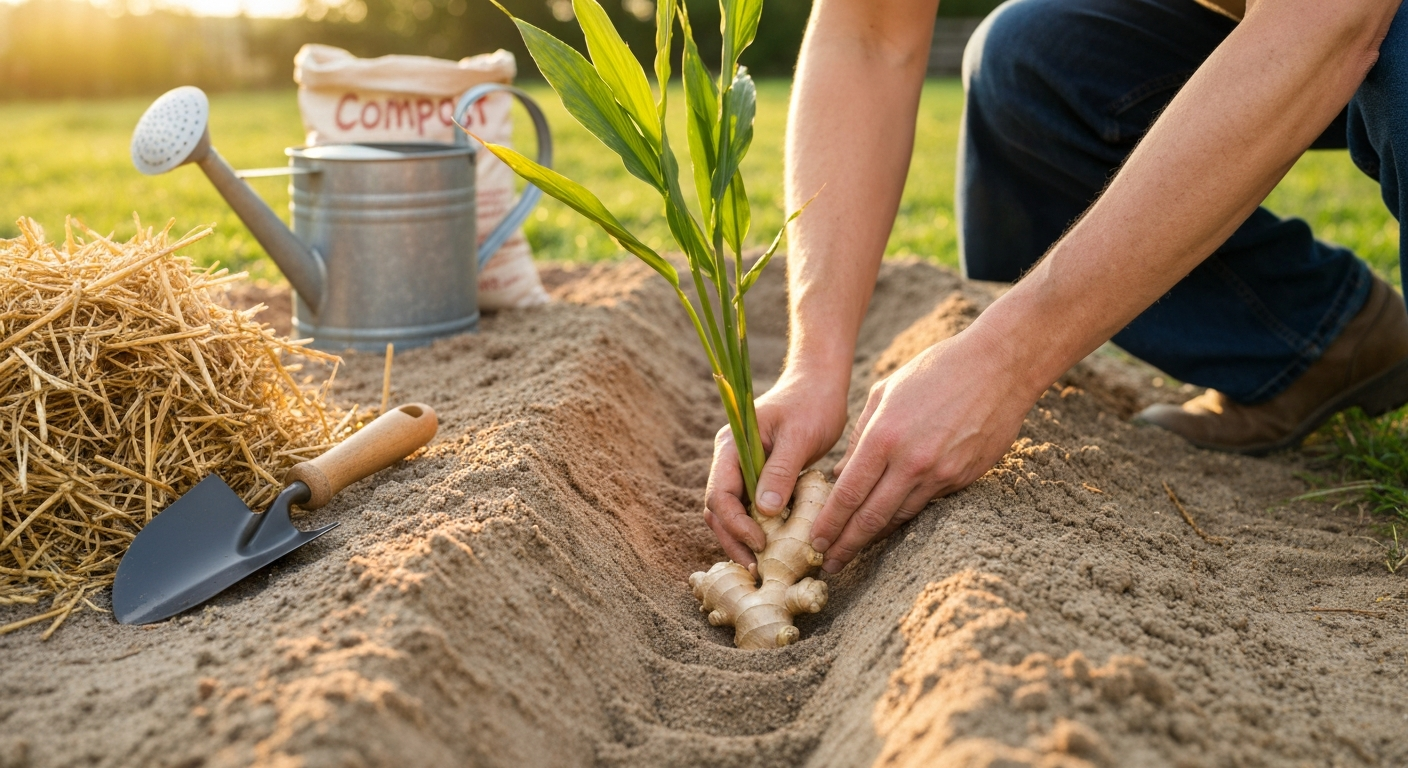
- Form shallow planting furrows 4-6 cm (about 1.5-2.5 inches) deep, spaced 25-30 cm apart. Ginger rhizomes are planted shallow, not deep.
- Set seed rhizome pieces in the furrow with growth buds facing upward. Space pieces 15-25 cm apart within the row.
- Cover lightly with the amended mix, firm gently, and water in.
- Apply a 5-8 cm layer of straw or shredded leaf mulch immediately. In sandy soil, mulch is not optional. It cuts surface evaporation dramatically, moderates soil temperature, and adds organic matter as it breaks down. Refresh it mid-season if it thins.
Container and raised-bed mixes for sandy locations
If your in-ground sand is too salty, too compacted, or too far gone to amend easily, containers and raised beds are the right move. I've had better results from a well-built raised bed on a sandy site than from any in-ground planting I've done in pure coastal sand. The controlled mix gives you consistent drainage without the unpredictability of native sandy soil.
Tested mix recipes
Research trials have actually published quantitative substrate recipes for ginger, which takes some of the guesswork out. The mix that consistently produced high rhizome yields in controlled trials was cocopeat to coarse sand at a 75:25 ratio by volume. That ratio gives you the moisture retention of coir with just enough drainage structure from the sand. Another propagation-tested mix is poultry compost, peat, and perlite at 2:1:1 by volume, which is richer in nutrients and works well if you're starting from scratch rather than working with existing sandy soil.
- Mix A (moisture-retentive, good for dry/hot climates): 75% cocopeat, 25% coarse horticultural sand by volume
- Mix B (nutrient-rich, good for propagation and container growing): 2 parts aged poultry or worm compost, 1 part peat or coir, 1 part perlite
- Mix C (in-ground sandy bed amendment): existing sandy soil amended to 70-75% native sand, 25-30% quality compost by volume
Container size and drainage setup
Research on pot size for ginger is pretty clear: bigger is better. Studies using 12-15 kg of substrate (roughly 12-20 liters of volume) produced significantly higher rhizome yields than smaller pots. The practical minimum for a productive harvest is a 15-20 liter container, and deeper is more important than wide. Ginger rhizomes develop at 16-20 cm depth, and the substrate needs to be at least 30 cm deep to give them room to spread plus working space above. A tall nursery pot or a deep planter box works better than a wide, shallow bowl. Always choose containers with multiple drainage holes. In a sandy or fast-draining mix, drainage isn't usually the problem, but blocked holes can create a wet layer at the base that leads to rhizome rot.
Growing ginger from rhizomes: selection, chitting, and planting
Whether you're working with sandy in-ground beds or a container mix, the rhizome you start with sets the ceiling for what you'll harvest. This section covers the full process from selecting your seed piece to getting it in the ground. And yes, to answer one of the most common questions I get: ginger root will regrow, provided it has at least one viable bud and you give it the conditions it needs. See the will ginger root grow section for a focused guide on sprouting and planting ginger root. For a related question, see the discussion on whether ancient seeds can grow on Ginger Island can ancient seeds grow on Ginger Island.
Picking the right seed piece
You can use grocery store ginger root if you can't find certified seed rhizomes, but buy organic if possible since conventional ginger is sometimes treated with sprout inhibitors. Look for pieces that are plump and firm, not shriveled, with clearly visible growth nodes or 'eyes,' those slightly lighter-colored, rounded bumps on the surface. Seed rhizome size matters more than most growers realize. Studies used seed pieces ranging from 25 to 200 grams, and larger pieces consistently produced better early vigor and higher yields. Aim for pieces around 40-60 grams, roughly the size of a large thumb segment, as a practical target for home growers.
Chitting (pre-sprouting) before planting
Chitting means encouraging the rhizome to sprout before you put it in the ground. It reduces time to emergence, confirms which pieces are viable, and gives you a head start especially in short-season climates. Place rhizome pieces in a shallow tray with a small amount of barely damp coir or peat around them, cover loosely with plastic, and keep them in a warm spot around 75-80°F (24-27°C). Check every few days. Sprouts typically appear in one to three weeks. Once shoots are 1-2 cm long, your pieces are ready to plant.
Curing cut pieces to prevent rot
If you're dividing a larger rhizome into planting pieces, allow the cut surfaces to air-dry and callus for one to two weeks before planting. This is especially important in sandy soil because exposed cuts in a fast-draining substrate can desiccate or get invaded by soil pathogens before roots establish. Virginia Cooperative Extension recommends this curing step, and in my experience skipping it is one of the most common reasons for early rot failures. Set cut pieces cut-side up on a clean dry surface at room temperature, away from direct sun, and leave them alone.
Planting technique in sandy beds
Plant at 4-6 cm depth (roughly 1.5-2.5 inches) with buds facing up. In very sandy soil, you can go slightly shallower, closer to 3-4 cm, because the loose medium doesn't support deep planting well and rhizomes tend to push upward as they grow anyway. Space plants 15-25 cm apart in rows 25-30 cm apart. After planting, water gently but thoroughly, and then mulch immediately. In sandy soil the mulch layer does a disproportionate amount of the moisture retention work in the first few weeks before the canopy fills in.
Watering and fertilizing a sandy ginger planting
In sandy soil, ginger needs more frequent watering than in loam. The goal is to keep the root zone near field capacity without waterlogging it. Field trials on sandy loam using irrigation-to-evaporation ratios around 0.9-1.2 produced the best rhizome yields. For home growers without evaporation gauges, a useful practical rule is to water when the top 2-3 cm of soil feels dry to the touch, which in hot weather on a sandy site can mean every one to two days. A finger-probe test daily in the first month is not excessive. Morning watering is better than evening to reduce foliar disease risk.
Fertilize on a split schedule rather than one big dose, because nutrients leach out of sand quickly. A light application of balanced slow-release granular fertilizer at planting, followed by liquid feeding every two to three weeks once shoots emerge, gives you a more consistent supply than a single heavy amendment. Keep an eye out for yellowing between leaf veins, which usually signals nitrogen or magnesium deficiency, both common in sandy soils. A diluted seaweed or fish emulsion feed alongside your regular fertilizer helps supply the micronutrients that leach out fastest.
Regional considerations: where sandy soil is an asset and where it isn't
Climate zone shapes how much the sandy soil issue matters. See Can ginger grow in Southwest Nigeria for local climate- and soil-specific guidance on planting and managing ginger in that region. In the Gulf Coast states, Florida, Hawaii, and the humid subtropics, sandy soil combined with warm temperatures and reliable summer rain can actually create close-to-ideal conditions for ginger once you've addressed nutrients. Ginger can stay in the ground year-round in USDA zones 8 and warmer if mulched heavily.
In cooler northern regions, sandy soil's faster spring warm-up is a genuine plus, but the combination of cold, late frosts, and fast-draining substrate means growers need to start rhizomes indoors in March or April and move them out after last frost. New England growers on sandy coastal soils face both the short season and the salt risk, a difficult combination that usually makes containers or deeply amended raised beds the smarter choice over in-ground sandy planting. For detailed, region-specific advice on timing, frost protection, and salt management, see our guide on can you grow ginger in New England.
In the arid Southwest and high-altitude Rocky Mountain states, sandy soil combined with low humidity and hot afternoons creates severe moisture stress for ginger. Deep mulching, drip irrigation, and afternoon shade are all necessary in those settings. Containers with a moisture-retentive mix moved to a shaded patio may be easier than fighting in-ground conditions.
Overwintering ginger in sandy or container sites
In zones below 8, ginger won't survive winter in the ground. As foliage yellows in fall, reduce watering and let the soil dry somewhat to signal dormancy. Dig rhizomes before the first hard frost, brush off the sandy soil (it shakes off easily, which is actually one advantage of sandy ground), and store them in a breathable container with barely damp peat or coir in a cool, dark space around 50-55°F (10-13°C). Don't seal them in plastic, that causes rot. In spring, pull them out, check for viable buds, and either start chitting directly or pot them up to get a jump on the season before outdoor soil warms up.
Container growers have the simpler option of moving the whole pot indoors before frost. Cut the foliage back to a few centimeters, reduce watering to once every two to three weeks, and keep the pot in a frost-free room. Resume normal watering in late winter when you see new growth emerging from the rhizome surface.
Troubleshooting common sandy-soil ginger problems
| Problem | Likely Cause in Sandy Soil | Fix |
|---|---|---|
| No sprouts after 3-4 weeks | Soil too cold or too dry; non-viable rhizome | Check soil temp (needs >68°F); water more frequently; pre-chit next batch indoors |
| Yellowing leaves, weak growth | Nitrogen/magnesium leaching | Apply liquid fertilizer every 2 weeks; add Epsom salt (1 tsp/liter) if interveinal yellowing |
| Soft, rotting rhizomes at base | Overwatering in amended mix or blocked drainage | Improve drainage; let surface dry slightly between waterings; cure seed pieces before next planting |
| Stunted plants near coast | Salt stress from sandy soil EC above 2.0 dS/m | Test EC; flush bed with fresh water repeatedly; move to raised bed with clean mix |
| Plants dry out within a day of watering | Too much sand, insufficient organic matter | Top-dress with compost; increase mulch depth; switch to drip irrigation |
| Misshapen or shallow rhizomes | Compaction or shallow amended layer | Loosen to 35 cm next season; keep foot traffic off bed; check bulk density |
Is it worth growing ginger in sand? Honest expectations
If you amend well, mulch heavily, water consistently, and fertilize on a split schedule, you can get a very respectable ginger harvest from a sandy site. The extra work compared to a naturally loamy bed is real but manageable. Where I'd hesitate is in two situations: if your sandy soil is near a coast and tests above 2.0 dS/m for EC, the salt issue is an ongoing battle that may not be worth fighting when a raised bed with clean mix is an easy alternative. And if you're in a climate zone where summer drought is common and consistent irrigation isn't feasible, pure sand will stress your plants repeatedly and you'll get thin harvests.
For everyone else, sandy soil is a workable starting point. It drains well, it warms up fast in spring, rhizomes are easy to harvest without a pickaxe, and the amendment process is straightforward. Fix the moisture retention and the nutrient leaching, keep salt out of the equation, and ginger will grow for you. Worth trying if you can irrigate regularly and are willing to add compost and mulch. Worth skipping the in-ground route if you're dealing with coastal salt or serious summer drought, and opting for containers instead.
FAQ
Can you grow ginger in sand?
Yes — but with qualifications. Ginger will grow in sandy sites if the sand is coarse, washed, and amended to retain moisture and nutrients. Pure, fine, or salty beach sand usually causes problems (poor water retention, nutrient leaching, compaction or salt stress). Successful sandy-site production uses amended mixes, raised beds or containers, frequent but measured irrigation, and attention to salinity and organic matter.
Why is plain sand a poor medium for ginger?
Plain sand drains very quickly (high saturated hydraulic conductivity), holds little plant‑available water, and allows rapid nutrient leaching. Fine or rounded sands can compact and reduce rhizome development; beach sand can carry salts that cause physiological stress and yield loss. Those factors make establishment, steady growth and good yields difficult unless corrected.
What sand types are acceptable for growing ginger?
Use washed, coarse, horticultural or ‘sharp’ sand (angular, screened) — not beach sand or fine play sand. Washed coarse sand improves aeration and drainage without excessive compaction; it should be blended with moisture‑retentive components (compost, cocopeat, peat, or coir) and some perlite or vermiculite when needed.
How should I mix sand for planting ginger (container or raised bed recipes)?
Proven mixes: • Soilless/container: cocopeat (coir) : washed coarse sand = 75:25 (v:v). • Propagation/seedlings: poultry compost : peat : perlite = 2:1:1 (v:v:v). • For in‑ground sandy sites: incorporate 20–30% high‑quality compost by volume and topdress with organic matter, or build raised beds with ≥30 cm of amended substrate. Adjust fertilizer to replace leached nutrients.
What container size and depth do I need for ginger in sandy mixes?
Use containers or raised beds at least 30 cm deep (preferably 40–50 cm) and 10–20+ L (12–20 L is a practical minimum) per plant for good rhizome development. Larger volumes buffer moisture and nutrient swings and produce higher yields.
How deep and how far apart should I plant ginger rhizomes?
Plant shallow: about 4–6 cm (1.5–2.5 in) below the surface with growth buds facing upward. Space plants roughly 15–30 cm apart depending on container/bed size and desired yield (commercial spacing often 12–30 cm). In containers, typically one rhizome piece per 12–20 L pot.
Next Articles
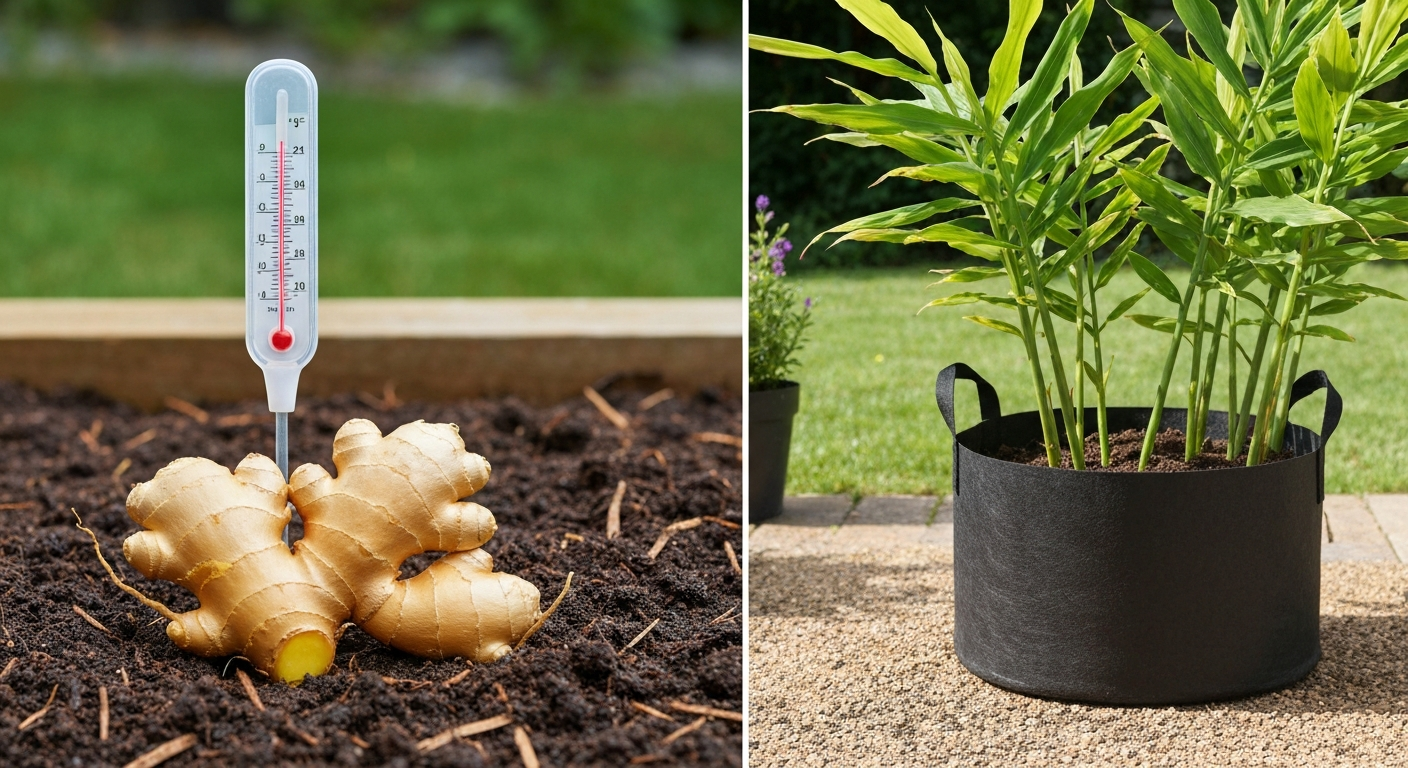
Will Ginger Root Grow? Zone-Based Guide for Home Gardeners
Will ginger root grow? Zone-by-zone verdict, how to force grocery rhizomes, containers, care and harvest.
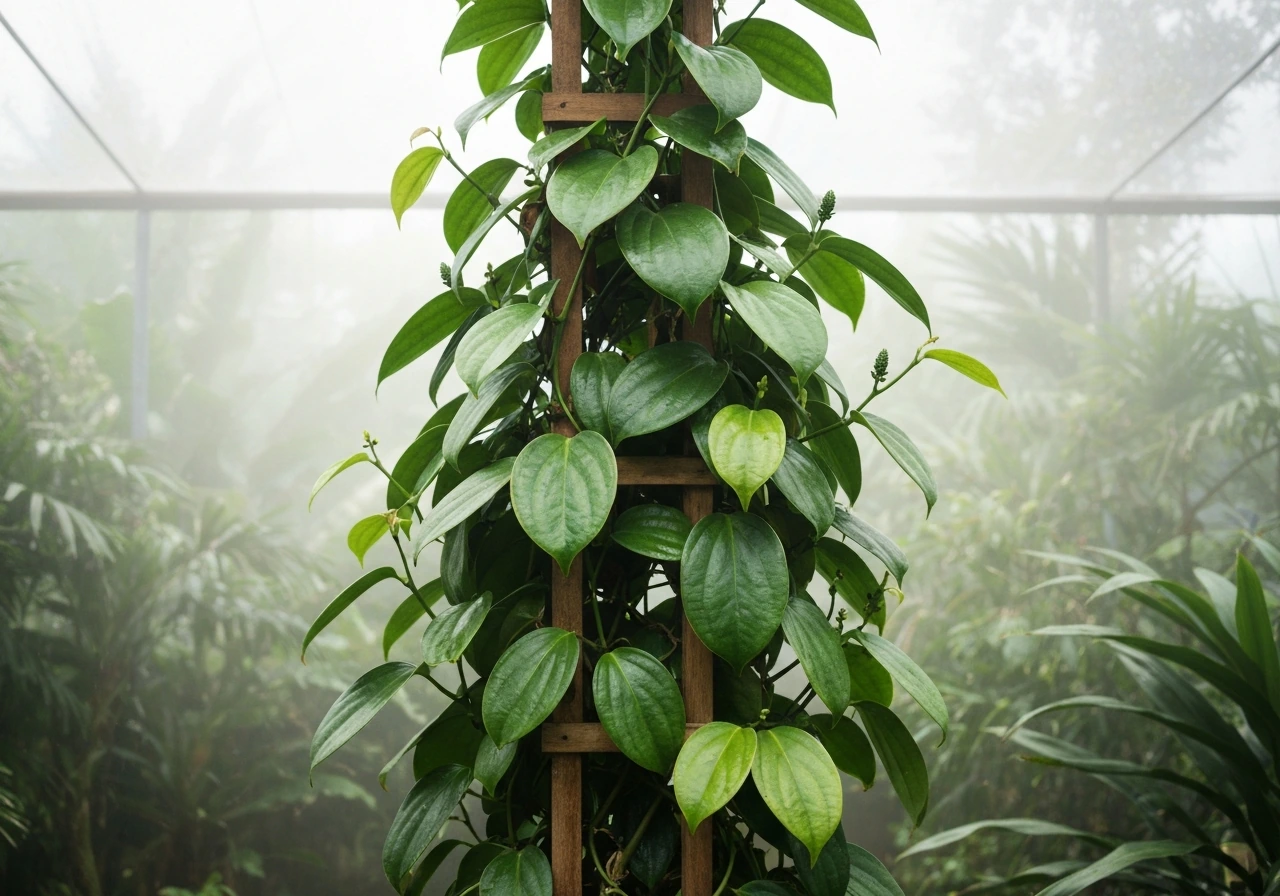
Can You Grow Black Pepper in the US Where and How
Learn where black pepper can be grown in the US and how to grow it indoors or in warm zones for fruit.

Can You Grow Capers in the US? Regional Guide for Home Gardeners
Regional guide to growing caper plants in the US, choosing cultivars, meeting soil and climate needs, and harvesting bud