
Yes, you can grow true wasabi (Eutrema japonicum) in Canada, but only in certain places and only if you're willing to meet its very demanding growing conditions. Southern coastal British Columbia, particularly the Lower Mainland and sheltered parts of Vancouver Island, is the one region where outdoor or semi-outdoor wasabi culture is genuinely realistic. Everywhere else in the country, you're looking at a greenhouse or indoor hydroponic setup, significant ongoing effort, and real costs. This isn't a plant you stick in the garden and check on occasionally. Wasabi is arguably the most finicky food crop a home gardener in North America can attempt.
Can You Grow Wasabi in Canada? Regions, Methods & Guide

Marcus Petersen
26 Jul 2026
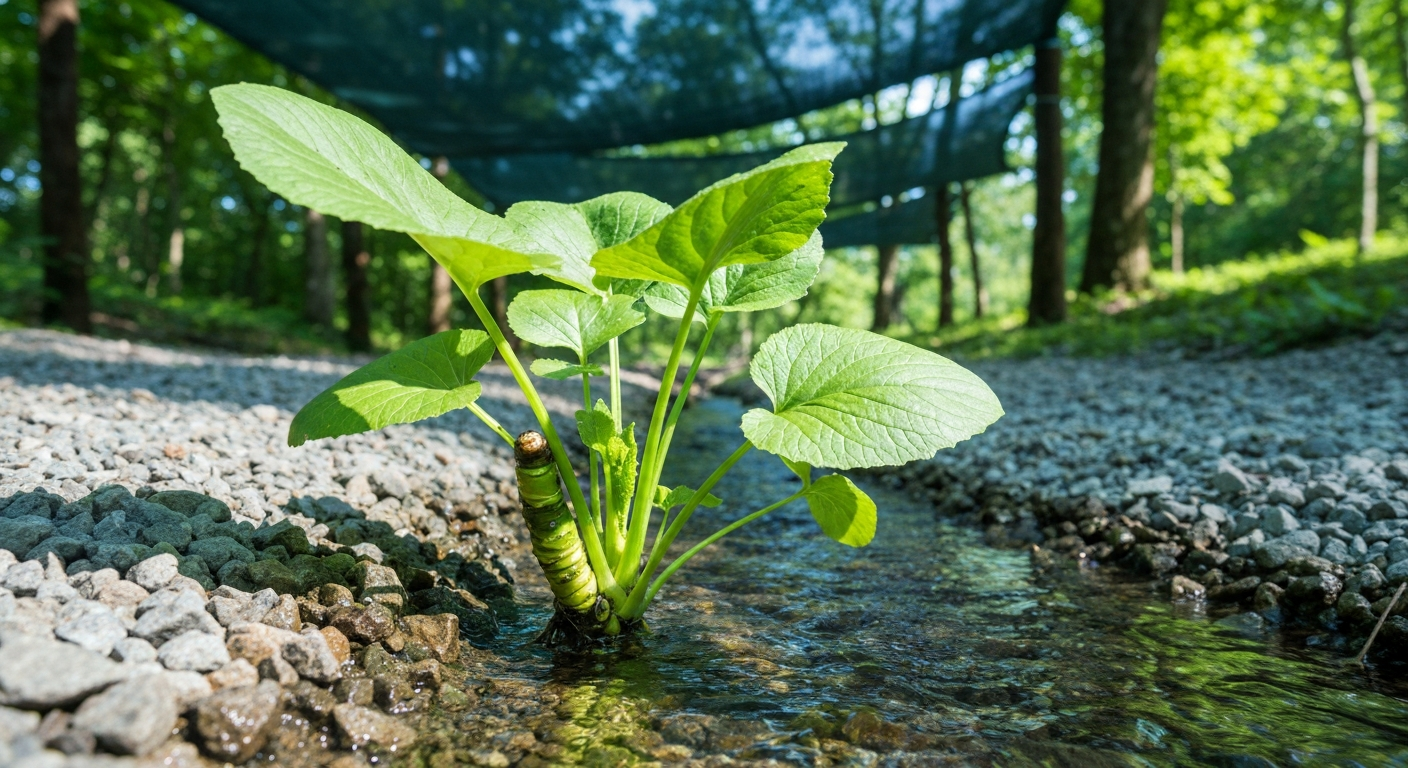
Who this guide is for
This guide is written for Canadian home gardeners and hobbyists who want a straight answer on wasabi feasibility, broken down by province and climate zone. It's also useful for U.S. readers comparing their situation to Canadian conditions, especially those in the Pacific Northwest or the northern tier of states. If you've come here from a related article on growing wasabi in the U.S. broadly, or are looking at how conditions in British Columbia compare to California or Hawaii, a lot of what follows will apply directly to your situation too. I'll walk through what wasabi actually needs, where in Canada those needs can realistically be met, which growing methods work best by region, and how to actually get plants in the ground (or into a hydroponic system). I'll also be honest about where this crop is simply not worth the trouble without major infrastructure.
Can you grow wasabi in Canada? A regional verdict
The single biggest factor is temperature. Wasabi's optimal air temperature range is roughly 8–18°C, with the sweet spot sitting around 12–15°C for both day and night. Hard freezes kill plants and hot summers (anything sustained above 20–22°C) cause serious heat stress. That range immediately tells you which parts of Canada are even in the conversation and which aren't. Environment and Climate Change Canada provides station‑level climate normals (1991–2020) and historical monthly/daily data that are the authoritative source for local mean monthly temperatures, frost dates, precipitation and humidity blank" rel="noopener noreferrer">Environment and Climate Change Canada provides station‑level climate normals (1991–2020) and historical monthly/daily data that are the authoritative source for local mean monthly temperatures, frost dates, precipitation and humidity..
| Region / Province | Outdoor Feasibility | Recommended Approach | Key Challenge |
|---|---|---|---|
| Coastal BC (Lower Mainland, S. Vancouver Island) | Yes, with effort | Shaded stream/rill bed, semi-hydroponic | Summer heat spikes; slug pressure |
| Interior BC (Okanagan, Interior valleys) | With effort / marginal | Greenhouse or spring-fed microsite with heavy shading | Hot summers, cold winters |
| Alberta | No (outdoors) | Heated/cooled greenhouse + hydroponics | Prairie extremes; cold winters, warm dry summers |
| Saskatchewan | No (outdoors) | Greenhouse + hydroponics only | Same as Alberta, more severe |
| Manitoba | No (outdoors) | Greenhouse + hydroponics only | Continental extremes |
| Southern Ontario | Marginal (season only) | Shaded container or greenhouse, overwinter inside | Freezing winters; humid summer heat |
| Southern Québec | Marginal (season only) | Greenhouse or sheltered container culture | Freezing winters; hot summer spells |
| Atlantic Canada (NS, NB, PEI, NL) | Marginal to unlikely outdoors | Greenhouse/hoop house with cool spring-fed rill if available | Hard freezes; short cool windows |
| Territories (YT, NT, NU) | No (outdoors) | Controlled environment only (significant cost) | Extreme cold; limited light |
The bottom line: coastal BC is the only region where a dedicated home gardener can seriously attempt outdoor or semi-outdoor wasabi without building a full climate-controlled greenhouse. Environment and Climate Change Canada climate normals for Kelowna (Kelowna (station) historical climate / normals, Environment and Climate Change Canada) show hotter summers and colder winters than coastal BC, which helps explain why interior Okanagan sites typically need artificial cooling, shading, or protected microclimates for wasabi to succeed blank" rel="noopener noreferrer">Kelowna (station) historical climate / normals — Environment and Climate Change Canada. Every other province can grow it, but you're essentially building a small climate chamber for one plant.
What wasabi actually is, and why it's so hard to grow
True wasabi (Eutrema japonicum, also listed in older literature as Wasabia japonica) is a semi-aquatic perennial in the Brassicaceae family, native to cool, shaded mountain stream valleys in Japan. The part you eat is the rhizome, a thick green stem that takes 18 months to 2 years to reach harvestable size. The leaves and leaf stems are also edible and pungent. In the wild, plants grow in gravel beds with cold, constantly flowing spring water, under a canopy of riparian forest. That's not a metaphor for what it prefers. That is literally the microhabitat it evolved for, and anything less requires you to artificially recreate those conditions.
Commercial Japanese wasabi farms, like the famous Daio Wasabi Farm in Azumino, Nagano, rely on spring water that stays around 13–14.5°C year-round regardless of air temperature. That constant cool, clean, oxygenated flow is the foundation of commercial production. Most Canadian gardeners don't have access to a natural spring, which is why the vast majority of successful wasabi grown in BC uses hydroponic or semi-hydroponic systems rather than open soil or true stream culture. A 2003 M.Sc. survey of BC commercial wasabi production documented exactly this, finding that river rock, rockwool, and other soilless media with overhead shade and misting were the dominant commercial approaches.
The growing conditions wasabi demands
Temperature
This is non-negotiable. Optimal air temperature is 8–18°C, with 12–15°C being ideal. Prolonged temperatures above 20°C cause plants to bolt, weaken, and die. Sustained freezes (below about -3 to -5°C at root level) will kill the rhizome. In a stream or rill system, water temperature is actually more critical than air temperature: you want water at 10–18°C, ideally around 13–14°C, and it needs to stay there. If your tap water comes out at 20°C in August, you have a serious problem.
Light and shade
Wasabi is a shade plant. In nature it grows under closed riparian canopy. In cultivation, most growers target 50–80% shade, depending on latitude and season. In coastal BC, dappled shade from deciduous trees can work well in spring and fall. During summer, you'll likely need supplemental shade cloth (50% or 70% density) to keep temperatures down even in coastal areas. In sunnier inland or prairie greenhouse setups, aggressive shading is mandatory.
Humidity and air circulation
High ambient humidity helps, but stagnant moist air encourages fungal disease, which is a real and well-documented problem for BC wasabi growers. You want humidity without stagnation: gentle air movement, good spacing between plants, and overhead misting systems timed to cool the environment rather than soak the foliage. In a greenhouse, a small fan running on a timer alongside periodic misting is the standard approach.
Water quality and delivery
Wasabi is extremely sensitive to water quality. You need cool water (10–18°C), neutral to slightly acidic pH (6.0–6.8), very low chlorine, low dissolved salts (low electrical conductivity), and good dissolved oxygen. Municipal tap water needs to be dechlorinated before use. In a recirculating hydroponic system, you'll want to monitor pH and EC regularly. In a stream or rill, the constant flow provides natural oxygenation; in a closed recirculating system, an air stone or venturi injector keeps dissolved oxygen up. Analogous stream crops like watercress are managed targeting dissolved oxygen above 5–6 mg/L, and wasabi growers use similar targets.
Soil and substrate
For soil-based beds, you want loose, high-organic loam with excellent internal drainage, pH 6.0–7.0, and consistent moisture retention without waterlogging. Compost amendment is standard. For stream culture, coarse river gravel is the traditional medium. For hydroponic setups, river rock, pea gravel, or rockwool are common. Whatever you use, the roots must stay cool and consistently moist, never waterlogged and never dried out.
Choosing a site and microclimate in a Canadian garden
In coastal BC, the ideal outdoor site is a north-facing or east-facing slope, naturally shaded by mature trees, with access to a cool water source. A stream-side location along a spring-fed creek is the gold standard. Failing that, a shaded raised bed along the north side of a building, away from reflected heat off walls or pavement, with a drip or trickle irrigation system fed from a cool-water source, is the next best option. Avoid south-facing positions and anywhere that gets direct afternoon sun in summer.
For every other province, microclimate selection shifts from optimizing outdoor conditions to choosing where to put a structure. In Alberta, Saskatchewan, Manitoba, and the territories, you're picking a greenhouse location: good access to power and water, ideally on the north side of a windbreak to reduce heating load in summer, with enough roof height for shade cloth installation. In southern Ontario and Quebec, a shaded patio or balcony with container plants can work for the cooler months of May through September, but you will need to overwinter plants indoors.
One thing I've found helpful when scouting sites: check the soil temperature at 10 cm depth in mid-July. If it's consistently above 18°C, the site is too warm for outdoor wasabi without substantial intervention. In coastal BC, many north-facing garden beds with good organic mulch will stay comfortably below that threshold through the summer.
Growing methods that actually work in Canadian conditions
Stream and rill beds (coastal BC only)
This is the traditional Japanese method and the closest to how wasabi naturally grows. A shallow gravel bed is fed with a constant flow of cool, clean water. Plants are set into the gravel with roots in the flow. The water both cools the root zone and delivers oxygen. In coastal BC, this is feasible if you have access to a spring, year-round creek, or a gravity-fed water source that stays cool in summer. Most home gardeners don't have this, which is why it's the most authentic method but also the least commonly used at the residential scale. If you do have a spring or cool stream on your property, this method produces the best rhizome quality and most closely mirrors commercial Japanese production.
Shaded raised beds (coastal BC, marginal regions)
A raised bed 30–45 cm deep, filled with amended loam or compost-rich growing mix, placed in heavy shade and kept consistently moist via drip irrigation, is the most practical outdoor method for coastal BC home gardeners. This works well from March through October in the Lower Mainland and southern Vancouver Island. You'll need to insulate or mulch the bed deeply for winter and may want to move plants to a protected location if a hard freeze is forecast. In southern Ontario and Quebec, this same setup works during the cooler shoulder seasons, but the bed must be emptied or plants moved inside before hard frost.
Containers (all regions)
Large containers (20–30 liters minimum per plant) work well and offer the advantage of mobility. In summer, move them to a shaded, cool spot. In winter, move them indoors to a cool basement or unheated garage that stays above freezing. Containers dry out faster than beds, so you need to water frequently, and they heat up quickly in sun, so shade placement is critical. I've had the best results with unglazed terracotta-style containers or fabric pots, which breathe and moderate temperature swings better than plastic.
Greenhouse and indoor hydroponic systems (all regions, required for most of Canada)
A controlled environment is the only reliable method for the prairies, territories, and a smart backup option everywhere else. Controlled-environment nutrient-solution cultivation has been shown in peer-reviewed research to support wasabi growth to around 60 g of rhizome tissue within approximately two years when water temperatures are maintained in the 13.5–18°C range. For home growers, a small greenhouse with a water chiller on the reservoir, shade cloth over the growing area, a humidity sensor, and a small fan for air movement is the standard setup. Indoor grow rooms with artificial lighting work too, but you'll need to cool the light energy coming off your fixtures, which adds to the complexity and cost. Deep water culture or nutrient film technique (NFT) systems with chilled reservoirs are the most common hydroponic configurations.
Equipment and setup details
- Shade cloth: 50% density for spring/fall in coastal BC; 70% for summer or any inland/greenhouse situation. Polypropylene woven shade cloth is durable and inexpensive.
- Water delivery: drip irrigation for raised beds; recirculating pump (submersible, 500–1000 L/hr for a small system) for hydroponic setups; gravity feed for stream/rill systems. Use a timer to run irrigation cycles if not using a constant-flow design.
- Water chiller: for greenhouse or indoor hydroponic systems outside coastal BC, a small aquarium or nutrient-solution chiller (units designed for 200–500 L reservoirs are available from aquaculture suppliers) is essential to keep root zone water below 18°C in warm months.
- Beds: standard cedar or composite raised bed frames work fine; line with landscape fabric, not plastic sheeting, to allow some drainage. For stream/rill beds, you need a waterproof liner (EPDM pond liner is common) with a gentle slope of 1–2% and a return pump to recirculate.
- Containers: 20–30 L minimum; fabric pots or breathable containers preferred. Avoid dark-colored containers that absorb heat.
- Humidity control: overhead misting nozzles on a timer (set for brief 15–30 second cycles every 1–2 hours in warm weather); a hygrometer to monitor; small oscillating fan to prevent stagnation.
- pH and EC meter: necessary for hydroponic systems. Target pH 6.0–6.8, low EC (under 1.0 mS/cm for most wasabi growers).
- Thermometer with probe: monitor root zone or water temperature separately from air temperature. This is the most important measurement you can take.
Propagation and planting: how to actually get wasabi growing
Getting plant material in Canada
This is often the first practical stumbling block. True wasabi is not available at your local garden center. In Canada, your options are specialty herb nurseries (a handful in BC carry wasabi starts, usually available in late winter or early spring), online suppliers who ship tissue-cultured plugs, or wasabi crowns/offsets from a grower contact. Seeds are available online but are less reliable for home growers, and germination rates are inconsistent. Tissue-cultured plants are the gold standard: they're disease-free, genetically consistent, and establish quickly. Expect to pay $15–30 CAD per plant from specialty suppliers, more for named cultivars.
Seed propagation
If you go the seed route, wasabi seeds require cold stratification before they will germinate reliably. Sow seeds in moist seed-starting mix, seal the tray in a plastic bag, and refrigerate at 4–6°C for 4–6 weeks. After stratification, move to a cool location (10–15°C) with indirect light. Germination is slow and patchy; expect 30–60 days. Seedlings are delicate and benefit from a cool, humid propagation environment. Given the time and uncertainty involved, seeds are best used by gardeners who want to experiment rather than those trying to get a harvestable rhizome as efficiently as possible. Clonal propagation is faster and more predictable.
Crown division and offsets
Established wasabi plants produce lateral offsets (small side shoots) from the base of the main rhizome. These can be detached when they're 5–8 cm long and have at least two or three visible leaf nodes. Use a clean, sharp knife, dust the cut surface with a light application of powdered sulfur or cinnamon as a natural antifungal, and pot the offset immediately into moist substrate. Keep it in a cool, shaded, humid spot for 2–3 weeks while it establishes roots. Crown division (splitting a mature rhizome) follows the same process: each division should have at least one healthy growing tip and some root mass attached.
Tissue-cultured plugs
Tissue-cultured wasabi plugs arrive in small containers with established root systems. They need an acclimatization period before going into a permanent system: keep them in a cool (12–15°C), shaded, humid environment for 1–2 weeks, gradually increasing air circulation. Transition them slowly from the agar-like culture medium to your soil or hydroponic substrate. Avoid direct transplant from sterile lab conditions to an outdoor bed in full production mode; the shock can set plants back significantly.
Planting step-by-step
- Prepare your substrate: for soil beds, mix equal parts aged compost and coarse perlite into your loam to a depth of 30 cm. For hydroponic systems, rinse river rock or other media thoroughly and prime your reservoir with dilute nutrient solution at pH 6.2–6.5.
- Soak your plants or offsets in a dilute seaweed solution (1 tsp per 4 L of water, room temperature) for 30 minutes before planting to reduce transplant stress.
- Dig or create a planting pocket large enough to accommodate the root mass without bending or cramping roots. In gravel/rill systems, nestle the root crown into the gravel so the growing tip sits just at or slightly above the surface.
- Set plants so the crown (the junction of roots and stem) is at or just above the substrate surface. Burying the crown too deep is one of the most common causes of rot in wasabi.
- Space plants 30–45 cm apart. Wasabi leaves spread outward significantly at maturity; crowded plants compete for light and air circulation.
- Water in well with dechlorinated, pH-adjusted water. In hydroponic systems, start nutrient flow immediately at low concentration.
- Apply a layer of coarse bark mulch or wood chip mulch around outdoor bed plants (not directly against the crown) to retain moisture and moderate soil temperature.
- Install shade cloth immediately if not already in place. Do not leave newly planted wasabi in direct sun, even for a few hours.
Timing and spacing summary
| Propagation method | Best planting window (coastal BC) | Best planting window (greenhouse/indoor) | Plant spacing | Time to harvestable rhizome |
|---|---|---|---|---|
| Tissue-cultured plug | March–April or September–October | Any time (climate controlled) | 30–45 cm | 18–24 months |
| Crown offset (rooted) | March–May or September | Any time | 30–45 cm | 18–24 months from offset |
| Seed (stratified) | February (indoors), transplant April–May | January–February indoors | Thin to 30–45 cm | 24–30 months from seed |
Care, pests, and common problems
Wasabi in Canada faces a specific roster of problems. Fungal pathogens are the most serious: Phytophthora, Fusarium, and Pythium root rots have all been documented in BC commercial operations. The keys to prevention are well-oxygenated water or well-draining substrate, good air circulation, and avoiding overwatering. Slugs are a persistent outdoor pest in coastal BC and will shred wasabi leaves overnight. Copper tape around bed edges and evening patrols with a flashlight are the most effective controls I've found. Aphids and cabbage loopers (the plant is in the Brassicaceae family) can also be an issue; insecticidal soap handles both.
Heat stress shows as yellowing or bleaching of leaves, wilting despite adequate water, and eventually plant collapse. If you see this in summer, you need more shade and cooler water immediately; there's no recovering a plant once the rhizome cooks. Cold damage at the other extreme shows as blackening of petioles and mushy leaf bases. Outdoor plants in coastal BC should be mulched heavily in November and either covered with frost cloth or moved to shelter if hard frost is forecast. In every other province, controlled-environment plants need their heating system checked before fall.
Harvest timeline and what to expect
Plan on 18–24 months from planting a healthy offset or tissue-cultured plug to a harvestable rhizome. Seed-grown plants take closer to 24–30 months. A well-grown home garden plant in coastal BC will produce a rhizome of roughly 30–80 g, with leaves and petioles harvestable at any time from about 6 months onward. Commercial Japanese rhizomes sold in markets typically weigh 100–200 g and have been cultivated for 2–3 years under optimal spring-water conditions. Don't expect restaurant-quality rhizomes from a first-attempt home garden; the flavor and heat will be real, but the size will likely be modest.
Harvest by cutting the rhizome at or just below the substrate surface. The plant often continues to produce offsets after harvest, so you can get a second crop from the same root system. Freshly harvested rhizome should be grated immediately before serving for maximum pungency; the volatile compounds that create wasabi's heat dissipate within 15–20 minutes of grating.
Cost and effort: a realistic picture
For coastal BC in a shaded raised bed: startup costs are modest, perhaps $50–150 CAD for bed materials, shade cloth, and initial plants. Ongoing cost is mainly water and time. The effort level is moderate but consistent: you need to check water temperature, moisture, and plant health at least twice a week during the growing season. For a greenhouse or indoor hydroponic system in any other province: expect to spend $500–2,000+ CAD on infrastructure (greenhouse film or panels, shade cloth, water chiller, pump, reservoir, hydroponic media) before you've bought a single plant. Running costs for heating and cooling a greenhouse in Alberta or Manitoba through a full year are not trivial. I wouldn't recommend this path unless wasabi specifically fascinates you, because there are easier ways to spend that money.
Easier alternatives if wasabi feels too demanding
Horseradish (Armoracia rusticana) is the most practical alternative for most Canadian gardeners. It's in the same family, produces a pungent rhizome, grows vigorously across all provinces without special conditions, and is genuinely cold-hardy to zones 3–4. It doesn't taste identical to wasabi, but it produces that same glucosinolate heat. If you want a plant that's low maintenance, reliably harvestable every year, and grows in a basic garden bed from Manitoba to Nova Scotia, horseradish is your answer. Wasabi arabashiri, a cultivated variety sometimes marketed as ornamental wasabi or 'horseradish wasabi hybrid', is also available from some specialty nurseries and tolerates a wider temperature range than true wasabi, though the rhizome quality and flavor are noticeably different.
How Canada compares to U.S. wasabi-growing regions
If you've been reading up on growing wasabi in the U.S. Pacific Northwest or are comparing your BC situation to California, the picture is broadly similar: coastal Washington and Oregon offer comparable conditions to coastal BC, and the methods that work there translate almost directly across the border. For detailed guidance specific to California's climates and microclimates, see can you grow wasabi in California. Hawaii's situation is quite different: its year-round warmth makes wasabi cultivation in lowland areas impractical, while higher-elevation sites are more promising. For a focused discussion of elevation, microclimate, and methods for Hawaiian growers, see Can you grow wasabi in Hawaii Can you grow wasabi in Hawaii?. Michigan's situation, with its Great Lakes-moderated climate and cool humid summers, sits somewhere between coastal BC and southern Ontario in terms of feasibility, and container or greenhouse methods dominate there as well. For a focused look at feasibility and methods specific to the Great Lakes region, see can you grow wasabi in Michigan. For BC gardeners especially, the Pacific Northwest experience is your most directly applicable reference point. For related guidance specific to growing wasabi in the United States, see can you grow wasabi in the us.
Is it worth trying?
If you're in coastal BC with a shaded north-facing bed, access to cool water, and genuine interest in the challenge, yes, absolutely worth trying. You'll likely succeed well enough to harvest real wasabi rhizome within two years, and the process is genuinely interesting. If you're in any other Canadian province and don't already have greenhouse infrastructure, honestly weigh whether the infrastructure cost and ongoing management justify it versus growing horseradish and enjoying that instead. If you already have a greenhouse for other crops, adding wasabi to a cool corner of it is very reasonable. If you're starting from scratch in Calgary or Winnipeg just to grow wasabi, the math is hard to make work for a home gardener.
FAQ
Can true wasabi (Wasabia/Eutrema japonicum) be grown in Canada at all?
Yes — but usually “with effort.” True wasabi can be grown in Canada where cool, stable temperatures, high humidity and cool water are available. Southern coastal British Columbia (Lower Mainland, southern Vancouver Island and sheltered coastal valleys) offers the most favorable outdoor/semiexposed microclimates and natural spring sites. Elsewhere (interior BC, Prairies, Ontario/Québec, Atlantic provinces, territories) successful production is possible but normally requires controlled environments (greenhouse, shadehouse, hydroponic/soilless systems or indoor cultivation with cooling and humidification) and careful site selection.
Which Canadian provinces/regions are realistic for outdoor or low‑tech wasabi culture?
Best (outdoor/low‑tech feasible): Southern coastal British Columbia — Vancouver, Sunshine Coast, southern Vancouver Island, some sheltered Gulf‑island valleys. Possible with effort: sheltered pockets in coastal British Columbia’s inland valleys. Marginal/outdoor impractical: interior BC (Okanagan valleys), Prairies (AB, SK, MB), most of Ontario and Québec, and the territories due to hot summers and/or severe winters; these regions need greenhouse or indoor systems for reliable results. Atlantic Canada: may be feasible in sheltered micro‑sites near cool springs but generally requires protected culture (hoop house/greenhouse).
What microclimate conditions does wasabi need (temperature, shade, humidity, water quality)?
Ideal air temperatures: roughly 8–18 °C, with many guides narrowing daytime optimal to ~10–15 °C. Shade: 70–90% diffuse shade (dappled woodland light or shadecloth) to prevent leaf/scorch stress. Humidity: consistently high relative humidity (keep leaf and root zone moist). Water: cool (≈10–18 °C), well‑oxygenated, low‑chlorine, low‑salinity water; neutral to slightly acidic pH (~6.0–6.8). Substrate: coarse gravel/riverbed for stream culture or loose, high‑organic loam with excellent drainage and steady moisture for soil plantings. Continuous flow or constant moisture is critical for stream/rill culture.
What are the recommended growing methods for Canadian gardeners?
Options ranked by suitability: 1) Stream/rill (spring‑fed) beds — ideal where a stable cool spring exists: gravel beds with steady flow and shade. 2) Semi‑hydroponic/river‑rock beds in shaded outdoor settings — mimic spring conditions when natural flow unavailable. 3) Containers with insulated liners and evaporative cooling or buried containers to keep root zone cool — for small gardeners. 4) Greenhouse/hydroponic systems with active cooling, shade cloth and humidification — most practical outside coastal BC or for year‑round production. 5) Indoor controlled environment (grow room) with air/water cooling and humidity control for hobbyists or small commercial.
Step‑by‑step planting and propagation for hobbyists (practical sequence)
1. Source plants: order verified rhizome divisions, tissue‑culture starts or potted plants (avoid inexpensive seeds if you want predictable results). 2. Site or container prep: pick shaded, cool site or prepare greenhouse; for stream beds use coarse gravel with flow, for containers use loose, moisture‑retentive mix and keep roots cool. 3. Planting: space crowns 30–45 cm apart; bury rhizome so growing point is at or slightly below soil surface. 4. Water: provide continuous cool water or keep substrate consistently moist; avoid flooding that smothers roots but ensure steady moisture. 5. Shade: install 70–90% diffuse shade. 6. Nutrition: low‑to‑moderate feeding; avoid high salt fertilizers. 7. Monitor: check water temperature, pH, DO (for flow systems) and watch for heat stress. Vegetative division (offsets) is fastest; tissue culture gives clean starts.
Typical timeline to harvest and expected yields for Canadian hobbyists
Time to usable rhizome: commonly 12–24 months from planted divisions under favorable conditions. In controlled hydroponic systems with optimized conditions, rhizomes can reach marketable size within ~18–24 months; some research shows small rhizome tissue growth earlier under ideal controlled conditions. Yield per plant varies widely: hobby plants often produce 50–250 g rhizome after 1–2 years; commercial yields and selected cultivars can be higher under optimized systems. Expect slower growth in marginal climates without rigorous environmental control.
Next Articles
Can You Grow Wasabi in California? How to Succeed
Yes, you can grow wasabi in California with shade, cool temps, steady moisture, and container or greenhouse care.
Can You Grow Wasabi in the US? How to Start
Yes, with cool shade and constant clean moisture. Learn US regions to try, container setup, care, and realistic harvest
Can You Grow Black Pepper in the US Where and How
Learn where black pepper can be grown in the US and how to grow it indoors or in warm zones for fruit.