
Yes, ghost pipe (Monotropa uniflora) does grow in Missouri. The Missouri Department of Conservation describes it as scattered nearly statewide but nowhere common, which is a pretty accurate summary of what you can expect: it shows up in the right conditions across many counties, but you won't stumble across it every time you walk into the woods. It is a native species with documented herbarium records from counties across the state, including Jefferson, Laclede, St. Charles, and Douglas counties, with confirmed bloom times running from late summer into October.
Does Ghost Pipe Grow in Missouri? Habitat, ID, and Care Tips

Marcus Petersen
23 Jul 2026
What ghost pipe actually is (and why it behaves nothing like a normal plant)
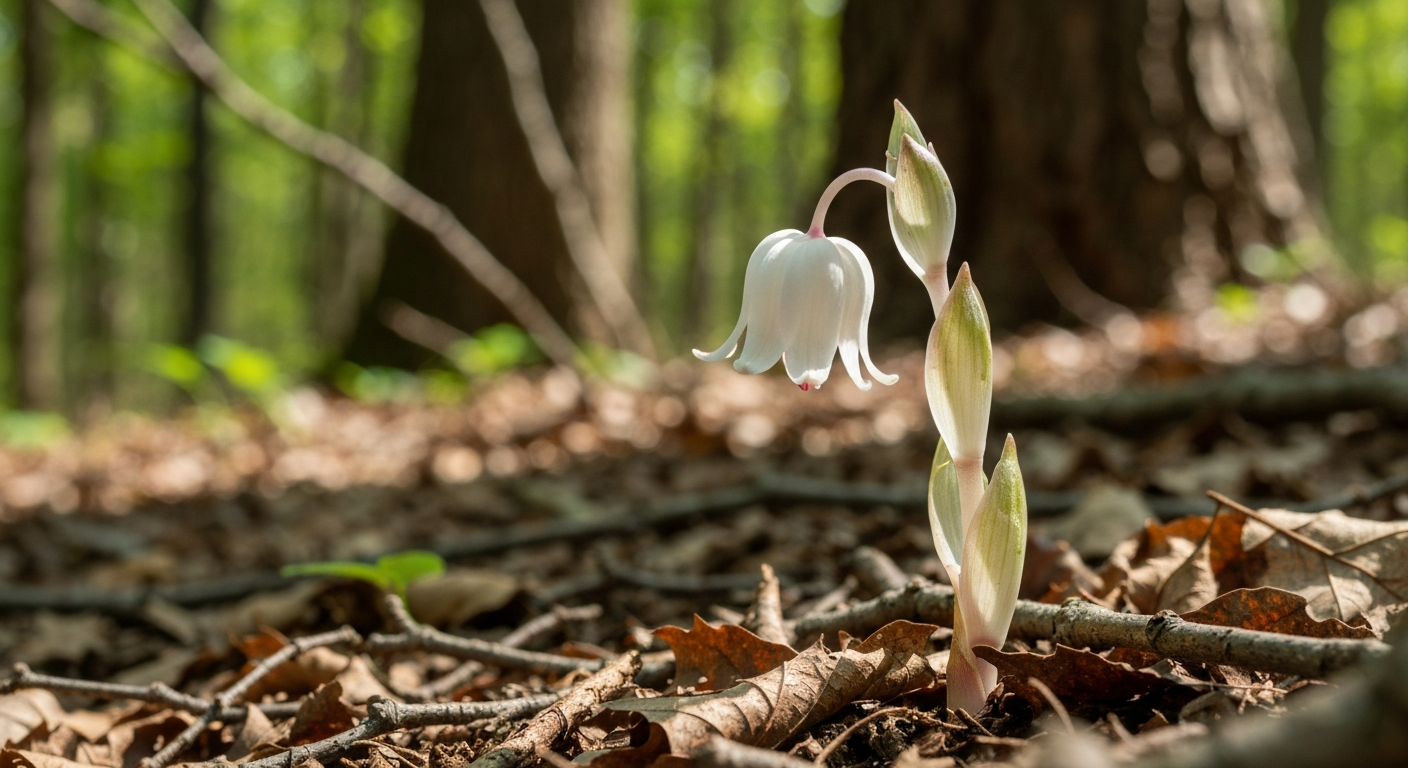
Ghost pipe looks like something a plant illustrator invented for a fairy tale: a waxy, translucent-white stalk with a single nodding flower, no green parts anywhere. That absence of green is the whole story. Ghost pipe contains no chlorophyll and does no photosynthesis at all. Instead, it is mycoheterotrophic, meaning it parasitizes fungi to get its energy. Specifically, it taps into ectomycorrhizal fungi, primarily members of the Russulaceae family (Russula and Lactarius species), that are themselves connected to the root systems of nearby trees. So ghost pipe is not just living on a fungus, it is living on a fungus that is living on a tree. The plant essentially steals carbon from that three-way network without contributing anything back. The molecular ecology research is unambiguous on this: M. Bidartondo & Bruns (2002), molecular evidence for mycorrhizal specificity in monotropoids (Molecular Ecology) demonstrated that Monotropa uniflora associates with specific ectomycorrhizal fungi Bidartondo & Bruns (2002) — molecular evidence for mycorrhizal specificity in monotropoids (Molecular Ecology). uniflora relies on specific ectomycorrhizal fungal partners, and different populations may associate with different Russulaceae species depending on what is locally available in the soil.
This biology is the reason ghost pipe is not a garden plant in any conventional sense. It has no leaves to photosynthesize, no ability to survive in isolation, and no tolerance for being separated from the fungal network it depends on. Every attempt to treat it like a wildflower you can dig up and relocate is fighting against its entire life strategy.
How to identify ghost pipe in the field
Ghost pipe is one of the more distinctive plants you will find in a Missouri woodland, once you know what to look for. The key features are consistent and reliable.
- Entire plant is white to pale pinkish-white, waxy and slightly translucent, with no green coloration anywhere
- One flower per stem, nodding downward like an upside-down pipe bowl when fresh, turning upright as the fruit matures
- Stems typically reach up to about 8 inches tall, with scale-like leaves rather than true photosynthetic leaves
- Petals number 3 to 6, most often 4 to 5 on Missouri material
- The whole plant turns pink to purple and then darkens to near-black when damaged or after it finishes flowering
- Often emerges in small clusters from the same patch of humus
The one look-alike worth knowing: pinesap
The only plant in Missouri that will genuinely make you look twice is pinesap (Monotropa hypopitys), a close relative. The Missouri Department of Conservation field guide calls this out directly, and the distinction is straightforward: pinesap carries multiple flowers per stalk, often up to around ten, while ghost pipe has exactly one flower per stalk. Pinesap also tends toward a more yellowish or reddish-tan color rather than the stark white of ghost pipe. If you see a cluster of nodding blooms on a single stem, it is pinesap. If there is only one bloom per stalk, it is ghost pipe.
Where and when to find ghost pipe in Missouri
Missouri specimen records and the MDC field guide give a consistent picture of habitat and timing. Knowing both dramatically improves your chances of actually seeing this plant.
Habitat
Ghost pipe turns up in humus-rich bottomland forests and in moist to dry upland woods, especially oak-hickory forest, which is the dominant woodland type across much of Missouri. The key environmental requirement is deep organic leaf litter and an active ectomycorrhizal fungal community, which means mature deciduous forest with established oak, hickory, or beech canopy. Specimen records from the state back this up: the Jefferson County record comes from dry upland woods, the Bennett Spring (Laclede County) record is from a state park forest, and the Weldon Springs Conservation Area (St. Charles County) record is from a managed forested landscape. You are not going to find ghost pipe in a lawn, a young second-growth scrub, or a forest edge with compacted soil.
Seasonal window
The MDC field guide gives a bloom time of August through October, and Missouri herbarium records support that window, with some July specimens also on record (including a Sainte Genevieve County collection from July 27). For practical purposes, late July through October is when you have a realistic chance of finding ghost pipe in Missouri. Peak emergence tends to follow periods of adequate summer moisture, so dry summers in Missouri can suppress populations in a given year even in suitable habitat. If you are planning a scouting trip, late August into September is your best window.
| Month | Likelihood of Finding Ghost Pipe in Missouri | Notes |
|---|---|---|
| June | Very low | Too early; emergence not documented |
| July | Low to possible | Some specimens on record; dependent on moisture |
| August | Moderate | Within main bloom window; best after rainfall |
| September | Highest | Peak documented occurrence across Missouri records |
| October | Moderate | Late-season plants present; turning dark/fruiting |
| November onward | Negligible | Season over; dried stalks may persist |
Why propagation and transplanting almost always fail
I want to be direct here because this comes up constantly: transplanting ghost pipe does not work in practice, and most field attempts at propagation fail. This is not a skill issue. It is a biological one. When you dig up a ghost pipe plant, you sever it from the ectomycorrhizal fungal network it depends on for every calorie it takes in. Without that network intact, the plant has no functional metabolism. It cannot photosynthesize, it cannot absorb nutrients from the soil on its own, and it has nothing to fall back on. It dies, typically within days.
The seed germination problem is equally challenging. Ghost pipe seeds are dust-like and nearly without nutrient reserves. In the wild, successful germination requires the seeds to land in soil already containing the right ectomycorrhizal fungal species. There is no waiting around for the right fungus to show up later. Controlled lab experiments have achieved germination in axenic (sterile) culture with specially designed media, but that is a long way from something a home gardener can replicate. Controlled lab experiments have achieved germination in axenic (sterile) culture with specially designed media, and published protocols describe in vitro axenic germination and cultivation of mixotrophic Pyroloideae including Monotropa uniflora Peer‑reviewed protocols report in vitro axenic germination and cultivation of mixotrophic Pyroloideae, including Monotropa uniflora (In vitro axenic germination and cultivation of mixotrophic Pyroloideae and Monotropa uniflora, Annals of Botany / PMC).. Even if you successfully germinated seeds in a lab setting, establishing the plant in a garden without a pre-existing mycorrhizal network linked to mature trees is essentially impossible. Missouri native plant restoration professionals do not attempt ghost pipe propagation for this reason.
- Obligate mycoheterotrophy: ghost pipe cannot survive without specific fungal partners, period
- Fungal specificity: it relies on Russulaceae (Russula and Lactarius) species, not just any mycorrhizal fungus
- Network dependency: those fungi must already be connected to photosynthetic host trees
- Seed biology: seeds carry almost no energy reserves and need the right fungus present at germination
- Transplant shock: digging severs the fungal connections instantly and the plant has no recovery mechanism
How to observe ghost pipe ethically (without trying to grow it)
The most honest answer to 'how do I grow ghost pipe in my garden' is: you do not grow it, but you might attract it, over time, if you have the right conditions. The Missouri Department of Conservation's own guidance is to take photos, not plants. That is the right call, both for conservation reasons and for practical ones. Ghost pipe populations at a given site are often small, and removing even a few plants or disturbing the soil around them can disrupt the fungal network that supports the whole patch.
If you want to observe ghost pipe, your best approach is to identify suitable mature oak-hickory forest in your area, particularly in conservation areas, state parks, or nature preserves where the soil and canopy have been undisturbed for decades. Plan visits in late August and September after rainfall, look in shaded depressions and areas with deep leaf litter, and move slowly. Photograph what you find using iNaturalist, which adds to the citizen-science record and helps researchers track population health across Missouri and neighboring states.
Steps for gardeners who want to support ghost-pipe habitat on their property
If you have wooded land in Missouri with mature oaks or hickories already present, you are in the only realistic position to potentially see ghost pipe appear on its own, over a long time horizon. This is not a guarantee, and it is not something you can rush. But these steps move conditions in the right direction.
- Stop raking and blowing leaves in wooded sections of your property. Deep, undisturbed organic leaf litter is essential. Ghost pipe needs humus-rich soil built up over years, and you cannot buy that in a bag.
- Avoid applying synthetic fertilizers or broad-spectrum fungicides anywhere near your woodland area. Fungicides in particular can devastate ectomycorrhizal populations and make ghost pipe establishment impossible.
- Do not till or disturb the soil under tree canopy. The fungal networks you are trying to protect are shallow and fragile.
- Plant native oaks (Quercus alba, Q. rubra, Q. velutina) or hickories (Carya ovata, C. laciniosa) if you are establishing a new woodland patch. These are the host trees that support Russulaceae fungi. Accept that ghost pipe, if it ever appears, will take decades.
- Allow natural deadwood and decaying logs to remain on the forest floor. This supports the broader fungal diversity that ectomycorrhizal communities depend on.
- Minimize foot traffic in areas where you suspect or hope ghost pipe might establish. Soil compaction disrupts fungal hyphal networks.
- Consider inoculating new tree plantings with native ectomycorrhizal inoculants (commercially available products designed for oaks) to accelerate fungal community development, though be aware this does not guarantee ghost pipe will ever appear.
Garden alternatives that give a similar woodland feel
If you want the visual atmosphere of a Missouri woodland floor without waiting decades for a plant that may never show up, there are genuinely beautiful native alternatives that you can actually establish and tend. These are real garden plants, not consolation prizes, and several can anchor a shade garden that honestly looks more interesting than a typical ornamental bed.
| Plant | Why It Works as an Alternative | Growing Conditions in Missouri |
|---|---|---|
| Wild ginger (Asarum canadense) | Low, spreading groundcover with rich forest-floor feel; unusual jug-shaped flowers hidden under leaves | Moist to mesic woodland shade; zone 4-8; tolerates Missouri summers with moisture |
| Solomon's seal (Polygonatum biflorum) | Arching stems with pendant white flowers; elegant and woodland-native; spreads slowly | Shade to part shade; moist, humus-rich soil; very reliable in Missouri woodlands |
| Bloodroot (Sanguinaria canadensis) | Pure white flowers in early spring from beneath leaf litter; genuinely dramatic in the right woodland setting | Moist deciduous woodland; ephemeral; disappears by summer; pairs well with hostas |
| White trillium (Trillium flexipes) | Bold white three-petaled flower in spring; unmistakably woodland; native to Missouri | Rich, moist forest soil; shade; slow to establish from seed but worth the wait |
| Mayapple (Podophyllum peltatum) | Spreads in colonies under woodland canopy, creating a lush forest-floor layer | Moist to mesic shade; spreads aggressively once established; low maintenance |
| Partridgeberry (Mitchella repens) | Tiny trailing native with white flowers and red berries; carpet-forming on the forest floor | Moist acid woodland; good under oaks and pines; very low and delicate |
For a layout that reads as a genuine Missouri woodland floor, combine a canopy of native oaks or hickories with an understory of serviceberry (Amelanchier arborea) or spicebush (Lindera benzoin), then layer the ground level with a mix of wild ginger, Solomon's seal, and bloodroot. Add a few Virginia bluebells (Mertensia virginica) for spring color and you have a planting that looks and functions like the forest understory where ghost pipe actually lives, without the frustration of trying to grow something that refuses to cooperate.
Dos and don'ts for foraging, photographing, or attempting to grow ghost pipe
Ghost pipe sits in a complicated space legally and ethically. It is not listed as threatened or endangered in Missouri, so there is no blanket prohibition on touching it. But that does not mean anything goes, and some contexts carry hard rules.
Do
- Photograph ghost pipe in place, from multiple angles, without moving or bending the stems
- Log observations on iNaturalist or similar platforms to contribute to population records
- Observe carefully and enjoy it: ghost pipe is genuinely rare to encounter and worth a slow look
- Leave the soil completely undisturbed around any ghost pipe you find
- Check whether you are on public land with its own rules before approaching any plant
- Focus on supporting healthy forest habitat on any woodland property you manage
Don't
- Dig up or attempt to transplant ghost pipe from the wild: it will die, and you will damage the patch
- Collect seeds for home sowing: dust-like seeds require very specific fungal conditions to germinate and the exercise is almost certain to fail outside a lab
- Harvest ghost pipe for medicinal or culinary use from wild populations: the plant is uncommon enough that harvesting puts real pressure on local populations, and harvesting from state parks, conservation areas, or other public lands is prohibited under Missouri regulations
- Treat it as a typical wildflower that can be moved, divided, or cultivated like bloodroot or trillium
- Apply fungicide, herbicide, or fertilizer near any known ghost pipe patch
- Share precise GPS locations of ghost pipe populations publicly: doing so can attract collectors and compromise small populations
How Missouri compares to neighboring states
Ghost pipe is not uniquely a Missouri plant. For state-specific occurrence details, see ghost pipe in Wisconsin which summarizes records and habitat notes for that state. It has a broad North American range and turns up across the Midwest and beyond wherever mature forest with ectomycorrhizal communities exists. For state-specific occurrence details, see does ghost pipe grow in Indiana. Gardeners in Indiana and Ohio are asking the same questions about local populations in their oak-hickory and mixed mesophytic forests, and the biology and cultivation challenges are identical regardless of state line. States with more extensive mature hardwood forest cover, like Michigan and Wisconsin, tend to have more documented occurrences simply because there is more suitable habitat. In drier, less-forested states like Oklahoma and Texas, ghost pipe becomes increasingly uncommon and restricted to specific forested refugia in the eastern portions of those states. More specifically, ghost pipe is rare in Texas and is generally confined to forested refugia in the eastern part of the state, see does ghost pipe grow in Texas. For more detail on occurrence in Oklahoma (i.e., does ghost pipe grow in Oklahoma), consult regional plant records and state natural heritage databases. Georgia's ghost pipe occurrences are concentrated in the mountain and Piedmont woodlands of the northern part of the state. For information on whether ghost pipe grows in Georgia, see Does ghost pipe grow in Georgia. Across all of these states, the same rule applies: you can visit it, photograph it, and support the habitat conditions that allow it to exist, but you cannot successfully grow it in a conventional garden setting.
FAQ
Does ghost pipe (Monotropa uniflora) grow in Missouri?
Yes. Monotropa uniflora (ghost pipe, also called Indian pipe) is documented from many Missouri counties and is treated as a native species in the state, though it is scattered and not common.
Where and when in Missouri am I most likely to find ghost pipe?
Look in humus‑rich, shady forests—bottomlands and moist to dry upland oak‑hickory woods. It usually appears mid‑summer into autumn, with most records and blooms from July through October (peak August–October). Search on the forest floor among deep leaf litter, near mature ectomycorrhizal trees like oaks and pines.
What are clear identification tips for ghost pipe and common look‑alikes in Missouri?
Ghost pipe: leafless, translucent white (sometimes pinkish) stems 5–20 cm tall, usually with a single nodding urn‑shaped flower per stem that may turn pink/purple then dark as it ages. Look‑alike: pinesap (Monotropa hypopitys) typically has multiple flowers per stalk (several to many) and a more yellowish or brownish tint—count flowers per stem to distinguish them.
Why is ghost pipe so difficult to grow or transplant?
Ghost pipe is an obligate mycoheterotroph: it lacks chlorophyll and gets carbon through specific ectomycorrhizal fungi that connect to photosynthetic trees. It requires a functioning forest mycorrhizal network and suitable fungal partners (often Russulaceae). These fine‑scale biotic dependencies make field transplantation unreliable and home cultivation impractical without specialized laboratory fungal culture and sterile techniques.
Has anyone successfully cultivated Monotropa uniflora?
Yes, in laboratory settings. Researchers have achieved in vitro germination and growth using sterile media and controlled fungal cultures. However, these are specialized lab protocols and do not translate to routine garden culture or easy transplanting in the field.
If I want to see ghost pipe rather than cultivate it, what practical steps should I take?
Survey appropriate habitats in late summer–fall in shaded, humus‑rich woods near mature oaks/pines. Use trailside observation—look for white translucent stems in leaf litter. Photograph and document sightings (note county, date, GPS if possible) and submit to iNaturalist or a local herbarium. Join local naturalist groups and guided fungus/plant walks—experienced observers often know local colonies.
Next Articles
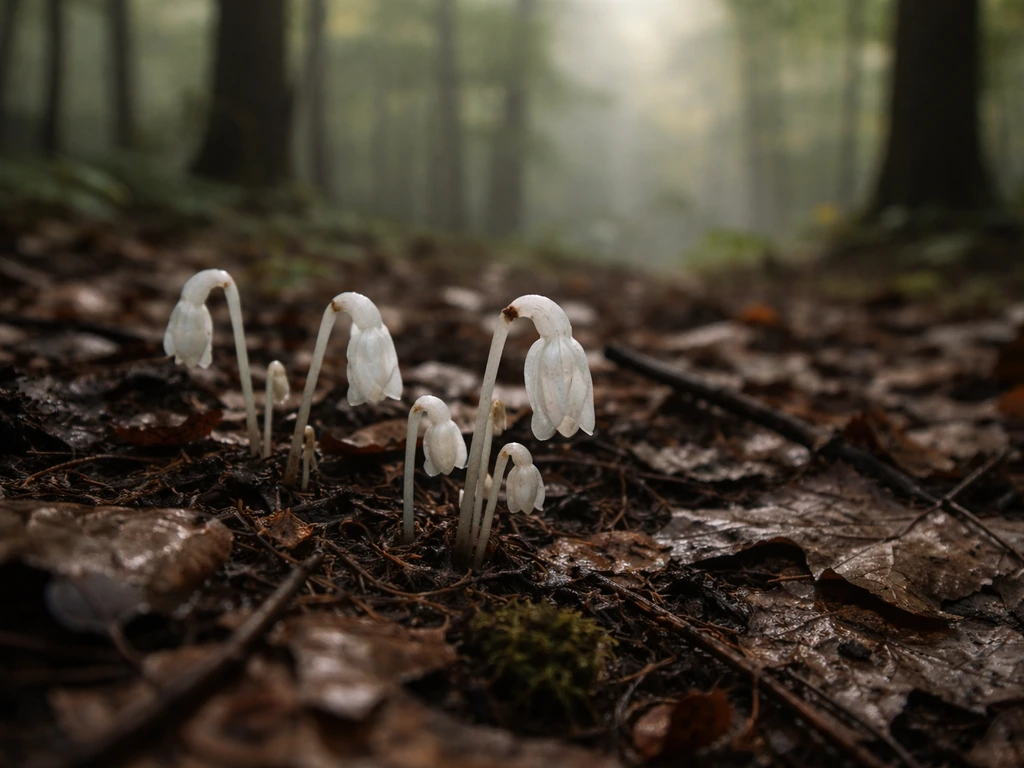
Does Ghost Pipe Grow in Indiana? Cultivation Guide
Find out if ghost pipe grows in Indiana and what it takes to cultivate it, plus failure causes, sourcing, and alternativ
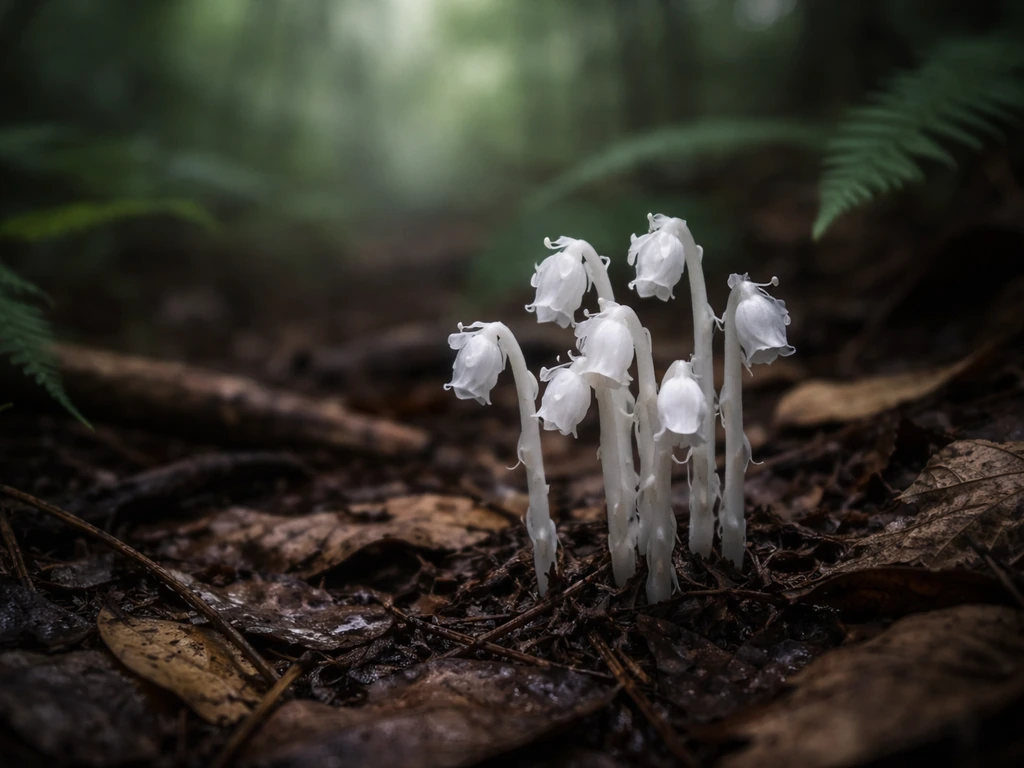
Does Ghost Pipe Grow in Georgia? Habitat and Growing Tips
Find out if ghost pipe grows in Georgia and where to look, plus realistic habitat and growing tips.
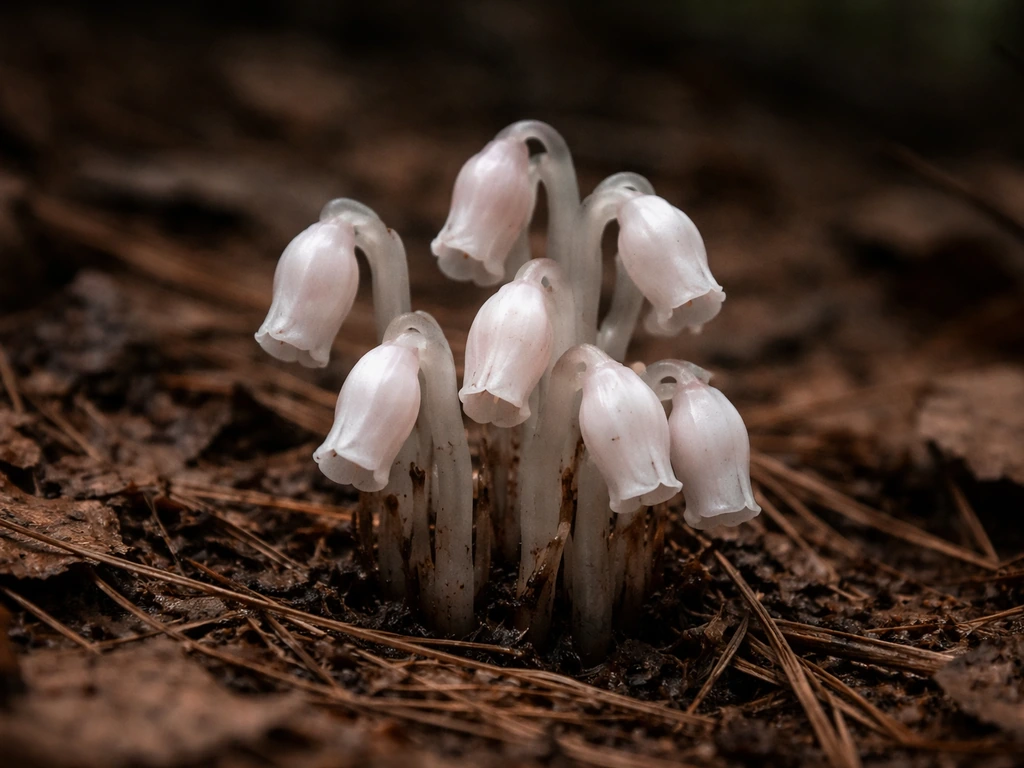
Does Ghost Pipe Grow in Ohio? Habitat and Sightings
Find out if ghost pipe grows in Ohio, where it may appear, and how to confirm sightings and identify it safely.