
Yes, you can grow saffron in New Zealand, and a surprising number of home gardeners already do. The crop suits the dry inland climates of Central Otago and Canterbury particularly well, and NIWA's national land-suitability mapping confirms those regions as the most reliable. Coastal and humid North Island sites are trickier but workable with raised beds and good drainage management. The one hard limit is summer waterlogging: saffron corms rot quickly in wet, poorly drained soil during dormancy, and that single failure point is responsible for most disappointing results I've heard about from NZ growers.
Can You Grow Saffron in New Zealand? Practical NZ Guide

Marcus Petersen
5 Aug 2026
Who this guide is for
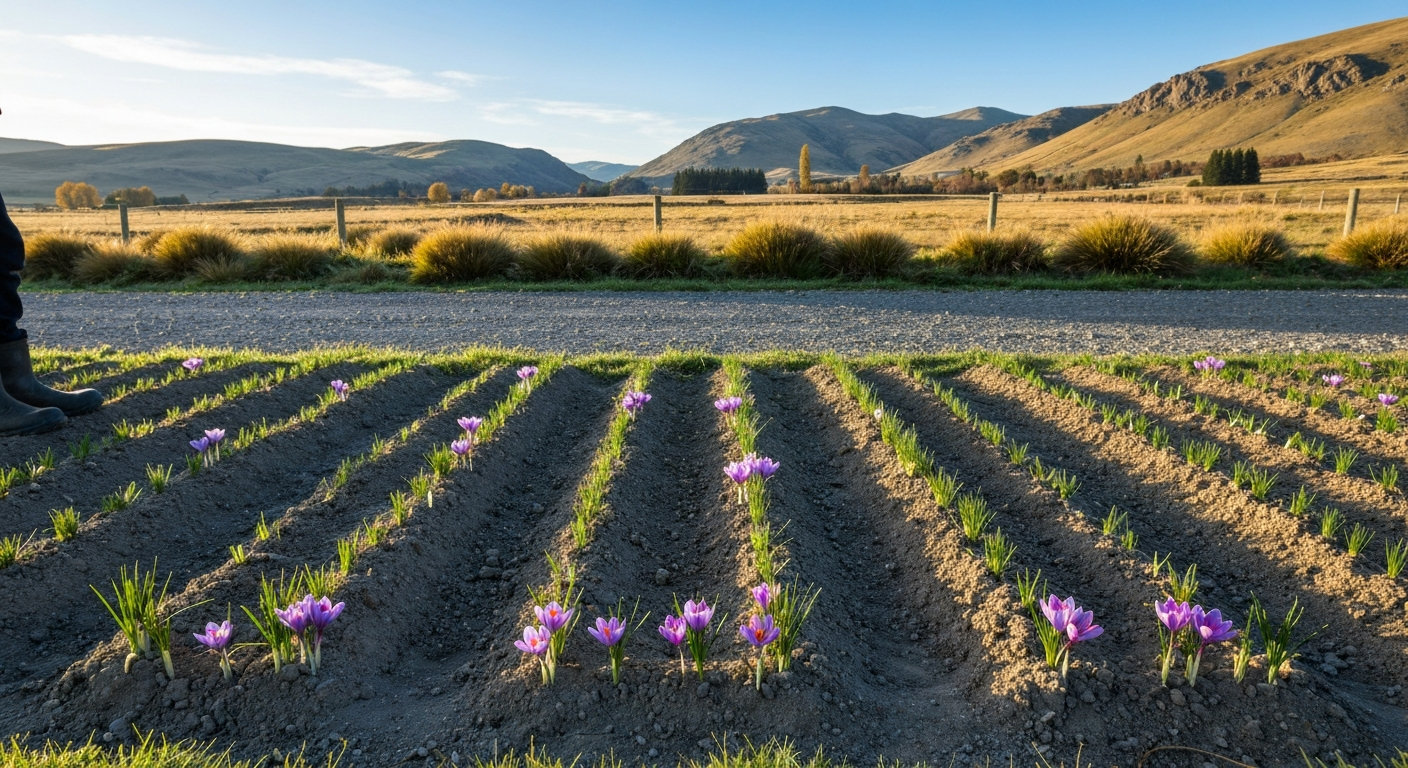
This article is written for two types of NZ gardeners. The first is the curious home grower who wants a small bed or container of saffron for novelty, personal use, or the satisfaction of harvesting the world's most expensive spice from their own backyard. You might get 20 to 50 stigmas from a first planting, which is enough to flavour a few dishes and decide if it's worth scaling up. The second type is the hobbyist who is seriously considering a small commercial patch, maybe 100 to 500 square metres, and wants to understand the realistic returns and effort before committing. I'll give both groups what they need, but I'll flag which advice applies to which situation. What this guide is not for: large-scale commercial production planning, which requires agronomic consultancy well beyond what any single article can responsibly cover.
Saffron basics every NZ gardener needs to know
Saffron comes from a single species, Crocus sativus, a sterile triploid that cannot reproduce from seed. Every plant in the world is a vegetative clone, and every new planting starts from a corm (a solid bulb-like storage organ, not a true bulb). That sterility matters for New Zealand biosecurity reasons, which I'll cover later.
The plant has a very specific two-phase temperature requirement that you need to understand before you plan your planting. During summer dormancy the corm needs warmth, roughly 23 to 27 degrees Celsius for around 50 or more days, to develop the internal structures that become next season's flowers. Then, as temperatures fall to around 15 to 17 degrees Celsius with cool nights near 10 degrees, that thermal shift triggers flower emergence. Get either phase wrong and the flowers either don't form or abort before they open. That's why a mild, constantly cool maritime climate is actually less suitable than a continental one with proper hot summers and crisp autumns.
Each flower produces exactly three red stigmas. Those stigmas, hand-picked and dried, are the saffron you use in cooking. A single corm typically produces one to three flowers in its first productive autumn. Over several seasons it divides into daughter corms, gradually building your stock and your harvest.
The NZ seasonal calendar: planting and harvest month by month
Saffron's calendar is inverted relative to the Northern Hemisphere guides you'll find on most overseas websites, so be careful when reading European or North American advice. In New Zealand the seasonal rhythm runs like this:
| Month | Season | What saffron is doing | Your job |
|---|---|---|---|
| January–February | Late summer | Dormant underground; corm organogenesis building floral structures | Keep soil dry; no irrigation; weed control |
| March–April | Early to mid-autumn | Flowers emerge (harvest window); stigmas ready within days of opening | Harvest stigmas daily at first light; dry immediately |
| May | Late autumn | Flowers finish; foliage emerges after or alongside late flowers | Allow foliage to grow freely; no disturbance |
| June–August | Winter | Leaves photosynthesising; building corm reserves | Light irrigation if very dry; protect from heavy frost in marginal areas |
| September–October | Spring | Leaves still active; corm filling | Continue to let foliage die back naturally; do not cut it |
| November–December | Early summer | Foliage yellows and senesces; corm enters dormancy | Stop all irrigation; lift and store corms in wet regions; leave in ground in dry regions |
| April–May (planting year) | Autumn (plant new corms) | Newly planted corms settle and may flower same season | Plant corms 10 cm deep, 10–15 cm apart; water once to settle in |
One important note: if you plant corms in April or May for the first time, they may flower that same autumn within weeks of planting. Don't be alarmed by the short gap between planting and harvest. The corm already contains the developing flower bud when you buy it.
Where in New Zealand saffron thrives (and where it's risky)
NIWA's national suitability mapping points strongly to the South Island's dry inland basins as the best ground. Central Otago is the standout, and it's no coincidence that New Zealand's largest saffron farm, Wynyard Estate near Alexandra, is established there. The combination of hot, dry summers and cold, clear autumns is almost textbook for Crocus sativus. Canterbury's inland plains are close behind. Southland growers report successful harvests too, often running into May on colder sites. In the North Island, Hawke's Bay and Marlborough (while technically South Island, it shares North Island conditions in many ways) offer the driest summers and are worth trying with good drainage. Areas I'd approach with caution: the Waikato, most of Auckland, Northland, and the West Coast of the South Island. It's not that saffron absolutely cannot grow there; it's that the combination of summer humidity, rainfall during dormancy, and mild winters that don't deliver a strong enough thermal trigger makes failure far more likely. Container growing with controlled drainage can shift the odds in your favour in those wetter regions.
| NZ Region | Suitability | Main challenge | Recommended approach |
|---|---|---|---|
| Central Otago | High | Frost risk in containers; otherwise excellent | In-ground beds; no special modification needed |
| Canterbury (inland) | High | Summer irrigation if very dry | In-ground; ensure some summer warmth retention |
| Southland | Moderate–High | Later flowering (May); harder frosts | In-ground; mulch lightly for frost protection |
| Marlborough | Moderate–High | Some summer rain events | Raised beds with good drainage; in-ground on slopes |
| Hawke's Bay | Moderate | Summer humidity in wet years | Raised beds; avoid heavy clay soils |
| Wellington | Moderate | Wind; variable summer warmth | Sheltered raised beds or containers |
| Auckland / Waikato | Low–Moderate | Warm, wet summers; mild winters | Containers with summer lift-and-store; not ideal in-ground |
| Northland | Low | Insufficient summer heat variation and too much rain | Not recommended without significant infrastructure |
| West Coast (SI) | Low | Excessive rainfall and humidity year-round | Avoid in-ground; container only if committed |
Is your specific site suitable? A quick decision guide
Even within a suitable region, the individual site matters enormously. Run through these checks before you order corms.
Sun
Saffron needs a minimum of six hours of direct sun per day during its active growing season (autumn through spring). A north-facing aspect is ideal in New Zealand. Shade from trees or buildings during the winter months will reduce the photosynthesis that builds corm reserves and cuts your next harvest.
Soil type and drainage
Sandy loam to loam is ideal, with a pH between 6.0 and 8.0. The non-negotiable is drainage: water must not sit around the corms, especially in summer. Authoritative reviews and crop‑science sources concur saffron prefers free‑draining soils (sandy‑loam to loam) with moderate fertility and a slightly acidic to alkaline pH (commonly cited pH ~6.0–8.0); waterlogging during summer dormancy promotes corm rot and crop failure (see Saffron: science, technology and health, cultivation and soil requirements) Saffron prefers free‑draining soils (sandy‑loam to loam) with moderate fertility and pH around 6–8. Do a simple jar test if you're unsure of your soil texture. If you have clay, build raised beds at least 20 to 30 cm high and fill them with a mix of topsoil, coarse sand, and compost. I've seen growers on heavy Canterbury clay get excellent results purely from raised bed construction.
Summer rainfall
If your site receives significant summer rain (say, more than 60 to 80 mm across December and January combined), you need a plan to keep corms dry. Options are: a simple low polytunnel over the bed during dormancy, lifting corms and storing them in a cool, dry shed, or growing in containers that you move under cover. Doing nothing in a wet summer is the fastest route to Fusarium rot.
Frost
Saffron foliage can handle moderate frosts down to around minus 5 to minus 7 degrees Celsius, and the corms themselves tolerate harder frosts when buried. In Central Otago where frosts are severe, in-ground corms generally survive fine. The risk zone is container-grown saffron in frosty areas: pots freeze through much more quickly than ground soil, and a prolonged hard freeze can kill the corm. In areas with severe frost, keep containers in an unheated shed or greenhouse during the coldest weeks, or insulate pots with hessian or bubble wrap.
Biosecurity and legal sourcing: what MPI requires
This is the section most overseas guides skip entirely, but it matters a lot in New Zealand. MPI (the Ministry for Primary Industries) regulates all plant material imported into the country under the Plants for Planting Import Health Standard. Saffron corms fall under the broader bulbs and corms commodity category, which means any import requires phytosanitary certification from the country of origin, MPI inspection on arrival, and in some cases Post-Entry Quarantine (PEQ) depending on the source country and pest risk. Importing corms without going through this process is illegal and can result in seizure and destruction of the material, plus fines.
The good news is that you almost certainly don't need to import. Multiple New Zealand nurseries and online suppliers sell Crocus sativus corms domestically, and those corms have already cleared all biosecurity requirements. Buying locally is simpler, faster, cheaper, and fully legal. I'd only consider the import pathway if you were trying to source a specific named variety or a large quantity for commercial planting and could not source it domestically, and even then you'd need to work through a licensed importer or directly with MPI's plant health team well in advance of your planned planting date.
Choosing corms and suppliers in New Zealand
Quality of the starting corm is probably the single biggest factor in whether your first season succeeds. Larger, heavier corms flower earlier, produce more stigmas, and multiply into more daughter corms. Research consistently shows that corms above about 20 to 30 mm in diameter produce reliably strong flowering. When buying, look for corms that are firm to the touch, with no soft spots, no visible mould, and intact papery tunics. Avoid any that feel hollow, have dark sunken areas, or smell musty. Those are early signs of Fusarium or Penicillium rot and you won't know the extent of the damage until the corm fails to flower.
Domestic NZ suppliers including The Plant Company, Greenleaf Nurseries, and Peonies NZ have stocked Crocus sativus corms and provide NZ-specific planting guidance. Availability is seasonal, so order in late summer (February to March) to ensure you have corms for the April to May planting window. Don't leave it until June; by then many suppliers are sold out and you'll wait another year.
Corm ordering checklist for NZ gardeners
- Order by late February or early March at the latest for autumn planting
- Specify the largest corm size available (aim for 8–10 cm circumference or larger if the supplier grades by circumference)
- Check that the supplier is NZ-based to avoid any import compliance issues
- On arrival, inspect every corm: firm, dry, no mould, intact tunic
- Store in a cool, dry, dark, well-ventilated location (a mesh bag in a shed) until planting day
- Do not store in a sealed plastic bag or sealed container as this encourages rot
- Plant within 4 to 6 weeks of receiving corms; do not leave them sitting all summer
Preparing the bed and planting
For an in-ground bed, dig to at least 30 cm depth and work in coarse sand and well-aged compost if your soil is heavy. Avoid fresh manure or high-nitrogen fertilisers at planting time; they encourage lush foliage at the expense of corm development and can promote rot. A balanced low-nitrogen fertiliser worked in before planting is plenty. Rake the surface level and let the bed settle for a week or two before planting if you have time.
Plant corms pointed side up at a depth of around 10 cm, measured from the base of the corm to the soil surface. In very free-draining sandy soils you can go slightly deeper, to 12 or 15 cm, to buffer against temperature swings. In heavy or wetter soils, plant slightly shallower, at 8 cm, and focus more energy on drainage improvement. Space corms 10 to 15 cm apart in all directions. Water in gently after planting to settle the soil, then largely leave them alone.
Container growing
For gardeners in Auckland, Northland, or the West Coast, or anyone with poor native soil, containers are a practical alternative. Use a pot at least 30 cm deep with excellent drainage holes, filled with a free-draining mix of potting mix and coarse horticultural grit (roughly 60:40). Plant at the same 10 cm depth. The major advantage of containers is mobility: you can shift pots under cover during wet summer periods to protect dormant corms, and move them to a warmer north-facing wall for summer heat accumulation. The disadvantage is that containers dry out quickly and you need to monitor moisture more carefully during the active growing season.
Watering, mulching, and summer dormancy management
During the active growing season (May through October roughly), saffron appreciates occasional irrigation if there's no significant rainfall, but it is not a thirsty plant. Light watering every one to two weeks in dry periods is sufficient. As foliage begins to yellow in November and December, reduce watering to nothing and allow the soil to dry out. This dry summer dormancy is not optional; it is biologically essential for corm development and rot prevention.
A light mulch of straw or pea straw (5 cm deep) applied after the foliage dies back can help regulate summer soil temperature and suppress weeds without trapping moisture. Avoid heavy organic mulches that retain water. In wet summer regions, remove mulch before the rainy period and either cover the bed or lift the corms entirely.
Lifting and storing corms in wet regions
If you're in a high summer-rainfall area, lift corms in November or early December once the foliage has fully yellowed. Brush off excess soil, allow them to cure in a dry, airy shed for two to three weeks, then store in a mesh bag or open tray in a cool, dry, dark location. Replant in April. This extra step adds labour but can make the difference between success and crop failure in the wetter parts of New Zealand.
Pests and diseases to watch for
Corm rot is the number one disease problem, caused by various fungal pathogens including Fusarium, Penicillium, Rhizoctonia, and Pythium. For more on saffron corm rot and recommended management practices, see Antagonism of Bacillus velezensis ZGE166 Against the Pathogenic Fungi Causing Corm Rot Disease in Saffron, PMC (Microbial Ecology, 2025) Antagonism of Bacillus velezensis ZGE166 Against the Pathogenic Fungi Causing Corm Rot Disease in Saffron — PMC (Microbial Ecology, 2025). The best defence is prevention: start with healthy corms, ensure excellent drainage, practice crop rotation (don't plant saffron in the same bed year after year), and remove and destroy any corms showing rot symptoms. There is no effective cure once rot is established in a corm; containment by removal is the only practical response for home growers.
Slugs and snails are a real threat, particularly to emerging foliage and flowers in autumn. Iron-based slug bait (sold as Quash or similar in NZ) is effective and safe around pets and wildlife. Apply around bed edges and under mulch in early March before flowering begins. Rats and mice will dig up and eat corms, and they are widespread across many NZ regions. Wire mesh (hardware cloth) laid 5 cm below the soil surface before planting, or raised beds with mesh-lined bases, offer the best physical protection. Standard rodent baiting and trapping around the garden perimeter is also sensible.
Harvesting saffron in New Zealand
Flowers open in the morning, usually between March and May depending on your region and the season's temperature progression. Once a flower is fully open its stigmas are immediately ready to harvest. You have a narrow window: pick within the first day of opening. Stigmas degrade in quality quickly, especially if rain or heavy dew gets to them. The best practice is to harvest first thing in the morning, before the warmth of the day, by picking the entire flower head and then pinching out the three red stigmas with clean fingertips or fine tweezers indoors.
Check your bed daily during the flowering window. Flowers don't all open at once; a bed may produce over two to three weeks. Missing even one day during peak flush means losing stigmas that have already degraded.
Drying and storing your saffron
Fresh stigmas contain a lot of moisture and must be dried within hours of harvest. Spread them in a single thin layer on a piece of baking paper and dry in an oven on the absolute lowest setting (around 40 to 50 degrees Celsius) with the door slightly ajar for 15 to 20 minutes, or use a food dehydrator on its lowest setting. Alternatively, dry at room temperature over a fine mesh in a warm, dry spot for 24 to 48 hours, though this method is slower and only works in low-humidity conditions. Properly dried saffron feels crisp and brittle, not flexible. Store in a small, airtight, opaque glass container away from light and heat. Correctly dried and stored saffron retains its potency for two to three years.
Realistic yields: what to expect at hobby and small-scale level
Let me be blunt about yield expectations, because this is where a lot of enthusiasm runs into reality. A single healthy corm might give you one to three flowers in its first autumn. Three flowers produce nine stigmas. You need roughly 150 to 200 dried stigmas to make one gram of dried saffron. So 50 corms in a good first year might yield somewhere in the range of 0.5 to 1 gram of finished saffron. That's roughly one generous pinch, enough for a couple of paellas. It's not nothing, but it's a hobby quantity, not a larder-stocking exercise.
The picture improves over time. Each corm divides over three to four years into several daughter corms, multiplying your stock without additional purchase. By year three or four a well-maintained bed can be producing meaningfully more. Growers in the emerging NZ small-scale industry (with reports of nearly 100 people actively growing saffron commercially in NZ) are typically working plots of a few hundred square metres to get commercially meaningful quantities. At home-garden scale the honest frame is: grow it for the experience, the small personal harvest, and the satisfaction of corm multiplication over time, not for a meaningful return on time invested.
Corm division and building your stock
After two to three seasons, a productive planting will become crowded as corms multiply. Lift the entire planting in late November or December, separate the daughter corms from the mother corm (the original), grade them by size, discard any showing rot or damage, and replant the largest ones in refreshed soil. Smaller daughter corms can be grown on in a nursery bed for a season before being moved to your main planting. This division process is also your main opportunity to check corm health and expand your bed without buying additional stock.
Troubleshooting common problems
- Corms planted but no flowers appear: Most common cause is corms that were too small at planting. Check diameter; if under 2 cm, grow on for another season before expecting flowers. Also check that summer soil temperatures were adequate (warm, not cool and shaded).
- Flowers emerge but stigmas are small or shrivelled: Often a sign of heat or moisture stress at flower-emergence time. Ensure adequate but not excessive soil moisture in early autumn.
- Corms mushy or rotten on lifting: Drainage failure or summer rain infiltration. Rebuild with raised beds or commit to lifting and storing over summer.
- Foliage yellows very early (before October): Check for waterlogging or root disease. Improve drainage and inspect corms.
- Slugs eating flower buds overnight: Apply iron-based slug bait around the bed before flowering season begins in late February.
- Rodent tunnelling under the bed: Install hardware-cloth mesh lining below corms at planting time; add perimeter trapping or baiting.
How New Zealand compares to neighbouring regions
If you're curious how NZ conditions stack up against other Southern Hemisphere and nearby growing environments, the comparison is instructive. For related information on growing other specialty crops in nearby regions, see can black seed grow in Nigeria. Australia's saffron-growing regions (principally Tasmania and parts of Victoria) share many of the same seasonal rhythms and challenges as New Zealand's South Island, including the March to May harvest window and the summer dormancy requirement. For practical guidance specific to Australian conditions (Tasmania and parts of Victoria), see can you grow saffron in Australia. If you’re asking whether can saffron grow in South Africa, the Western Cape’s Mediterranean climate does support small-scale saffron production and is a useful regional comparison. South Africa's Western Cape produces saffron at small scale in its Mediterranean-type climate, where dry summers align well with dormancy needs. Canada's growing conditions, while also suitable in some inland provinces, operate in the Northern Hemisphere calendar and face much harder winter freezes than most NZ sites. For guidance on growing saffron in colder Northern Hemisphere climates, see can saffron grow in Canada. New Zealand's overall position is genuinely favourable compared to many temperate countries, particularly for gardeners in the South Island's inland zones.
Is it worth trying in your situation?
If you're in Central Otago, inland Canterbury, or Southland with decent soil drainage, the answer is a clear yes. Buy a bag of 20 to 30 quality corms from a NZ supplier, plant them in April in a well-drained north-facing bed, and you will almost certainly harvest saffron that same autumn. The effort is low, the cost is modest, and the reward of growing your own saffron is genuinely satisfying even if the quantity is small. If you're in Auckland, Northland, or the West Coast, I'd say try it in containers first with a commitment to moving pots under cover in summer. Expect some trial and error before you get consistent results. If you're not willing to manage summer drainage actively in a wet climate, wait until you have a suitable site rather than spending money on corms that will rot. The crop rewards good site matching more than most garden plants.
FAQ
Can home gardeners in New Zealand successfully grow saffron (Crocus sativus)?
Short answer: Yes — many NZ home gardeners and commercial growers (especially in dry inland areas like Central Otago, parts of Canterbury and Southland) successfully grow saffron. Success depends on matching local microclimate to saffron’s need for a warm growth period followed by a cool trigger for flowering and ensuring dry summer dormancy or lifting corms in wet areas.
Which New Zealand regions and climate types are most suitable or marginal for saffron?
Most suitable: dry inland and rain‑shadow areas (Central Otago, parts of Canterbury, Marlborough, inland Otago, some Southland sites) where summers are relatively dry and warm and autumns cool. Marginal: coastal, high‑rainfall or very humid areas (much of West Coast, Northland, some Waikato pockets) unless you can provide excellent drainage, raised beds, protective covers or containers for summer dryness.
What is essential saffron biology I need to know for NZ (growth cycle and triggers)?
Crocus sativus is a sterile triploid grown from corms. It requires: (1) A warm/active growth period (summer) to build corm reserves, (2) a cooling period in late summer/early autumn to trigger flowering, and (3) a dry dormancy during summer to avoid corm rot. Larger mother corms (>20–30 mm) produce more flowers and daughters. Flowers appear in autumn (Southern Hemisphere: March–May).
What is the NZ seasonal calendar (Southern Hemisphere) for planting, growth and harvest?
General NZ calendar cues: April–May (autumn): plant fresh corms in most regions. June–August (winter): shoots may be present/leafing in milder zones; foliage grows late winter/spring in some sites. September–February (spring–summer): foliage builds corm reserves; keep soil dry in summer. March–May (autumn): flowering and stigma harvest (peak Mar–Apr in many NZ regions; colder sites may extend into May). Lift/store corms if your site is wet in summer.
Can I import saffron corms into New Zealand or should I buy locally?
Do not import without following MPI rules. Importing corms is subject to New Zealand’s 'Plants for Planting' import health standard: you must check commodity requirements, obtain permits if needed, secure phytosanitary certification from the exporting NPPO and possibly post‑entry quarantine (PEQ). For most home gardeners the simplest legal and lowest‑risk route is to buy corms from NZ nurseries or domestic suppliers (many sell Crocus sativus locally).
How do I legally and safely obtain corms in NZ?
Recommended options: (1) Buy from NZ reputable suppliers/nurseries that sell disease‑graded corms; (2) obtain corms from local growers or garden clubs; (3) if importing, contact MPI to apply for import permits and follow specified inspection/PEQ procedures. Always request healthy, firm, large corms (20–30 mm+) and ask about disease history and grading.
Next Articles
Can You Grow Saffron in Australia? Regional Guide & Tips
Can you grow saffron in Australia? Practical guide, planting calendar, care, yields & sourcing for gardeners.
Can Saffron Grow in Canada? Regional Guide for Gardeners
Can saffron grow in Canada? Practical, region-by-region guide to growing, harvesting, and storing saffron at home.
Can Black Seed Grow in Nigeria? How to Plant and Harvest Nigella sativa
Yes, Nigella sativa can be grown in Nigeria. Learn seed sourcing, planting timing, care, harvest, drying, and troublesho