
Yes, ginger can grow in Colorado, but not the way it grows in Georgia or Hawaii. You won't be planting it in the ground in April and forgetting about it. Colorado's short growing seasons, low humidity, and cold nights mean outdoor-only cultivation is a longshot in most of the state. What reliably works is container growing, with pots you can start indoors in early spring and move outside once nighttime temps stabilize above 50°F. Greenhouse production works well too if you have the setup. Pure outdoor growing in raised beds is feasible on the Western Slope and in protected Front Range microclimates, but it's a race against the calendar and requires real commitment.
Does Ginger Grow in Colorado? Outdoor, Greenhouse & Container Options
Marcus Petersen
7 Aug 2026
The quick verdict by growing method
| Method | Feasibility in Colorado | Best suited for | Main limiting factor |
|---|---|---|---|
| Container/indoor | High | Most of Colorado, all zones | Attention to humidity and watering |
| Greenhouse | High | Gardeners with existing structure | Setup cost, temperature management |
| Outdoor seasonal (raised bed) | Moderate, zone/site dependent | Western Slope, warm Front Range spots | Short frost-free season, low humidity |
| Open-ground outdoor (in-ground) | Low to very low | Only the mildest Western Slope pockets | Season too short, drainage issues in clay soils |
Is this project worth it for you? A quick decision checklist
Before you order rhizomes, run through these questions honestly. I've watched people start this project with enthusiasm and abandon it by July because they underestimated what Colorado's climate demands of a tropical crop.
- Zone and frost dates: Are you in USDA Zone 5b or warmer? Denver sits around Zone 6a, with a median last frost in late April to early May and a first fall frost in early to mid-October, giving roughly 150–165 frost-free days. The Western Slope near Palisade stretches to about 192 days. Ginger needs 8–10 months for mature rhizomes, so outdoor-only growing almost never completes a full cycle in Colorado.
- Microclimate: Do you have a south-facing wall, a protected courtyard, or a raised bed with dark-colored mulch that holds warmth? These microclimates add weeks and matter enormously.
- Time investment: Container ginger needs consistent moisture checks, regular fertilizing every 2–3 weeks through the season, and indoor management from roughly February through May before outdoor placement. If you travel frequently in summer, it'll suffer.
- Space: Each rhizome needs a container at least 12–16 inches deep and 14–18 inches wide for a decent yield. Plan for multiple pots if you want more than a small harvest for cooking.
- Investment tolerance: Seed rhizomes, quality potting mix, a perlite amendment, and a heated propagation space add up. You won't get grocery-store yields from a pot, but the fresh baby ginger you harvest around month five is genuinely excellent and worth the effort if you enjoy the process.
What ginger actually needs to thrive
Zingiber officinale is a tropical rhizomatous perennial. It evolved in warm, humid, partly shaded forest margins in South and Southeast Asia. Every one of its biological requirements is in tension with Colorado's baseline climate, so the more specifically you can mimic its native conditions, the better your results.
| Requirement | Ideal range | Colorado challenge |
|---|---|---|
| Air temperature (growing) | 66–82°F (19–28°C) | Colorado nights regularly dip below this, even in summer at elevation |
| Soil temperature (sprouting) | 77–79°F (25–26°C) | Colorado spring soils stay cold well into May outdoors |
| Relative humidity | 70–90% | Colorado's average RH is often 30–50%, especially on the Front Range |
| Light | Filtered/indirect; no intense direct midday sun | Colorado's intense high-altitude UV and dry air can scorch leaves |
| Soil pH | 6.0–6.5 | Colorado soils often run alkaline (7.0–8.0+); amendment required |
| Drainage | Excellent; humus-rich loam | Heavy clay soils on the Front Range hold water and cause rhizome rot |
| Water | Consistently moist, never waterlogged | Low humidity dries containers fast; overhead watering risks disease |
| Growing cycle to mature rhizome | 8–10 months | Colorado's outdoor season is 5–6.5 months depending on location |
Colorado's climate and where ginger fits (or doesn't)
Colorado is not one climate. Elevation drives almost everything. Denver at 5,280 feet has a reasonably long frost-free window but intense sun, low humidity, and unpredictable late spring frosts. Mountain valleys above 7,000 feet can see frost in any month of the year. The Western Slope, particularly the low-elevation river valleys around Grand Junction and Palisade, has the warmest and longest growing seasons in the state, with roughly 190+ frost-free days and daytime summer highs that stay consistently warm. That's where outdoor ginger in a raised bed has the best shot.
The Front Range corridor from Pueblo north through Denver and Fort Collins is the middle ground. Pueblo tends to run warmer and drier than Denver, with a slightly longer season. Fort Collins and Boulder are colder but both have microclimate pockets, particularly south-facing slopes and urban heat zones, where an ambitious gardener can push the outdoor season. The Colorado mountains and high plains are essentially non-starters for outdoor ginger without a structure to extend the season.
Humidity is the overlooked factor. I've talked to gardeners who managed the temperature and timing correctly but still got disappointing results because Colorado's ambient humidity routinely drops below 30% on dry Front Range days. Ginger leaves will curl and dry out under those conditions without aggressive misting or a humid microenvironment. Containers grouped together and partially shaded help. A greenhouse with an evaporative cooler or misting system helps even more.
Outdoor, greenhouse, or containers: which option fits your situation
Container and indoor growing
This is the approach I'd recommend to almost every Colorado gardener starting out. You start rhizomes indoors in February or early March, give them warm soil temperatures indoors (a heat mat under the pot is genuinely useful and gets sprouts moving faster), and move them outside to a sheltered spot once nighttime temps are reliably above 50°F, usually late May on the Front Range. You bring them back in before the first fall frost in October. This indoor-outdoor cycle gives you roughly 5–6 months of outdoor growing plus whatever indoor growth you get in spring and fall, enough time to harvest fresh young ginger at 4–6 months and potentially some mature rhizomes at 8 months if you started early.
- Pros: Works in any Colorado zone, easy to control humidity and temperature, manageable investment, flexible harvest timing
- Cons: Requires attention to watering (containers dry fast in Colorado's dry air), not hands-off, yields are modest per pot
- Best for: Front Range gardeners, anyone without a greenhouse, beginners to growing ginger
Greenhouse growing
A greenhouse changes the math significantly. Even an unheated hoop house extends your season by 4–6 weeks on each end. A heated greenhouse lets you run ginger as close to a year-round crop as you'll get in Colorado. Royal Botanic Gardens, Kew, maintains Zingiber officinale at 64–77°F with high relative humidity, and that's the environment you're replicating. The key challenges are keeping humidity up (Colorado's dry air infiltrates even sealed greenhouses), avoiding overwatering in winter, and managing fungal diseases that thrive in warm, moist conditions. Integrated pest management using Trichoderma-based biological inoculants at planting has shown real promise in high-tunnel production trials for reducing rhizome rot.
- Pros: Near-ideal temperature and humidity control, full 8–10 month growing cycle achievable, higher yields, year-round possibility with heating
- Cons: Significant infrastructure cost if you don't already have a structure, disease management is more complex in enclosed humid spaces
- Best for: Serious hobbyists, gardeners already using a greenhouse for tomatoes or other crops
Outdoor seasonal planting in raised beds
This is the highest-effort, highest-risk approach in most of Colorado. The only realistic candidates are the Western Slope low-elevation zones and the warmest Front Range microclimates. Even then, you're working with 5.5 to 6.5 months of outdoor growing time against a crop that wants 8–10 months for full maturity. The workaround is to pre-sprout rhizomes indoors in February, plant them out in mid-May into raised beds amended with generous compost, mulch heavily to hold soil moisture and warmth, and harvest young ginger in September before the first hard frost rather than waiting for full maturity. You won't get the big, fibrous, dry-storage rhizomes, but you'll get excellent fresh baby ginger.
- Pros: Most natural approach, satisfying if it works, no special equipment beyond a good raised bed
- Cons: Risky in most of Colorado, requires pre-sprouting indoors anyway, yield is limited by season length
- Best for: Western Slope gardeners in Zones 6b–7a, Front Range gardeners with south-facing protected raised beds
Picking your seed rhizomes and varieties
For Colorado containers and greenhouses, you want seed rhizomes, not the grocery store stuff. Grocery-store ginger is often treated with growth inhibitors and can carry soil-borne pathogens that become a serious problem once you put them in a pot with warm, moist conditions. Buy from reputable specialty herb nurseries or certified organic ginger suppliers. For container growing in Colorado, smaller, faster-developing varieties or standard culinary ginger planted as smaller pieces (1–2 inch rhizome sections with at least one growth bud, or 'eye') work well.
If you do use grocery-store ginger as a starting point (I've done it, and it does sometimes work), soak the pieces in warm water overnight to help remove any inhibitor residue, choose pieces with plump, firm flesh and visible growth buds, and do a hot-water seed treatment: submerge the rhizome pieces in 122–124°F water for 10 minutes before planting. This sanitation step, widely used in commercial production, significantly reduces the introduction of Pythium, Fusarium, and Ralstonia, the three main pathogens that cause rhizome rot.
- Certified organic seed ginger from specialty nurseries: best disease-risk starting point, worth the premium
- Hawaiian or Indian culinary ginger varieties: standard Zingiber officinale, widely available and well-suited to container production
- Grocery store organic ginger: usable with proper sanitation, treat rhizomes before planting
- Baby/young-harvest types: any culinary ginger harvested early (4–6 months) gives tender baby ginger with milder flavor, ideal for Colorado's shorter outdoor season
Step-by-step planting guide for Colorado
Timing
Start indoors in late February to early March. This gives rhizomes time to sprout and develop under warm indoor conditions before you move them outside. In Colorado, waiting until May to start is too late for anything more than a very early fresh ginger harvest. If you're running a heated greenhouse, you can push starts to January.
Site selection
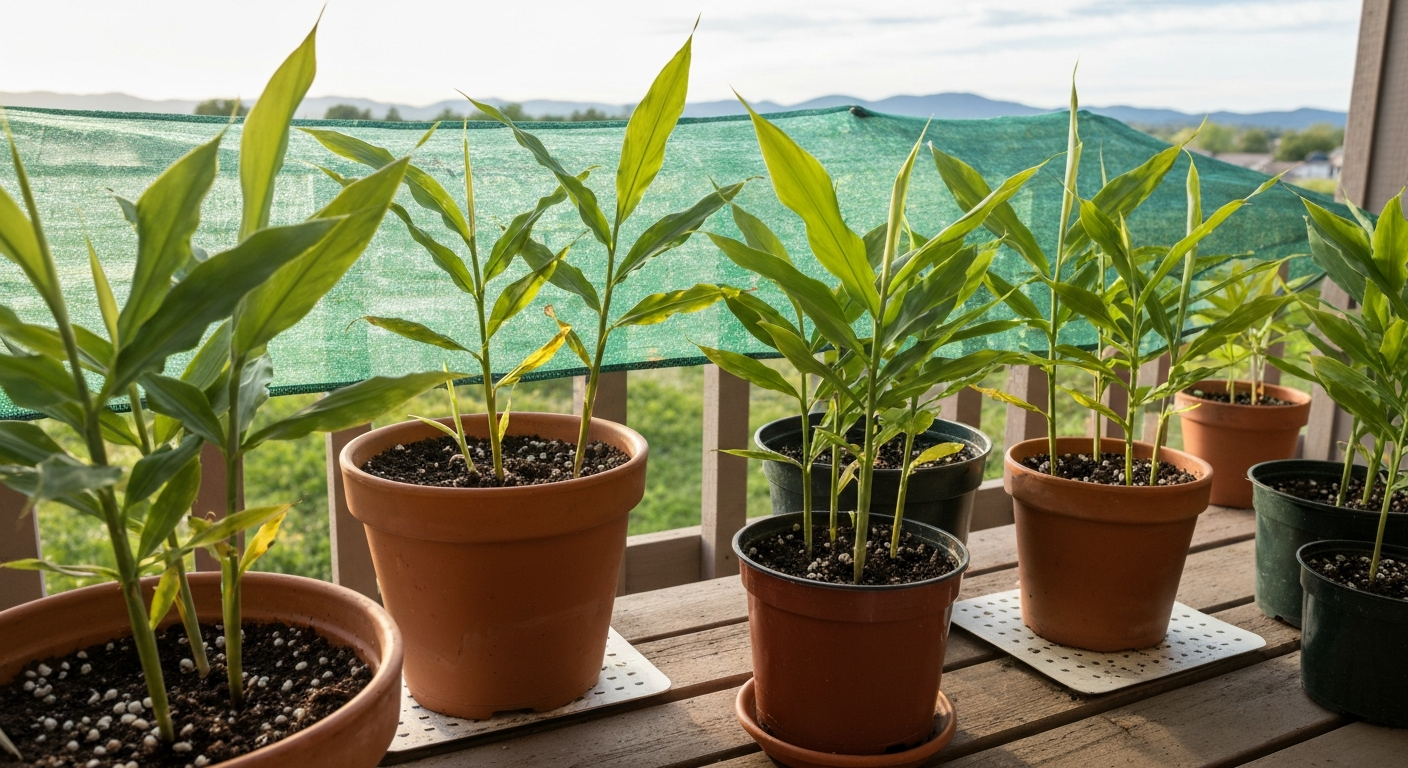
For containers moved outdoors: choose a spot with morning sun and afternoon shade, especially on hot Front Range days when direct Colorado sun combined with low humidity will stress the plants. East-facing walls, the north side of a trellis, or under a shade cloth (30–40% shade) are ideal. For outdoor raised beds on the Western Slope: a south-facing bed with a dark mulch cover and wind protection is your best bet.
Container and soil preparation
Use containers at least 12 inches deep, ideally 14–16 inches. Shallower pots restrict rhizome development. The soil mix matters more in Colorado than almost anywhere else because you need it to hold moisture without waterlogging (which causes rot) while staying loose enough for rhizome expansion. Plants of the Genus Zingiber as a Source of Bioactive Phytochemicals: From Tradition to Pharmacy (review) notes that ginger grows best in a friable, humus‑rich loam with slightly acidic soil pH around 6.0–6.5 and good drainage ginger grows best in a friable, humus‑rich loam with slightly acidic soil pH ~6.0–6.5 and good drainage. Colorado's tap water and native soils also tend toward alkalinity, so your mix needs to buffer toward pH 6.0–6.5.
- Mix 50% high-quality potting soil (not garden soil, which compacts) with 30% compost and 20% perlite. The perlite is non-negotiable for Colorado; it prevents the waterlogging that causes rhizome rot.
- Add a small amount of sulfur or acidifying fertilizer if your tap water or local potting mix runs above pH 6.5. Test with an inexpensive pH meter.
- Ensure drainage holes are clear. Ginger roots sitting in pooled water will rot within days in warm conditions.
- Pre-warm the potting mix before planting by placing filled pots in a warm room (around 70–75°F) for 2–3 days, or use a seedling heat mat under the pot set to 77°F (25°C). This soil temperature is where sprouting is fastest.
- Place rhizome pieces 2–3 inches deep, growth buds facing up, spaced so each piece has roughly 6 inches of container space around it.
- Water gently after planting and cover the pot with plastic wrap or a humidity dome until sprouts emerge to maintain soil moisture and warmth during germination.
Outdoor raised bed preparation (Western Slope and warm Front Range)
- Build raised beds at least 12 inches tall to improve drainage and warm up faster than in-ground beds.
- Fill with a blend of topsoil, compost, and aged manure. Avoid heavy clay or any fill that compacts and holds water.
- Amend to pH 6.0–6.5 if your local soil runs alkaline, which it likely does in most of Colorado.
- Pre-warm the bed for 2 weeks before planting using black plastic mulch or a floating row cover.
- After planting, apply 3–4 inches of straw or shredded leaf mulch. This preserves soil moisture, keeps soil temperature stable, and reduces splash-borne disease spread.
- Do not plant out until nighttime soil temperatures are consistently at or above 60°F and all frost risk has passed, typically late May on the Front Range and mid-May on the Western Slope low elevations.
Ongoing care through the Colorado season
Watering
This is where Colorado gardeners most often go wrong. The low ambient humidity and intense sun dry containers out fast, sometimes twice as fast as they would in more humid states. Check soil moisture daily in midsummer. You want the root zone consistently moist but never soggy. Drip irrigation or a soaker hose at the base of plants is ideal because it delivers water directly to roots without wetting the foliage, which reduces fungal disease risk. Never water overhead in the evening.
Fertilizing
Ginger is a heavy feeder. Once plants are actively growing (you'll see pseudostems emerging and leaves unfurling), begin feeding every 2–3 weeks. A balanced organic liquid fertilizer with emphasis on nitrogen and potassium works well. Compost tea, fish emulsion, or a diluted all-purpose liquid fertilizer are practical choices for home scale. Reduce feeding in late summer as the plant begins to shift energy into rhizome bulking rather than leaf growth.
Humidity management
Group containers together to create a more humid microenvironment. Mist foliage lightly in the morning on dry days. If you're growing indoors or in a greenhouse, a small humidifier or an evaporative pad can make a significant difference. Ginger leaves will start to brown at the tips and roll at the edges when humidity drops too low, which in Colorado can happen quickly during chinook winds or during the pre-monsoon dry stretch in May and June.
Mulching
Keep 2–3 inches of organic mulch over the root zone in outdoor beds at all times. In containers, a thin layer of wood chip mulch or straw on the soil surface slows moisture evaporation dramatically. This isn't optional in Colorado's dry climate.
Pests, diseases, and what to watch for
The biggest disease threats to Colorado ginger are all soil-borne: Pythium and Fusarium rhizome rot, and bacterial wilt caused by Ralstonia solanacearum. All three are favored by warm, wet soil conditions, which means overwatering is your primary risk factor. Commercial and extension sources note that cold, wet winter conditions are the primary risk for rhizome rot; using raised beds and excellent drainage to avoid winter soil saturation is critical Commercial and extension sources note that cold, wet winter conditions are the primary risk for rhizome rot; using raised beds and excellent drainage to avoid winter soil saturation is critical.. In Colorado, you're less likely to encounter these pathogens in native soil than a tropical grower would be, but once introduced through infected planting material, they can wipe out a pot within weeks. This is why seed sanitation and starting with certified or treated rhizomes matters so much.
- Rhizome rot (Pythium/Fusarium): yellowing leaves, mushy rhizomes, foul smell. Prevention is everything: good drainage, no overwatering, hot-water seed treatment before planting.
- Bacterial wilt (Ralstonia): wilting without yellowing, brown water-soaked tissue inside rhizomes. No cure; discard affected plants and do not reuse that soil.
- Leaf spot (Phyllosticta): small brown spots with yellow halos on leaves. Usually cosmetic in containers; improve air circulation and avoid overhead watering.
- Spider mites: common in Colorado's dry conditions, especially on indoor plants. Look for fine webbing and stippled leaves. Insecticidal soap or neem oil spray works well for home-scale control.
- Root-knot nematodes: less likely in sterile potting mix; more of a risk if you use garden soil in your containers. Use fresh commercial potting media to avoid introduction.
Harvesting and storage
In Colorado containers, you'll realistically be harvesting young (baby) ginger starting at around 4–6 months after planting. This means a February start gets you to a July or August harvest of tender, pink-tinged young rhizomes. This fresh ginger has a milder, juicier flavor than grocery store ginger and is excellent for pickling, cooking, and juicing. For mature ginger with the papery skin and full pungency you see at the grocery store, you need 8–10 months, which means a February start targeting a November or December harvest indoors. This is achievable with container growing if you bring plants back inside before the first fall frost and keep them growing under grow lights.
To harvest, tip the container onto its side or dig carefully at the edges of a raised bed. Pull up the entire clump, brush off soil, and cut or snap off what you need. You can replant a portion of the healthiest rhizomes immediately for next season. Yields from a single 14-inch container are modest: expect roughly 0.5 to 1.5 pounds of rhizomes per pot depending on how well the season went. That's not commercial scale, but it's a meaningful harvest for a home cook. Reports from traditional small-scale farming suggest planted rhizome weight can multiply roughly 4–6 times under good conditions, so a 4-ounce seed piece in an ideal season could yield close to a pound.
For storage, mature ginger rhizomes keep well at cool room temperature (55–60°F) for several weeks, or you can freeze them whole and grate directly from frozen, which works extremely well and preserves the crop for months.
Overwintering and keeping plants going year-round
If you want to keep your ginger plants going into a second season, bring containers inside before the first hard frost (usually early October in Denver). The plants will die back to the soil surface, which is normal. Reduce watering significantly during this dormant period, but don't let the soil go completely dry. Keep the pot somewhere that stays above freezing, around 50–55°F minimum. A basement, unheated but frost-free garage, or spare room works. In late January or February, move the pot back to warmth, increase watering, and the rhizomes will re-sprout. You can divide and re-pot at this point to expand your planting.
How Colorado compares to other states where people ask the same question
Colorado's situation is genuinely more workable than Minnesota or Illinois for outdoor ginger. For detailed guidance on Minnesota's constraints and adapted techniques, see our article on can you grow ginger in minnesota. Minnesota's shorter seasons and colder baseline temperatures make even container outdoor growing more challenging, and gardeners there are largely restricted to indoor or greenhouse production year-round. Illinois has longer seasons in the southern part of the state and higher humidity, which actually makes it somewhat more hospitable than Colorado for outdoor ginger despite similar zone ratings. Utah, particularly the Wasatch Front, is comparable to Colorado in many ways: short frost-free windows at elevation, dry climate, alkaline soils. For more detailed guidance on growing ginger in similar conditions, see our Utah-specific planting guide: can you grow ginger in Utah (381a27a9-e9d5-407f-a175-299659d40de9). The main difference is that southern Utah's Dixie region has warmer conditions that give it an edge. Colorado's Western Slope is probably the most ginger-friendly part of either state for outdoor attempts.
If ginger feels like too much: easier alternatives for Colorado
If the container management and humidity work feels like more than you want to take on, turmeric (Curcuma longa) is a very close relative that handles similar conditions and follows the same growing calendar. It's slightly more forgiving of Colorado's variable moisture and gives you a similarly rewarding tropical-feeling harvest. Galangal is another option, though it's even more heat-demanding. For ornamental appeal with less culinary pressure, shell ginger (Alpinia zerumbet) and ornamental ginger varieties tolerate container culture well and add tropical drama to a Colorado patio without the harvest expectations. Hardy ginger relatives like wild ginger (Asarum canadense) grow well in shaded Colorado gardens and are genuinely cold-hardy, though they don't produce culinary rhizomes.
Bottom line: is ginger worth growing in Colorado?
Try it if you're willing to commit to containers, start in February, and manage watering carefully through a dry Colorado summer. The barrier isn't your growing zone; it's the combination of short season, low humidity, and alkaline soil conditions that all need to be actively managed. Greenhouse growers have the easiest path to reliable yields. Front Range container gardeners can expect a satisfying fresh ginger harvest if they start early and stay attentive. Western Slope gardeners in low-elevation zones have a real shot at outdoor raised-bed production. Mountain gardeners above 7,000 feet should skip outdoor ginger entirely and go straight to containers or a greenhouse. It's not a low-effort crop for Colorado, but it's far from impossible, and the fresh young ginger you pull from your own pot in August is genuinely one of the better arguments for trying it.
FAQ
SEO title and meta description
Title: Can You Grow Ginger in Colorado? Practical Guide for Home Gardeners Meta description: Learn whether culinary ginger (Zingiber officinale) can be grown in Colorado — outdoor seasonally, in greenhouses, or in containers — with step‑by‑step planting, care, harvest timing, pest control, overwintering and realistic yield expectations tailored to Colorado zones and microclimates.
Quick answer / verdict for Colorado gardeners
Short verdict: Yes — but usually not reliably outdoors year‑round. In most of Colorado, the best approaches are container/indoor culture or greenhouse/high‑tunnel production. Outdoor seasonal plantings can work only in the warmest, lowest microclimates (low‑elevation Western Slope or protected urban heat islands) and with careful soil/season management. Expect 4–6 months to harvest young (fresh) ginger and ~8–10 months for mature storage rhizomes; yields are modest for small gardens unless greenhouse conditions closely match ginger’s warm, humid needs.
Which growing methods give reliable results in Colorado? (outdoor seasonal / greenhouse / container)
Outdoor seasonal: Possible only in lowest‑elevation, long‑season microclimates (e.g., some Western Slope pockets, protected front‑range sites with heat‑retaining south exposures). Requires raised beds, heavy mulch, row covers and planting after all frost. Risk: cool nights and wet soils cause rot. Greenhouse/high tunnel: Best for reliable production. Allows sustained 18–28°C daytime temps, higher humidity, filtered light and protected dry soil — reduces rot risk and extends the season. Containers / indoor: Most practical for home gardeners statewide. Use large pots (5–10+ gallons), indoor heat mats or warm windowsill/bright room, humidity management and controlled watering. This is the lowest‑risk option outside a heated greenhouse.
Ginger’s core biological needs (temperature, humidity, light, soil, water)
Temperature: Optimal growth ~19–28°C (66–82°F); sprouting fastest near 25–26°C. Frost kills shoots and cold, wet soil causes rhizome rot. Humidity: Prefers high relative humidity (≈70–90%). Dry indoor air can slow growth — use humidifiers or trays. Light: Bright, filtered light (partial shade). Avoid hot afternoon sun in containers/greenhouse without shading. Soil: Rich, friable, well‑draining loam with abundant organic matter; slightly acidic pH ~6.0–6.5. Water: Keep root zone consistently moist but not waterlogged; avoid prolonged saturation to limit oomycetes (Pythium/Phytophthora) and Fusarium.
When to plant in Colorado and timing expectations
Planting time: Wait until soil and air temperatures are consistently warm — after final spring frost and when night temps are reliably above ~10–13°C (50–55°F). On Front Range this is often late May; Western Slope may be mid–April–May depending on site. For containers/greenhouse you can start earlier by controlling temperature. Harvest timing: Fresh (juvenile) ginger at 4–6 months. Mature rhizomes for drying/storage at ~8–10 months. In Colorado outdoor plots expect to harvest young ginger in-season; full 8–10 month maturity usually requires overwintering in protected environment or greenhouses.
Sourcing and preparing seed rhizomes (propagation)
Source: Buy certified disease‑free culinary rhizomes or tissue‑cultured plants from reputable suppliers. Avoid supermarket ginger if visibly treated or shriveled and be aware of disease risk. Preparation: Select firm chunks with visible "eyes" or buds. Optional hot‑water sanitation (industry method): ≈50–51°C (122–124°F) for ~10 minutes to reduce pathogens — for home use be cautious with temps and follow supplier guidance. Let pieces air‑cure 1–2 days to callus before planting. Plant 2–4″ deep, eyes upward, spaced ~12–18″ in garden; in containers use one seedpiece per 5+ gallon pot or adjust spacing for bigger pots.
Next Articles
Can You Grow Ginger in Utah? How to Succeed Indoors or Out
Yes. Learn how to grow ginger in Utah indoors or containers: timing, soil, frost care, feeding, harvest, and fixes.
Can You Grow Ginger in Minnesota? Container Guide and Timing
Yes, grow ginger in Minnesota using containers: timing, pot size, soil, rhizome planting, overwintering and rot-proof ca
Can You Grow Ginger in Illinois? Container Guide
Yes, grow ginger in Illinois using indoor or greenhouse containers. Learn timing, planting, care, harvest, and winter ov