
Yes, you can grow lemongrass in Minnesota, but not as a perennial in the ground. Treat it as an annual outdoors each summer, or grow it in containers and bring it inside before your first fall frost. Either way, you will get usable stalks by late summer with the right setup. The plant will not survive a Minnesota winter outdoors, full stop, so any plan that leaves it in the ground past October is a plan to lose the plant.
Can You Grow Lemongrass in Minnesota? Guide for Gardeners

Marcus Petersen
13 Aug 2026
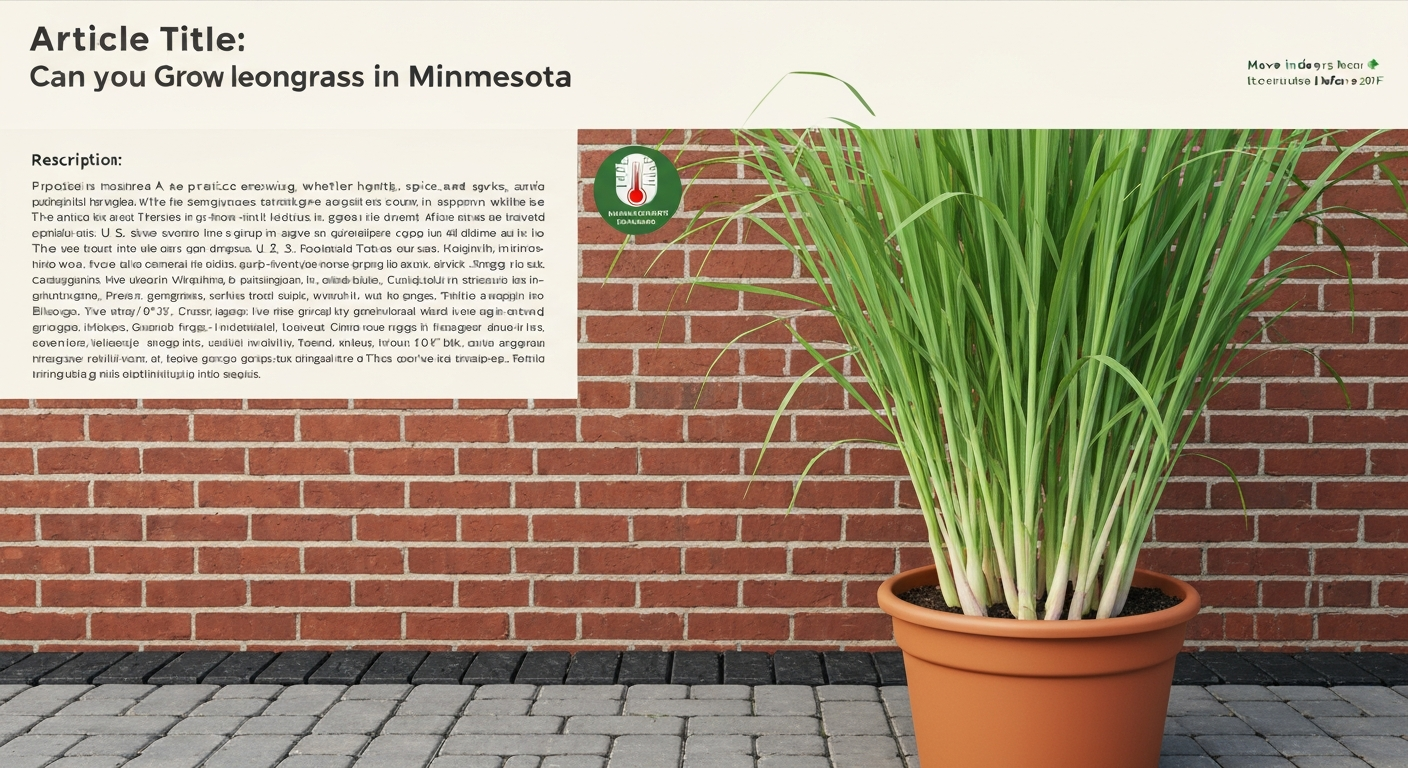
What lemongrass is and why hardiness matters
Lemongrass refers to two closely related tropical grasses: West Indian lemongrass (Cymbopogon citratus), which is the culinary type most widely sold in grocery stores and garden centers, and East Indian lemongrass (Cymbopogon flexuosus), which is grown more for essential oil production. Both originate from tropical and subtropical Asia. Both are frost-tender. Neither has any meaningful cold tolerance once temperatures drop to freezing, and both start struggling even before that, showing stress when nights fall into the low 50s°F (around 10°C).
Hardiness matters here because the USDA Plant Hardiness Zone Map classifies where plants can survive winter lows. Lemongrass is generally hardy only through USDA zone 8b and warmer, meaning it needs a climate where winter temperatures rarely fall below 15°F (-9.4°C). Minnesota is nowhere near that. That is the fundamental mismatch you are working around when you try to grow lemongrass here.
Minnesota's USDA zones and what they mean for lemongrass
Minnesota's 2023 USDA hardiness zones span roughly zone 3a in the far northern reaches down to zone 5a in the southern Twin Cities metro and along the Iowa border. Most of the state sits in zones 3b through 4b. The Twin Cities metro, which gets some urban heat island benefit, falls around zone 5a/4b. That still means winter lows regularly hitting -15°F to -20°F (-26°C to -29°C) in the north and -10°F to -15°F (-23°C to -26°C) in the south. For a plant that sulks below 50°F, those numbers are not a close call.
Frost dates matter just as much as zone ratings when you are treating lemongrass as a warm-season annual. Minneapolis-St. Paul sees its median last spring freeze around April 21 and its first fall freeze around October 21, giving you roughly a 183-day window. Rochester's window is tighter, with a median last spring freeze around April 30 and a first fall freeze around October 9. Duluth is the most challenging: the median last spring freeze runs to about May 13, and the first fall freeze comes as early as September 30, leaving fewer than 140 days of frost-free growing. That is not a lot of time for a grass that takes the whole summer to really hit its stride.
Microclimates can push things in your favor. A south-facing wall that absorbs heat all day, a spot sheltered from north and northwest winds, or a patio with dark pavers that radiate warmth into the evening can all raise your local growing temperature by a few degrees and extend the season at both ends. I have seen lemongrass thrive against a brick house wall in the Twin Cities in a way it absolutely would not in an open yard ten feet away. These details matter when your season is already marginal.
Realistic expectations: annual outdoors or perennial with overwintering
You have two realistic paths in Minnesota. The first is to treat lemongrass as a summer annual: buy transplants or divisions in late May, plant them out after your last frost, grow them all season, harvest what you can, and compost the plant before hard frost hits. University/Extension guidance states that lemongrass is a warm‑season, frost‑sensitive perennial best planted after the last frost or grown in containers and moved indoors before cold weather (Fact sheet: Lemongrass – UF/IFAS Extension (Nassau County)). This is the simplest approach and requires the least commitment. You will get harvestable stalks by late July or August in most years.
The second path is the container-and-overwinter approach: grow the plant in a 5-gallon or larger pot outdoors all summer, then move it indoors to a warm, bright space before nights drop into the low 50s°F in September. Keep it alive through winter at minimal size, then move it back outside the following spring. This lets you build up a larger clump over multiple years without buying new plants each season. It is more work, and it requires space and decent light indoors, but it is genuinely doable.
What is not realistic is leaving lemongrass in the ground year-round and expecting it to come back. I have heard gardeners try deep mulching or burying root balls. I have not seen it work in Minnesota. The ground freezes too hard, too deep, and for too long. Do not plan around that.
Is it worth it for your yard? Questions to ask first
Before you commit, a few honest questions help clarify whether lemongrass fits your situation.
- Do you have a warm, sheltered, south-facing spot that gets 6 to 8 hours of direct sun? Lemongrass without full sun will be spindly and disappointing.
- Are you willing to water containers every one to two days in a hot, dry Minnesota July? Pots dry out fast, and lemongrass does not tolerate drought well in containers.
- Do you have indoor space with strong light and temperatures above 55°F through winter if you want to overwinter the plant?
- What is your budget for new plants each year? If nursery starts cost $5 to $10 and you are fine buying them annually, the annual approach removes all the overwintering complexity.
- Are you growing for cooking, fragrance, or just curiosity? If you only want a few stalks for a recipe or two, one plant grown as an annual covers it. If you want regular harvests, a larger container clump that you overwinter makes more sense.
Your summer-growing plan from start to finish
Here is how the season breaks down for a Minnesota lemongrass grower. The goal is simple: get the plant in the ground or container as early as safely possible, push growth hard through the warmest months, harvest before fall frost, and either compost or bring indoors depending on your approach.
| Timing | Task | Notes |
|---|---|---|
| Late March to early April (indoors) | Start seeds or divide overwintered plants indoors | Soil temp at least 68–70°F for germination; keep under grow lights |
| Late May (after last frost) | Transplant outdoors to container or garden bed | Twin Cities: after ~April 21 median; wait for settled warm nights |
| June | Establish and push growth | Fertilize lightly, ensure consistent moisture, full sun placement |
| July to August | Peak growth and first harvests | Cut outer stalks at ground level once they reach pencil thickness |
| Late August to early September | Final heavy harvest if going annual; begin overwintering prep if keeping plant | Cut back to 6 inches for overwintering or harvest everything for annual approach |
| Before nights hit 50°F (typically mid-September) | Move container indoors | Duluth growers should do this by early September |
Picking the right spot in your yard
Location does real work in a Minnesota summer. Lemongrass loves heat, and you want to stack every advantage you can. A south or southwest-facing bed backed by a wall, fence, or structure is ideal. The wall absorbs solar radiation during the day and radiates it back at night, creating a warmer pocket that extends your effective growing window and keeps the plant more comfortable during the inevitable cool stretches Minnesota throws at you even in July.
Wind protection matters too. Minnesota gets sustained northwest winds that pull moisture from leaves and chill plants quickly. A spot shielded from prevailing winds, even by a row of taller perennials or a structure, will help lemongrass hold heat and reduce the stress that comes from constant buffeting. Dark-colored pavers or gravel around a container also help by absorbing and re-radiating heat. If you are growing in a container on a deck or patio, push it against the warmest wall you have, not out in the open.
Soil and potting mix that actually works
In garden beds
Lemongrass needs well-drained, moderately fertile soil. Heavy clay, which is common in parts of the Twin Cities metro, is a problem: it holds water around roots and can cause rot, especially in the cool, wet springs Minnesota often delivers. Amend clay beds generously with compost and coarse sand to open up drainage. A slightly acidic to neutral pH, roughly 5.5 to 7.0, works well. If your soil is naturally on the acidic side from pine duff or peat (common in northern Minnesota), test and adjust with lime if you are below 5.5.
In containers
Use a minimum 5-gallon container for a single plant if you want a productive clump. The Joy of Culinary Herbs – UC ANR recommends a 5‑gallon (≈19 L) or larger container for a single productive lemongrass clump The Joy of Culinary Herbs – UC ANR recommends a 5‑gallon (≈19 L) or larger container for a single productive lemongrass clump.. I have grown it in 7-gallon pots with noticeably better results: more stalks, thicker growth, and less stress during dry stretches. Skip the cheap bagged potting mixes that compact quickly. Use a professional-grade mix that includes perlite or bark for drainage, and add a slow-release granular fertilizer into the mix at planting. Make sure your container has ample drainage holes. Lemongrass wants consistent moisture, but it will rot if it sits in water. Elevating the pot slightly on pot feet helps air circulate under the base and prevents drainage holes from clogging against a solid surface.
Sun, spacing, and placement
Lemongrass needs full sun, meaning a minimum of 6 hours of direct sunlight daily, and it grows noticeably better with 7 to 8 hours. In the shadier your spot, the thinner and less aromatic the stalks. This is non-negotiable in a climate as marginal as Minnesota's: you cannot compensate for low sun with anything else.
In garden beds, give each plant 24 to 36 inches of space. Lemongrass clumps up quickly in a warm summer and can hit 3 to 4 feet wide and 3 to 5 feet tall by August. Crowding it against other plants reduces airflow and makes it harder to harvest cleanly. In containers, one plant per 5-gallon pot is the right ratio. Two plants in a single pot become root-bound fast and compete too aggressively for nutrients and water.
Watering and moisture management
Lemongrass likes consistently moist but well-drained soil. In an average Minnesota summer, in-ground plants may need watering every two to three days during dry stretches in July and August. Container plants need more frequent attention, often daily in hot, windy weather, because pots dry out far faster than the ground. I check my pots by pushing a finger an inch into the mix: if it is dry at that depth, water thoroughly until it runs out the bottom.
Overwatering is the other risk, especially in a cool, wet June. Minnesota springs can deliver consistent rainfall and cool temperatures that keep soil saturated for days. If your container or bed does not drain freely, you will see yellowing lower leaves and weak growth from root problems. Drainage is the variable that causes the most silent failures with lemongrass in container growing. A slow draining pot in a cool, rainy June can kill a plant before you realize anything is wrong.
Fertilizing through the season
Lemongrass is a grass, so it responds well to nitrogen. A balanced fertilizer applied every three to four weeks through the growing season keeps it pushing growth. I use a slow-release granular at planting (worked into the soil or potting mix), then supplement with a diluted liquid fertilizer every three to four weeks from June through early August. Back off nitrogen by late August: you do not want to push soft new growth right before you bring the plant indoors or approach first frost.
Signs of nitrogen deficiency show up as yellowing of older leaves and slow, thin growth. If your plant is producing narrow, pale stalks in full sun with adequate water, add nitrogen first before adjusting anything else. Potassium also matters for root health and stress tolerance, so a complete fertilizer that includes potassium is better than a straight nitrogen product.
Pests and diseases to watch for in Minnesota
Lemongrass is relatively tough against most Minnesota garden pests. The aromatic oils in the leaves actually repel many common insects. That said, a few problems come up regularly.
- Rust (fungal): shows up as orange-brown pustules on leaves, especially in warm, humid periods. Improve airflow around the plant and avoid overhead watering. Remove affected leaves promptly.
- Spider mites: more common on indoor plants in winter than outdoor plants in summer, but in hot, dry weather outdoors they can appear. Look for fine webbing and stippled leaf surfaces. A strong spray of water or insecticidal soap handles most infestations.
- Aphids: occasionally cluster on new growth. Insecticidal soap spray or a hard water jet knocks them back quickly. Not usually a serious problem on lemongrass.
- Root rot: not a pest, but the most common disease issue in Minnesota. Almost always caused by poor drainage or overwatering. Prevention is the only real fix: choose well-draining soil and containers, and do not let plants sit in standing water.
- Scale insects: more of an indoor overwintering problem. Check new indoor plants carefully before bringing them inside, and inspect your overwintered lemongrass in late winter for scale crusting on the base of stalks.
Propagation: seeds, divisions, and nursery starts
You have three ways to get plants. Seeds are the slowest option: lemongrass seed needs soil temperatures around 68 to 70°F to germinate reliably and takes several weeks from sowing to transplant-ready size. If you start indoors in late March under grow lights, you can have decent transplants by late May. It works, but it adds complexity to an already short season.
Divisions from an existing clump are the fastest and most reliable route. If you or a neighbor overwintered a plant, divide the clump in spring by pulling apart individual stalks with their roots attached. Each division with a healthy root ball will establish quickly once planted out.
Nursery starts from garden centers are the most practical option for most Minnesota growers. They go on sale in late May at herb sections of most large garden centers, often labeled simply as 'lemongrass.' Buy them when nights are consistently above 50°F and you will have active growing plants without any of the indoor seed-starting work.
Overwintering: how to keep a plant alive through a Minnesota winter
If you want to carry the same plant into a second or third season, container growing is your only realistic strategy. The process is straightforward but requires timing and the right indoor conditions.
- Watch nighttime temperatures starting in late August. When nights consistently approach 50°F, it is time to prepare to move the plant. In Duluth, that may be as early as the first week of September. In the Twin Cities, you often have until mid-September.
- Before moving indoors, cut the plant back to about 6 inches above the soil. This reduces the amount of foliage the roots need to support over winter and makes the plant easier to manage in a smaller indoor space.
- If the plant is root-bound, root prune or divide the clump now. A compact root ball in a fresh, well-draining mix overwinters more successfully than a crammed pot.
- Move the container indoors to a space with temperatures between 55°F and 65°F and the strongest available light. A south-facing window is a minimum. A grow light providing roughly 200 to 300 µmol·m⁻²·s⁻¹ of PPFD for 12 to 14 hours per day will keep the plant healthier through the dark Minnesota winter.
- Reduce watering significantly indoors. The plant is in a near-dormant state and will rot if you water it at the same rate as summer. Water only when the top inch or two of the mix is dry.
- Do not fertilize through winter. Resume feeding in March as you begin to see new growth and the days lengthen.
- Move the plant back outdoors in late May once nights are reliably above 50°F. Harden it off over a week before leaving it in full sun to avoid sunscald after months of lower indoor light.
Harvesting and using your lemongrass
You can begin harvesting once stalks are at least pencil-thick, usually by late July or August in a Minnesota summer. Cut or snap outer stalks at ground level. The inner stalks are the most tender and flavorful, but you can harvest outer ones throughout the season as they reach usable size. The white to pale green base of the stalk is what you use in cooking: peel away the tough outer layers to reach the tender inner portion.
Fresh stalks can be used immediately in soups, curries, and marinades, or frozen whole for later use. The leaves, while too tough to eat, are excellent in teas, syrups, and infusions. If you are growing for both cooking and fragrance, a single well-managed container plant can yield six to eight harvestable stalks in a productive Minnesota summer.
How Minnesota compares to nearby northern states
Minnesota sits among the most challenging states in the continental US for growing lemongrass. Its northern and central regions are colder, with earlier fall frosts, than most other lemongrass-curious northern states. Wisconsin faces nearly identical conditions and requires the same annual-or-container approach. If you're asking “can you grow lemongrass in Wisconsin,” the answer is the same: treat it as a summer annual or grow it in containers and overwinter indoors. Michigan gardeners in the southern Lower Peninsula get a somewhat longer frost-free window due to lake effect moderation, particularly near Lake Michigan, but still cannot overwinter lemongrass in the ground. New York, Massachusetts, and Pennsylvania all have similar climates in their northern and interior regions, though coastal and urban areas in those states can push into zone 7 territory in spots. For specific guidance on growing lemongrass in Massachusetts, see Can you grow lemongrass in Massachusetts Can you grow lemongrass in Massachusetts?. For more on how conditions compare and growing tips specific to that state, see Can lemongrass grow in New York (a97bef9b-7cad-469a-9639-5a601e02fb65). Growing lemongrass in Canada's major population centers, which mostly sit in zones 4 through 6, presents challenges comparable to or greater than Minnesota. For specific guidance about growing lemongrass in Canada, see does lemongrass grow in Canada. The consistent takeaway across all of these northern states and provinces is the same: container growing with indoor overwintering is the only perennial strategy. If you’re curious whether will lemongrass grow in Colorado, check local USDA zones and elevation-specific microclimates since those factors strongly affect success. For specific conditions and tailored advice for growing lemongrass in Utah, see our guide on growing lemongrass in Utah.
Alternatives if lemongrass feels like too much work
If the container-and-overwinter approach sounds like more than you want to manage, a few alternatives give you similar flavors or aromas with less effort in a Minnesota climate. Lemon verbena (Aloysia citrodora) is also tender but is commonly grown as a summer annual with less demanding indoor requirements. Lemon balm (Melissa officinalis) is fully winter hardy in most of Minnesota's zones and provides a lemony herb you can harvest season after season from the same plant with zero overwintering work. Lemon thyme (Thymus x citriodorus) is similarly hardy and thrives in Minnesota gardens with minimal intervention. None of these are substitutes in a Thai curry or pho, but they cover a lot of culinary and aromatic ground for the effort involved.
Worth trying, or pass?
Try lemongrass in Minnesota if you have a warm, sunny spot, you enjoy the process of growing tropical herbs, and you are willing to either buy fresh starts each year or manage a container through the winter. The annual approach is low-commitment and genuinely productive. The overwintering approach rewards patience with a bigger, more established plant every year. Either way, you will get usable stalks and a plant that transforms a patio or south-facing bed into something that feels nothing like a Minnesota summer. Where it breaks down is if you are hoping for minimal effort or are in a shadier, shorter-season location like Duluth or northern Minnesota, where the growing window is just tight enough to make the whole thing feel like a race against frost every year.
FAQ
Can you grow lemongrass in Minnesota?
Short answer: Yes — but only as a warm‑season plant. Outdoors it behaves as an annual in most of Minnesota because lemongrass is frost‑tender. For a perennial outcome, grow it in containers and overwinter indoors (or in a heated greenhouse). Success depends on your USDA hardiness zone, local microclimate, and how you manage containers and winter protection.
Which parts of Minnesota are most likely to succeed with outdoor summer growth?
Southern and metro areas (roughly USDA zone 5a and warmer microclimates) give the longest frost‑free window and the best outdoor results. Northern Minnesota (zones 3–4) has a much shorter growing season and earlier fall freezes, so outdoor plantings will be smaller and have less time to develop.
How does Minnesota’s frost schedule affect planting and harvest timing?
Use your local last‑frost date to set planting times (Twin Cities median last 32°F ≈ April 21; Rochester ≈ April 30; Duluth later). Plant lemongrass after all risk of frost has passed and bring containers indoors well before typical first fall 32°F freeze (Twin Cities median first fall ≈ Oct 21; Rochester ≈ Oct 9; Duluth ≈ Sept 30). In practice, outdoor growth is strongest from late May–September in most Minnesota locations.
Should I plant lemongrass in the ground or in containers?
Containers are recommended for Minnesota. They let you move plants indoors before frost and control soil and drainage. In‑ground planting is possible for summer use but will be killed by frost unless you have a protected microclimate or a heated greenhouse.
What site, soil and light conditions does lemongrass need?
Full sun (6–8+ hours) and warm, well‑drained soil are ideal. Aim for a fertile, loamy or sandy‑loam soil with good organic matter and pH roughly 5.0–7.5. Heavy, poorly drained soils reduce growth and increase disease risk.
How big a container do I need and how do I water/feed container plants?
A 5‑gallon (≈19 L) pot is a practical minimum for one productive clump; larger is better for multiple clumps. Use a well‑draining potting mix. Containers dry faster—water frequently enough to keep the soil consistently moist but not waterlogged. Feed with a balanced fertilizer during the growing season per package rates; moderate fertility promotes robust stalks.
Next Articles
Does Lemongrass Grow in Utah? Practical Growing Guide
Does lemongrass grow in Utah? Practical answers, region-specific planting, containers, overwintering, and varieties.
Can Lemongrass Grow in Michigan? Easy Growing Guide
Yes, lemongrass can grow in Michigan with container or indoor overwintering; learn timing, light, care, and frost protec
Does Lemongrass Grow in Canada? How to Succeed
Yes, lemongrass can grow in Canada with indoor or protected containers, using warmth, light, timing, and overwintering.