
Yes, ghost pipe (Monotropa uniflora) does grow in Oklahoma, but only in very specific corners of the state and in conditions most home gardeners will never be able to recreate. Documented herbarium specimens place it in Cherokee, McCurtain, LeFlore, Bryan, and Tulsa counties, with the most detailed field notes coming from steep, wet woods along the Illinois River near Tahlequah. It is not common, it is not easily found, and it absolutely cannot be cultivated in a backyard setting. If you are hoping to grow it, I will save you some time: that is not going to work. But if you want to know where to look for it in the wild, how to identify it, and how to report a sighting responsibly, this article covers all of that.
Does ghost pipe grow in Oklahoma: where to find, ID, stewardship

Marcus Petersen
8 Aug 2026
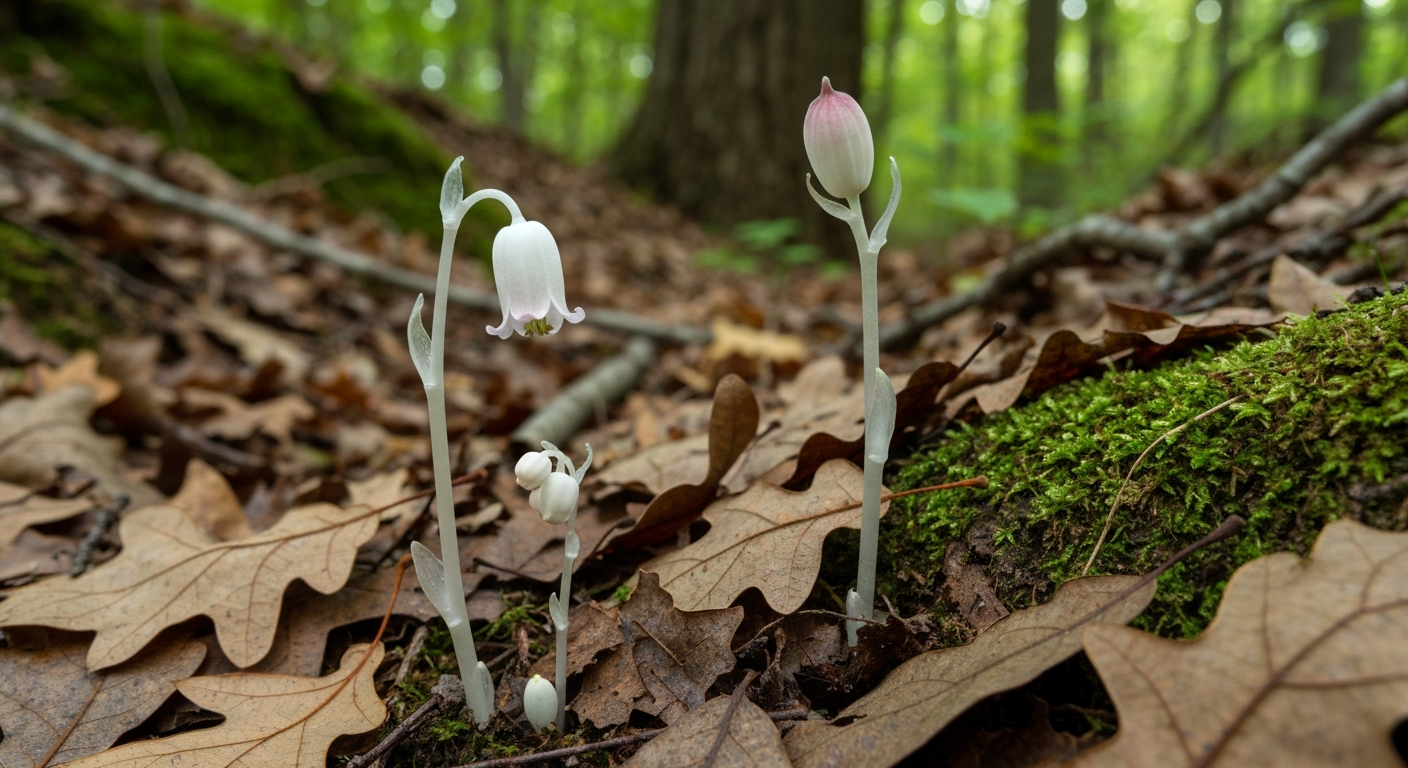
Quick answer: Does ghost pipe grow in Oklahoma?
Ghost pipe is a confirmed native plant in Oklahoma, with herbarium vouchers on record at the Oklahoma State University Herbarium and the Robert Bebb Herbarium at the University of Oklahoma. The earliest recorded Oklahoma specimen dates to 1946 (Barclay, Proc. Barclay (1946), "New Stations in Oklahoma for Hexalectris Aphylla (Nutt.) Raf. and Monotropa Uniflora L.", Proc. Okla. Acad. Sci., documents the 1946 Oklahoma Monotropa uniflora specimen blank" rel="noopener noreferrer">New Stations in Oklahoma for Hexalectris Aphylla (Nutt.) Raf. and Monotropa Uniflora L. — Proc. Okla. Acad. Sci. (Barclay 1946). Okla. Acad. Sci.), with additional collections made in Cherokee County in October 1966 and October 1967 by J. M. Anderson. Global databases including blank" rel="noopener noreferrer">NatureServe, GBIF, and Plants of the World Online all list Oklahoma within the documented U.S. range. That said, occurrences are sparse and historically few. You are not going to stumble across ghost pipe on a casual woodland hike in most parts of Oklahoma. If you're also wondering whether ghost pipe grows in Texas, see the article does ghost pipe grow in Texas for range and habitat comparisons. It occupies a narrow ecological niche in the eastern, forested region of the state and is essentially absent from the drier western two-thirds of Oklahoma. For information on whether ghost pipe grows in Ohio, see does ghost pipe grow in Ohio.
What ghost pipe actually is
Ghost pipe is one of the stranger plants you will encounter in North American forests. It contains no chlorophyll, produces no green tissue, and performs no photosynthesis whatsoever. Instead, it is what botanists call a mycoheterotroph: a plant that steals carbon from fungi. More specifically, it taps into ectomycorrhizal fungi, primarily members of the Russulaceae family (think Russula and Lactarius species), which are themselves in a mutualistic relationship with the roots of mature forest trees, usually oaks and beeches. Ghost pipe essentially parasitizes that underground fungal network without giving anything back. Research by Yang and Pfister (2006) documented that ghost pipe associates with a diversity of russulacean fungi in eastern North America, though individual plants tend to be specific about which fungal partners they use.
Because it needs no sunlight, ghost pipe can push up through deep leaf litter in heavily shaded understory conditions where almost nothing else would survive. It is a true perennial, but it spends most of its life entirely underground. The white or pale pink stems you see are the flowering and seed-setting phase, which can be brief. The rest of the year, the plant exists as a cluster of brittle, fleshy roots embedded in fungal mycelium beneath the humus layer. This biology is the core reason cultivation is not feasible, which I will come back to later.
How to identify ghost pipe in the field
Ghost pipe is genuinely distinctive once you know what you are looking for. The entire plant is waxy and white, sometimes tinged pale pink, and it glows slightly in low forest light in a way that makes it look almost artificial. Each stem typically bears a single nodding flower (uniflora means one-flowered), which hangs downward in bud like a bent pipe, then turns upright as the seed capsule matures. Stems are usually 10 to 30 centimeters tall, translucent, and covered in small scale-like bracts instead of true leaves. The flower has 3 to 6 petals and 8 to 10 stamens. When you touch ghost pipe or cut it, it oxidizes rapidly and turns black, which is a useful confirmation detail. A clump of several stems often emerges together from the same root mass.
Common lookalikes to rule out
The most likely source of confusion is pinesap (Monotropa hypopitys, sometimes listed as M. brittonii), which is a close relative and can occur in similar habitats. The key difference is simple: pinesap has multiple flowers per stem arranged in a small cluster or raceme, while ghost pipe has exactly one flower per stem. Pinesap also tends toward a yellowish or tawny color rather than pure white. Indian pipe is another common name for Monotropa uniflora itself, so if you see that name in a field guide or online, it refers to the same plant. No other Oklahoma plant looks quite like ghost pipe, but always check the flower count before logging a definitive identification.
| Feature | Ghost Pipe (M. uniflora) | Pinesap (M. hypopitys) |
|---|---|---|
| Flowers per stem | One (single, nodding) | Several (cluster/raceme) |
| Color | Waxy white, sometimes pale pink | Yellowish, tawny, or reddish |
| Height | 10–30 cm | 10–30 cm (similar) |
| Turns black when damaged? | Yes, rapidly | Less pronounced |
| Oklahoma occurrence | Documented in eastern counties | Possible in similar habitats |
When to look: seasonal timing in Oklahoma
Ghost pipe has a broader emergence window than many people expect. Across its North American range, plants can appear from May through October depending on local conditions. In Oklahoma specifically, the herbarium record is telling: Anderson's Cherokee County collections were made on October 30, 1966, and October 11, 1967. That suggests late-season emergence is entirely normal for Oklahoma's eastern forests, likely tied to late-summer and fall rainfall patterns. The Ouachita and Ozark forest regions of eastern Oklahoma tend to receive meaningful late-season precipitation that can trigger emergence after summer dry spells.
In practical terms, I would plan searches for late summer through mid-autumn in Oklahoma, roughly August through October, particularly after a run of rain following a dry period. Emergence often happens quickly after soil moisture returns, so timing a forest walk within a week or two of significant rainfall gives you the best odds of finding flowering stems before they mature and collapse. By the time capsules are fully erect and dry, stems begin to deteriorate, so the window for seeing the classic nodding white flower is relatively short.
Where to look in Oklahoma: habitats and regions
Ghost pipe's Oklahoma range is almost entirely confined to the forested eastern part of the state. For information on its presence in neighboring states, including whether ghost pipe grows in Missouri, see does ghost pipe grow in Missouri. For information on occurrences in nearby states, including whether ghost pipe grows in Indiana, see the state distribution note titled does ghost pipe grow in Indiana. If you're also wondering about its presence in neighboring states, see Does ghost pipe grow in Georgia for regional differences and occurrence notes. The documented county records point consistently toward the Ozark Plateau (Cherokee County, including the area around Tahlequah) and the Ouachita Mountains (LeFlore and McCurtain counties). Bryan County in the southeast and Tulsa County round out the historic record. If you are in western Oklahoma, the High Plains, or anywhere west of roughly I-35, realistic odds of encountering ghost pipe drop to near zero: the habitat simply does not exist there.
Within those eastern counties, you need to narrow down further to specific microhabitats. The Anderson collections from Cherokee County came from steep slopes and wet woods on river bluffs above the Illinois River, with a canopy of oak, maple, dogwood, and Ostrya (hop-hornbeam). The plant was found in deep humus at the base of trees in dense shade. That profile translates into a practical search image: mature, unlogged forest, north-facing or east-facing slopes, stream hollows and ravine bottoms, places where leaf litter has accumulated undisturbed for decades. State parks and wilderness areas within the Ouachita National Forest and Cherokee Nation lands in northeastern Oklahoma contain habitat that fits this description.
- Cherokee County: Illinois River corridor, Tenkiller Ferry Lake area, Tahlequah-area state parks and natural areas
- McCurtain County: Ouachita National Forest tracts, Beavers Bend State Park, Little River bottomlands
- LeFlore County: Ouachita foothills, Talimena Scenic Drive corridor, mature mixed hardwood hollows
- Bryan County: bottomland hardwood forest near the Red River tributary drainages
- Seek north- or east-facing slopes with intact canopy, deep leaf litter, and visible ectomycorrhizal mushrooms (Russula, Lactarius) nearby
Planning a search: practical tips for Oklahoma
Before you head out, pull occurrence records from iNaturalist and GBIF filtered to Oklahoma. Even a handful of georeferenced sightings can tell you which specific forest tracts are worth visiting. The TORCH portal (Texas Oklahoma Regional Consortium of Herbaria) and SEINet also index digitized herbarium specimens for the region, and searching those databases for Oklahoma records will surface the historical voucher data referenced above. Cross-reference those locations with satellite imagery on Google Maps or CalTopo to look for continuous forest cover, meaning no clearcuts or recent disturbance.
In the field, move slowly through the most shaded, moist sections of the forest understory. Ghost pipe is easy to miss at a glance because it blends into pale debris on the forest floor and stands only 10 to 30 centimeters tall. Look especially at the base of large oaks and in spots where the soil is visibly darker and spongy with decomposed organic matter. Check north-facing hillsides and the protected inner bends of stream corridors. If you see Russula or Lactarius mushrooms, those are fungal relatives of ghost pipe's underground partners, so that microsite is worth examining carefully.
When you find a plant, photograph it thoroughly before you do anything else. Shoot a full-habit image showing the whole stem and its emergence from the leaf litter, a close-up of the nodding flower from the side, a close-up of the flower interior (petals, stamens, sepals), and a wider shot showing the neighboring tree species and substrate. These angles are all needed for a confident identification and for submitting a useful record. Do not dig, do not pick, and do not disturb the root cluster: ghost pipe's roots are incredibly fragile and the fungal connection is invisible but essential.
Why you cannot grow ghost pipe at home
I want to be direct about this because the question comes up constantly: cultivating ghost pipe in a home garden is not realistically possible. The propagation literature is unanimous on this point. Ghost pipe has no chlorophyll and cannot survive on sunlight, water, and soil nutrients the way a normal garden plant does. It depends entirely on a three-way relationship: a mature tree (typically oak or beech), a specific ectomycorrhizal fungus (usually Russulaceae), and the ghost pipe plant itself parasitizing that fungal network. To grow ghost pipe, you would need to establish all three parties simultaneously in undisturbed humus-rich woodland soil, and you would need the right fungal species already present and already colonizing the roots of an appropriate tree.
Even professional botanists cannot reliably germinate or establish ghost pipe from seed. The seeds are dust-like and require fungal infection to germinate at all. Transplanting wild specimens fails almost universally: the brittle, fleshy roots do not survive excavation, and even if they did, severing the plant from its underground fungal network is fatal. University propagation protocol syntheses list ghost pipe as very difficult to impossible for casual cultivation and explicitly recommend against digging wild plants. I have seen gardeners attempt this with optimism; it does not go well. The honest answer is that ghost pipe belongs to the forest and cannot be moved.
This is a very different situation from, say, trying to grow saffron in an unusual climate zone, where you are working against seasonal or soil constraints but still dealing with a plant that responds to standard horticultural inputs. Ghost pipe requires an entire ecosystem to be pre-assembled and functioning underground. The best thing you can do as a gardener is protect mature forest habitat, avoid disturbing woodland floor humus, and let the conditions that support ghost pipe remain intact.
Conservation, legal considerations, and ethical stewardship in Oklahoma
Oklahoma occurrences of ghost pipe are sparse and historically few. NatureServe rates Monotropa uniflora as G5 (globally secure) overall, but state-level data for Oklahoma is limited enough that regional conservation inventories treat Oklahoma occurrences as sensitive. Because the state-level rank can change as new data comes in, the most current and accurate status should be confirmed directly with the Oklahoma Natural Heritage Inventory, the Robert Bebb Herbarium at the University of Oklahoma (collection code OKL, maintained through OU's Biological Survey), or the OSU Herbarium (OKLA). If you're wondering whether ghost pipe grows in Wisconsin, consult Wisconsin state herbarium records and regional flora accounts for that state's occurrence data does ghost pipe grow in wisconsin. These institutions are the authoritative data custodians for Oklahoma rare plant records.
From a legal standpoint, digging or collecting ghost pipe on public land in Oklahoma, including state parks, Wildlife Management Areas, and Ouachita National Forest tracts, requires permits. On private land, you need landowner permission. Even if collection were legal in a given context, the propagation literature is explicit: digging ghost pipe almost always kills it, and the site disturbance damages the fungal network that may support future emergence of that clonal root mass. The ethical position is simply not to dig it.
If you believe you have found ghost pipe in Oklahoma, the most valuable thing you can do is document it carefully and report it. Here is the recommended workflow:
- Photograph the plant from multiple angles: full habit, flower close-up, interior of flower, base of stem at soil level, and the surrounding tree species
- Upload the observation to iNaturalist with as much detail as possible; request community ID to reach Research Grade status
- Use iNaturalist's geoprivacy setting to obscure the exact coordinates if the site seems vulnerable to disturbance or harvest pressure
- Contact the Robert Bebb Herbarium at the University of Oklahoma (OU Biological Survey; curators Amy Buthod or Abigail Moore) or the OSU Herbarium (director Mark Fishbein) to report the sighting and ask whether a voucher specimen should be collected by a professional
- If the location is on Ouachita National Forest land or a state wildlife area, notify the relevant land manager so the record can enter their natural heritage tracking system
These reports genuinely matter. The known Oklahoma record for ghost pipe is thin, and every verified sighting adds to the understanding of where this plant persists in the state. Researchers comparing distributions across neighboring states, whether looking at Missouri, Arkansas, Texas, or farther afield to Indiana, Michigan, Ohio, or Georgia, need Oklahoma data to fill in the regional picture. A well-documented iNaturalist observation with confirmed ID and appropriate privacy settings is a real scientific contribution.
What gardeners can actually do to help
Since cultivation is off the table, the most meaningful action for gardeners who care about ghost pipe is habitat stewardship. If you own or manage forested land in eastern Oklahoma, protecting existing mature hardwood canopy, avoiding tilling or disturbing woodland floor humus, and leaving coarse woody debris and leaf litter in place all support the conditions ghost pipe needs. Avoiding fungicide applications near mature oaks and not compacting soil in forest areas also protects the ectomycorrhizal fungi that ghost pipe depends on. None of this is glamorous gardening, but it is the only realistic intervention available.
If you are primarily a plant seeker rather than a cultivator, connecting with the Oklahoma Native Plant Society or the OU Biological Survey's botanical outreach programs is a practical way to find guided walks in suitable eastern Oklahoma forest habitat. These networks also circulate sighting reports and can point you toward historically productive sites when that information is appropriate to share. Ghost pipe is one of those plants that rewards patience and knowledge of forest ecology more than any amount of horticultural effort, and that is actually part of what makes finding it in the wild genuinely satisfying.
FAQ
Does ghost pipe (Monotropa uniflora) grow in Oklahoma?
Yes. Monotropa uniflora is documented from Oklahoma — historic and modern voucher records exist for several counties (e.g., Tulsa, LeFlore, McCurtain, Bryan, Cherokee) and national databases include Oklahoma within the species’ U.S. range. Occurrences in Oklahoma are patchy and relatively uncommon compared with some eastern states.
How can I identify ghost pipe in the field? What are the key diagnostic features?
Ghost pipe is a non‑green, achlorophyllous perennial that appears waxy white to pale pink (sometimes with gray or black spotting when aging). Typical features: an unbranched stem bearing usually a single nodding, bell‑shaped flower that is white and urn‑like; petals 3–6; flowers nod in bud and may become erect as fruit develops. It lacks green leaves and photosynthetic stems. Common look‑alikes include pinsap (Monotropa hypopitys) which has multiple flowers per stem. Use close photos of the whole plant, the single flower, and the base (substrate/nearby trees) to confirm ID.
When is ghost pipe visible above ground in Oklahoma (seasonal cues)?
Emergence and flowering can be variable. Across its range Monotropa uniflora typically emerges and flowers from late spring through late summer (commonly June–August), but Oklahoma voucher records and regional accounts show plants may be found into September and October depending on local conditions. Look after forest leaf‑out when soil moisture and humus layers are intact.
Where in Oklahoma should I search for ghost pipe? What habitats and regions?
Focus on mature, shaded, humus‑rich woodlands and river bluff forests. Oklahoma specimen labels and publications note occurrences on steep slopes and wet woods above rivers (e.g., Illinois River near Tahlequah), bottoms and ravines, and under canopy trees in oak–maple–dogwood–hop‑hornbeam stands. Counties with documented records include Tulsa, LeFlore, McCurtain, Bryan and Cherokee — southern and eastern Oklahoma wooded areas and river systems are the best places to search.
Why is ghost pipe so patchy and uncommon in Oklahoma?
Monotropa uniflora is fully mycoheterotrophic: it lacks chlorophyll and depends on ectomycorrhizal fungi (often russulacean fungi) that connect to living trees to obtain carbon. This triple dependency (suitable fungi + suitable host trees + intact undisturbed humus/soil) makes populations naturally patchy and sensitive to habitat disturbance, so occurrences are localized and infrequent.
Can I grow ghost pipe in my home garden? Is cultivation feasible?
Realistically no for typical home gardeners. Successful germination and long‑term survival require infection by the correct ectomycorrhizal fungi and an intact woodland soil/forest fungal network; attempts to transplant wild plants or grow them in garden soil almost always fail. Propagation protocols and university guidance advise that cultivation is extremely difficult and generally impractical for casual gardeners.
Next Articles
Does Ghost Pipe Grow in Missouri? Habitat, ID, and Care Tips
Yes: ghost pipe occurs in Missouri woodlands, where to find it, ID tips, why you can't cultivate it, and ethical guidance
Does Ghost Pipe Grow in Indiana? Cultivation Guide
Find out if ghost pipe grows in Indiana and what it takes to cultivate it, plus failure causes, sourcing, and alternativ
Does Ghost Pipe Grow in Georgia? Habitat and Growing Tips
Find out if ghost pipe grows in Georgia and where to look, plus realistic habitat and growing tips.